
Turkey’s new Kurdish process is being presented as a historic road map for disarmament, normalization, and the final liquidation of the PKK. But behind this official language, a more sensitive political engineering project is emerging. Ankara is not only trying to use Abdullah Öcalan to manage the PKK’s disarmament. It is also helping him reassert authority over the broader Kurdish political movement, especially the legal civilian sphere represented by the People’s Equality and Democracy Party.
This is where the process becomes dangerous.
Devlet Bahçeli, leader of the Nationalist Movement Party, recently proposed that Öcalan should be given a new functional status as a kind of “Peace Process and Political Transition Coordinator.” Bahçeli argued that fragmented structures could delay the process, increase provocations, invite foreign intervention, and produce new internal conflicts. He said Öcalan’s influence over the organization should therefore be preserved and even strengthened through a new mechanism.
Officially, Bahçeli presents this as a limited and temporary mechanism. He says Öcalan’s role would not mean recognizing him as the political representative of Kurds or as an advocate of ethnic rights. Rather, it would be limited to coordinating the liquidation of the PKK and ensuring that armed structures fully lay down their weapons.
But this distinction is artificial. In Kurdish politics, authority over the PKK has never remained purely military. It has always carried political, symbolic, and organizational consequences. If the state gives Öcalan new communication channels, a new title, logistical support, and renewed legitimacy as the single address of the process, that influence will not stop at the PKK. It will inevitably flow into the legal Kurdish political sphere.
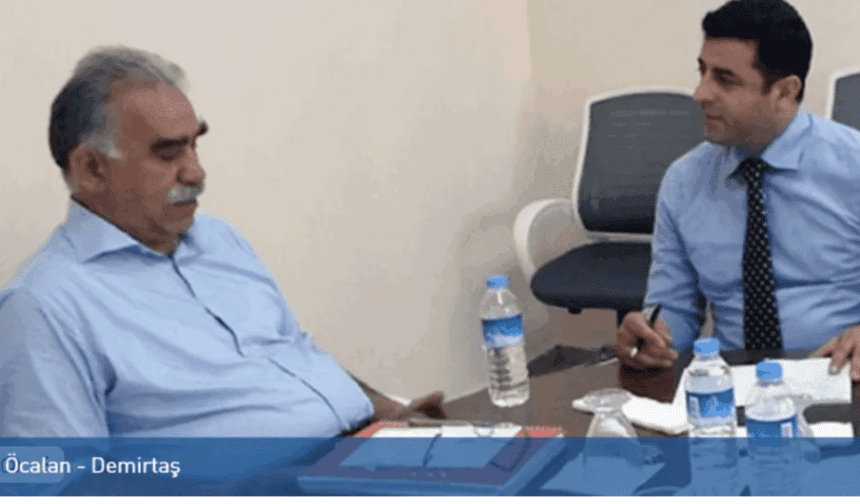
This is why the alleged remarks attributed to Öcalan about Selahattin Demirtaş are so revealing. According to disputed prison-island notes, Öcalan said Demirtaş must either contribute to the process or “shut his mouth,” adding that if Demirtaş does not do so, “I will shut it for him.” He was also quoted as saying that Demirtaş should know that “the chief negotiator is me.”
If authentic, these words are not merely a personal insult. They are a political declaration. Öcalan is not only claiming authority over the PKK. He is claiming authority over the direction, boundaries, and leadership of Kurdish politics itself.
Demirtaş represents a different kind of Kurdish legitimacy. He is not a military commander. He is not a mountain cadre. He did not build his influence through armed struggle or prison authority. His legitimacy came from elections, public speeches, democratic opposition, and his ability to speak not only to Kurds but also to broader Turkish society. In 2015, he represented the possibility of a Turkey-wide democratic politics rooted in the Kurdish movement but not limited to it.
That is precisely why he is a problem for the new design.
The state wants one address, one negotiator, and one chain of command. For Ankara, this is efficient. A single interlocutor can discipline armed cadres, prevent splinter groups, and keep the process under control. But for Kurdish politics, this model carries another meaning: it risks subordinating civilian politics to Öcalan’s restored authority.
The return of the so-called “thirty-year veterans” makes this transformation even more significant. These are figures who spent decades in prison, many of them linked to the movement’s older structures and some associated with Öcalan’s prison circle. Their return has created excitement among parts of the Kurdish public because they are seen as people who paid the price and now return as the “real owners” of the movement.
But this return can also become a source of division.
If Öcalan is restored as the central power broker, and if veteran cadres begin reshaping the party from below, the legal civilian actors of Kurdish politics may be squeezed. Deputies, mayors, local organizers, women’s structures, youth activists, and figures close to Demirtaş may all be forced to prove loyalty to a new hierarchy. Criticism may no longer be treated as democratic debate. It may be labeled as sabotage of the process.
This is the central risk: a process presented as peace may end up dividing the Kurdish political movement in Turkey.
On one side, there may emerge an Öcalan-centered line, supported by the state’s need for a single authority. On the other side, there may remain a civilian, pluralist, electoral line that wants the Kurdish question to be handled through parliament, local government, public legitimacy, and democratic representation. The first line offers discipline. The second offers political diversity.
The government clearly prefers the first.
For Ankara, Öcalan is useful because he can say things that elected Kurdish politicians cannot say. He can pressure the PKK. He can discipline dissident voices. He can speak in the name of historical authority. Most importantly, he can be used to bypass the legal Kurdish political class while still claiming that the process has Kurdish consent.
That is why Bahçeli’s proposal is not only about disarmament. It is also about political management. It seeks to prevent the PKK from fragmenting, but it also gives the state a tool to manage Kurdish politics through Öcalan’s authority. News About Turkey described Bahçeli’s proposal as placing Öcalan’s continued influence at the center of the next phase and as a way to prevent fragmentation, delays, and splinter groups.
The problem is that Kurdish society today is not the Kurdish society of the 1990s. The movement now includes legal politicians, imprisoned civilian leaders, women’s organizations, local administrations, youth structures, civil society networks, diaspora actors, and the Rojava experience. It cannot be reduced to one man, one island prison, or one vertical command structure.
Trying to do so may produce the opposite of what Ankara expects. Instead of unity, it may create resentment. Instead of discipline, it may create silent fractures. Instead of moving armed politics into democratic politics, it may transfer the old hierarchy into the legal field.
If the process becomes a state-assisted restoration of Öcalan’s authority over the entire Kurdish movement, it will not democratize Kurdish politics. It will centralize it. It will not strengthen civilian representation. It will subordinate it. It will not solve the Kurdish movement’s internal crisis of legitimacy. It may deepen it.
The most important question, therefore, is not whether Öcalan still has influence over the PKK. Everyone knows he does. The real question is whether the Turkish state is now trying to use that influence to redesign the legal Kurdish political field.
All signs suggest that it is.
This would not be the first time the Turkish state has tried to weaken a powerful political movement by using rival actors, proxy structures, or internal fractures against it. In the 1970s, when the leftist movement became a major social force, the Turkish state sought to weaken it by dividing it, including by creating the PKK under Öcalan’s leadership. Today, Ankara appears to be using Öcalan again — this time to divide and weaken the broader Kurdish political movement in Turkey
That is why this process should not be read only as a peace initiative. It may also be read as a strategy of controlled fragmentation. By strengthening Öcalan as the single address, Ankara may hope to divide Kurdish politics between those who accept his restored authority and those who believe Kurdish representation must move beyond prison-centered leadership. In that sense, the state’s old habit has not disappeared. It has simply changed form.
By: News About Turkey (NAT)