
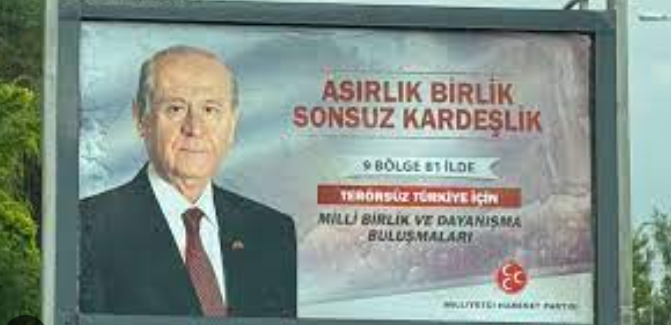
A new public campaign launched by Turkey’s Nationalist Movement Party (MHP) has stirred political controversy and sparked concerns over possible federal restructuring of the Turkish state. The party recently unveiled promotional posters for upcoming rallies under the slogans “Centuries of Unity and Eternal Brotherhood” and “National Unity and Solidarity Gatherings for a Terror-Free Turkey in 9 Regions and 81 Provinces.”
The phrase “9 regions” has ignited debate across social media and political circles, with critics asking whether the party is laying the ideological groundwork for a shift away from Turkey’s long-standing unitary system. While the MHP insists the language reflects historical party ideology, opposition voices suggest a more ominous motive.
‘Nine Lights’ or Nine Federal Units?
MHP officials quickly moved to defend the campaign. MHP Bursa MP İsmet Büyükataman explained that the number nine holds deep symbolic meaning in Turkish mythology and nationalist ideology, particularly within the framework of the “Nine Lights Doctrine” authored by party founder Alparslan Türkeş. He emphasized that previous MHP campaigns have also been structured around the number nine.
Sources close to MHP leader Devlet Bahçeli offered conflicting interpretations. Some described Bahçeli’s attachment to the number nine as a form of “numerology obsession,” while others reaffirmed its ideological ties to Türkeş’s doctrine. Either way, party insiders sought to frame the campaign as a reaffirmation of nationalist identity, not a structural political shift.
Opposition Warns of Hidden Agenda
Not all were convinced. Speaking to Turkish media, Zafer Party executive board member Yusuf Aksoy questioned whether the campaign signals deeper intentions. “Is the MHP preparing the public for a federal system?” he asked. “If this is just about the Nine Lights doctrine, why is it only remembered during internal party mobilizations? Why not recall it when negotiating with Öcalan or inviting him to Parliament?”
Aksoy argued that the MHP’s invocation of nationalist doctrine is an attempt to normalize a dramatic shift among its base. He warned that such rhetoric, combined with recent administrative reshuffling, may be laying the groundwork for a regionalized governance model. “This isn’t about symbolism. This is about reshaping Turkey’s internal map.”
Administrative Clues Raise Eyebrows
Aksoy cited the May 1 decision in the Resmi Gazete that reassigned Zonguldak and Bartın provinces from the Sakarya to the Ankara Court of Appeals jurisdiction. He pointed out that, according to the MHP’s map, Bartın is now aligned with Ankara, while Zonguldak is under Istanbul—suggesting that regional divisions are being restructured based on services and administrative hubs rather than geography or culture.
“These divisions are not about climate or topography, like Turkey’s official seven regions. They hint at a decentralized service model—a shift from centralized government to regional management,” Aksoy said. “That alone raises red flags.”
Echoes of a Dismantled Past
For Aksoy and other critics, the use of such regional language is deeply unsettling. “Any move to alter the unitary nature of the Republic of Turkey reminds us of the Treaty of Sèvres—a blueprint for partition,” he warned. “To advocate or even suggest such restructuring is to betray the very foundations of the Turkish Republic.”
He further claimed that the “unofficial DAM alliance”—a reference to the ruling bloc of DEM, AKP, and MHP—may be quietly aligning behind a plan to introduce regional autonomy under the guise of ideological tradition. “The DEM Party has long pushed for a federated structure. If the MHP is now echoing similar language, it’s not a coincidence—it’s a convergence,” Aksoy added.
A Trial Balloon for Change?
Some observers say the campaign could be a trial balloon to test public sentiment around decentralization, especially given Bahçeli’s historic role as a voice preparing the ground for broader policy shifts.
“If Bahçeli is introducing ‘9 regions’ today, it may not be mere nostalgia,” Aksoy cautioned. “It may be a soft launch of a far more serious change to Turkey’s political architecture.”
Confederal Echoes Across Borders
This campaign aligns with the principles of democratic confederalism, an ideological framework developed by PKK leader Abdullah Öcalan. It advocates for decentralization and networked autonomy while rejecting the traditional nation-state model. We have discussed this approach numerous times, including just the other day, several hours before the unveiling of the posters. Our discussions have suggested the concept of a “Turkish-led confederation” that could evolve towards federalism by combining decentralization with central coordination to maintain territorial integrity.
Against this background, “Nine regions” likely refers to the idea of including Iraq and Syria—specifically Iraqi Kurdistan and Rojava—as part of a future confederation or federation under “Greater Turkey.”
Turkey is officially divided into seven geographical regions, a classification developed during the First Geography Congress held in Ankara in 1941. These regions are the Marmara Region (Marmara Bölgesi), Aegean Region (Ege Bölgesi), Mediterranean Region (Akdeniz Bölgesi), Central Anatolia Region (İç Anadolu Bölgesi), Eastern Anatolia Region (Doğu Anadolu Bölgesi), Southeastern Anatolia Region (Güneydoğu Anadolu Bölgesi), and the Black Sea Region (Karadeniz Bölgesi).
Importantly, these regions are not administrative divisions but rather geographical groupings based on characteristics such as climate, landforms, vegetation, agricultural patterns, and human geography.
In contrast, Turkey’s actual administrative structure is composed of 81 provinces (iller), which are organized into smaller administrative districts (ilçeler) and overseen by centrally appointed governorates.