
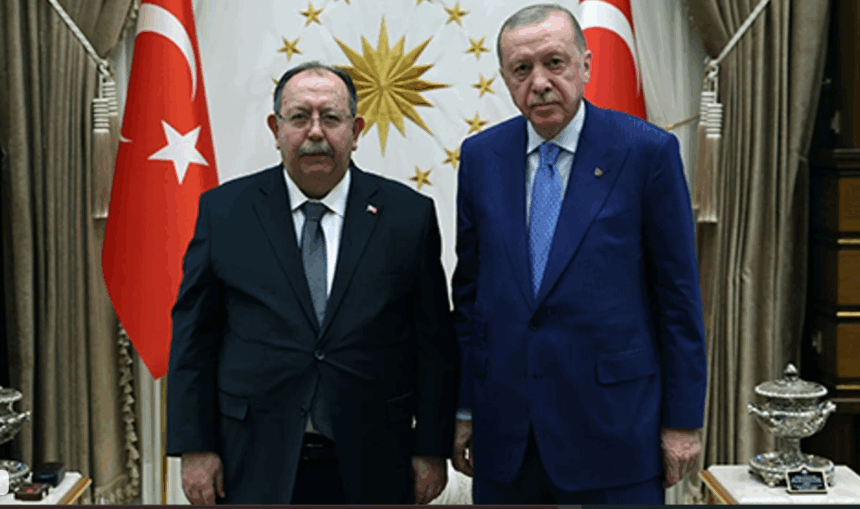
President Recep Tayyip Erdoğan’s closed-door reception of Supreme Election Council (YSK) Chairman Ahmet Yener on Thursday at the Presidential Complex has reignited concerns over the independence—and the appearance of independence— of Turkey’s top election authority at a moment when it is about to be partially reconstituted. No official statement was issued.
The Erdoğan–Yener meeting doesn’t happen in a neutral vacuum: it occurs in a political context where a significant segment of the public already doubts the neutrality of key refereeing institutions.
The optics are sharpened by timing: six of the YSK’s 11 members are set to reach the end of their terms in January 2026, including Yener. Anadolu Agency reported that the Court of Cassation (Yargıtay) and Council of State (Danıştay) will hold elections in the second week of January to fill those seats, with outgoing members eligible for re-election. Anadolu Ajansı
After the incoming members are sworn in, the council will hold an internal secret-ballot vote to choose (or re-choose) its president—meaning the January selections will immediately shape who presides over the institution that will supervise Turkey’s next nationwide electoral contests.
“Not routine”: why critics say the silence matters
Commentators critical of the government argue that a private, unexplained meeting between the head of the executive and the head of the election authority is not merely a ceremonial courtesy call. The critics described the meeting as “extraordinary,” warning that it should not be normalized precisely because the YSK’s composition—and potentially its chairmanship—is about to be reshaped.
The criticism is not only about what might have been said behind closed doors; it’s about institutional signaling. Election authorities derive legitimacy from public confidence, and critics argue that confidence is weakened when the top electoral judge appears at the presidential palace without any public explanation, days before a decisive membership transition.
the Erdoğan–Yener meeting doesn’t happen in a neutral vacuum: it occurs in a political context where a significant segment of the public already doubts the neutrality of key refereeing institutions
The pipeline argument: from HSK disputes to the YSK’s future
A central claim in the criticism is structural: who controls the judicial “upstream” can shape the electoral “downstream.” Critics point to the controversy around the Council of Judges and Prosecutors (HSK) selection process in 2025, arguing that battles over judicial governance matter because they influence the makeup and career pathways within the higher judiciary—institutions that later play a role in selecting YSK members.
That argument gained traction after Turkey’s Constitutional Court (AYM) rejected an application seeking the annulment of a TBMM decision on HSK member elections, citing lack of jurisdiction (“görevsizlik”). The Constitutional Court’s own announcement confirmed the rejection, and reporting noted that four judges dissented.
Critics interpret that episode as a warning sign: if disputes about judicial selection procedures are effectively insulated from review, they argue, then institutional checks weaken—making it easier for the governing bloc to shape the broader ecosystem that ultimately touches election administration. Supporters of the court’s stance reject that interpretation, but the ruling has become part of a wider debate about whether Turkey’s institutional architecture is being rewired through legal and procedural bottlenecks.
The Trump factor: “rigged elections” as reputational shorthand
The palace meeting also resonates internationally because Erdoğan’s election record has become a kind of global political punchline—most notably after U.S. President Donald Trump told Erdoğan in a September 2025 Oval Office meeting that he “knows about rigged elections better than anybody.”
Trump’s remark was consistent with his own long-running rhetoric about “rigged” votes. But critics argue it still matters: it reinforces a damaging external narrative at the very moment Turkey is reselecting the senior figures who will oversee the next electoral cycle. In their view, Erdoğan’s closed-door contacts with the election chief give oxygen to precisely the kind of suspicions that strong election institutions are supposed to suffocate.