

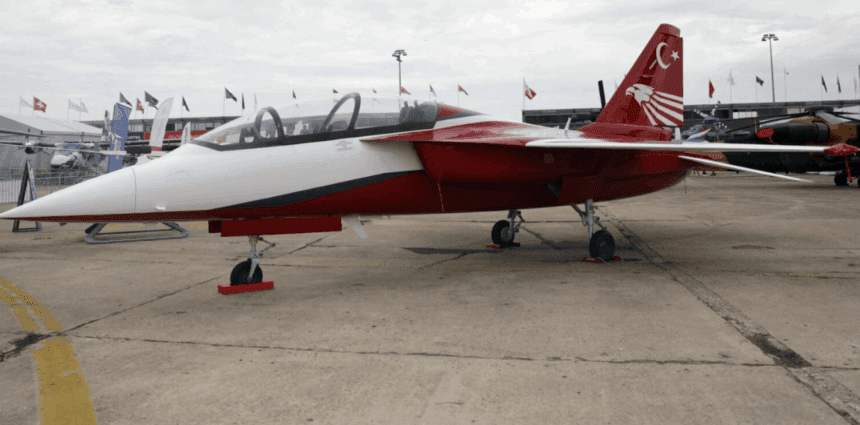
Spain has signed a contract with Turkey to purchase 30 Turkish-made HÜRJET jet trainer aircraft in a deal valued at €2.6 billion ($3 billion), according to an announcement by Haluk Görgün, head of Turkey’s Presidency of the Defense Industry. Turkish officials described the agreement as Turkey’s first export of a jet aircraft to a NATO ally, marking a symbolic milestone for Ankara’s defense industry as it pushes into higher-end aviation exports.
The contract was signed between Turkish Aerospace Industries (TAI), Airbus, and Spain’s Ministry of Defense as part of Spain’s integrated advanced jet training system, which is intended to modernize the country’s advanced pilot training pipeline. Görgün said the package goes beyond aircraft procurement, covering advanced pilot training, ground-based simulation systems, maintenance infrastructure, and long-term operational support intended to keep the fleet sustained over its service life.
Turkish officials said the aircraft will be built at TAI facilities, while Spain is expected to take part in the program’s industrial production. Spain has been exploring options to replace and upgrade its advanced jet trainer fleet, and the HÜRJET has been among the platforms considered as Madrid looks to update training capacity in line with evolving fighter requirements and tighter integration between live flying and high-fidelity simulation. Deliveries are expected to begin in 2028, aligning with Spain’s stated goal of building a more comprehensive training system rather than simply replacing airframes.
Industrial cooperation has already begun to take shape around the aircraft. Spanish aerospace firm Airtificial signed a contract with Turkish Aerospace in November to manufacture flight control systems for the HÜRJET at its facility in Seville, a step that Turkish and Spanish stakeholders have presented as part of a broader effort to embed Spanish industry in the project.
Developed by Turkish Aerospace, the HÜRJET is a twin-seat, single-engine supersonic jet designed for advanced training and light attack missions. The aircraft made its first flight in April 2023 after development began in 2017, and Turkey has positioned the platform as a future replacement for its aging T-38M and NF-5 trainer aircraft in the 2030s. Turkish planners have also floated the HÜRJET for close air support missions alongside the F-16 fleet, and TAI has said it is considering a carrier-capable naval variant, reflecting Ankara’s wider ambition to diversify the aircraft’s roles and broaden its export appeal.
In the export market, the HÜRJET will be competing against entrenched rivals including Boeing’s T-7, Korea Aerospace Industries’ T-50, and Leonardo’s M-346. Spain’s decision to move forward with the HÜRJET—packaged into an Airbus-linked training system—signals that Turkey’s aircraft is now being treated not only as a national program but as a platform capable of anchoring an integrated training architecture inside a major NATO air force.