
Turkey’s Grand National Assembly (TBMM) has published the full transcript of a delegation’s November 24, 2025 visit to İmralı prison, where three lawmakers met Abdullah Öcalan, the imprisoned founder of the Kurdistan Workers’ Party (PKK). The release, circulated as a 16-page “İmralı High-Security Prison Meeting Record,” provides the most detailed public account to date of how Ankara’s latest “terror-free” political track is being debated alongside fast-moving developments in Syria—where the Kurdish-led Syrian Democratic Forces (SDF) have suffered rapid territorial reversals and are under pressure to integrate into the new Syrian state framework.
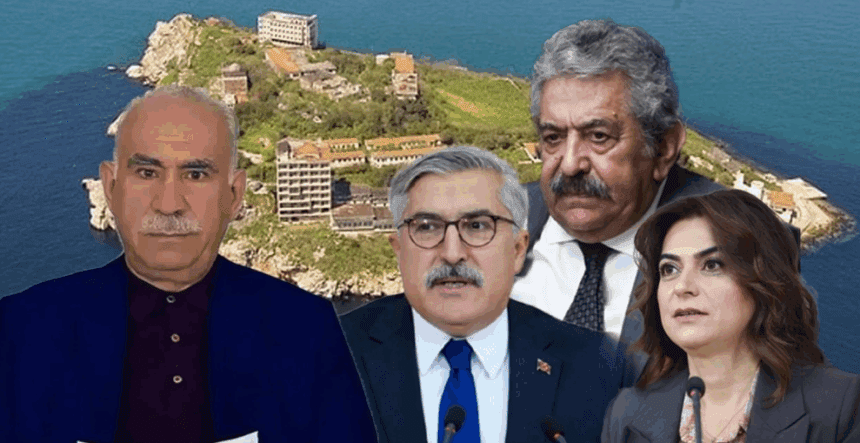
The meeting was conducted on behalf of the parliament’s “National Solidarity, Brotherhood and Democracy Commission,” which TBMM says began work on August 5, 2025 to build societal support and a legal-democratic basis for ending violence and strengthening national cohesion. The delegation comprised AKP deputy chair Hüseyin Yayman, MHP deputy chair Feti Yıldız, and DEM Party group deputy chair Gülistan Kılıç Koçyiğit.
In the transcript, Öcalan repeatedly frames the process as historically consequential, describing the Kurdish question as “a thousand-year problem” and arguing that success would “open a door” shaping “not only the next 100 years but the next 1,000 years.” He voices support for moving from armed conflict to politics, and stresses that ending violence must include what he calls abandoning “mental weapons,” not only physical arms.“ He also says he believed the PKK should have been dissolved in 1993 and that he wanted to conclude the armed phase then, pointing to the Özal period as a missed opening.
A notable feature of the record is Öcalan’s overt praise for President Recep Tayyip Erdoğan and, especially, MHP leader Devlet Bahçeli—crediting Bahçeli with a rare act of political courage and portraying Bahçeli’s outreach as central to the initiative. Öcalan also links his willingness to contribute to changes in prison conditions and communication channels, saying he could deliver on commitments if “conditions allow,” and pointing to discussions around an “umut hakkı” (“hope right”) formula as essential for him to work effectively.
The transcript is also explicit about the domestic political sensitivities surrounding the initiative. Yayman tells Öcalan the delegation is mindful of the concerns of families of fallen soldiers and says the public expects faster, concrete steps—especially regarding disarmament and developments in Syria. Yıldız argues that democratic resolution is possible only if “terror ends,” and raises concerns that some PKK-linked elements are acting in ways that could undermine public confidence. Koçyiğit, speaking for the DEM Party, says the commission wants to hear Öcalan’s views directly and understand what steps could help the process move from words to practice.
While the record is framed as part of a Turkey-centered political effort, Syria emerges as the main stress test. The lawmakers press Öcalan on whether PKK-linked militants are effectively “relocating” rather than disarming—specifically whether fighters pulled out of northern Iraq are being shifted into Syria, contradicting earlier commitments to end armed activity. They also urge that disarmament must apply to all affiliated structures, not only those operating inside Turkey.
The transcript’s Syria focus lands amid a dramatic turn on the ground. Over the past two weeks, Syrian interim President Ahmed al-Sharaa’s forces have made rapid gains in the northeast, triggering a crisis for the SDF and prompting ceasefire and integration talks backed by international mediation. Reuters has reported that the Syrian government has been moving to take over SDF-run prisons and camps holding Islamic State-linked detainees under a broader political agreement signed on January 18, with a ceasefire and deadlines for an integration plan.
Within that context, the delegation repeatedly references a “March 10 integration agreement,” saying compliance is essential and urging Öcalan to make a new statement about Syria. In parallel reporting on the Syria track this week, U.S. envoy Tom Barrack has publicly emphasized upholding the truce and reiterated support for an integration process tied to the January 18 agreement, after meeting SDF commander Mazloum Abdi and Kurdish politician Ilham Ahmed.
Öcalan’s replies in the transcript largely align with Ankara’s stated red lines. He denies advocating a separate Kurdish state, federalism, or administrative autonomy, and endorses a unitary Syria while arguing for “local democracy” and civil-society organization as safeguards against renewed dictatorship. On security, he suggests public-order forces akin to policing rather than a separate “defense” structure—while also arguing that without meaningful democratic safeguards, Syria’s new leadership could slide toward authoritarian rule.
At the same time, the record includes one of Öcalan’s clearest assertions of continued influence over Syria’s Kurdish landscape. He describes Mazloum Abdi (Ferhat Abdi Şahin) as a close figure who is “loyal,” and says he believes he can engage the Syrian Kurdish side through dialogue if given the ability to communicate. These claims are presented as part of a broader argument that he can help steer armed actors away from confrontation if the political track is sustained.
The transcript also highlights Öcalan’s geopolitical framing, including warnings that external actors could exploit Kurdish politics and Syria’s transition. He argues that both Israel and Iran have their own regional “projects,” and urges “democratic integration” as the alternative—casting the Turkey-centered settlement as a model that could eventually extend into a wider regional framework involving Syria, Iraq, and, indirectly, Iran.