
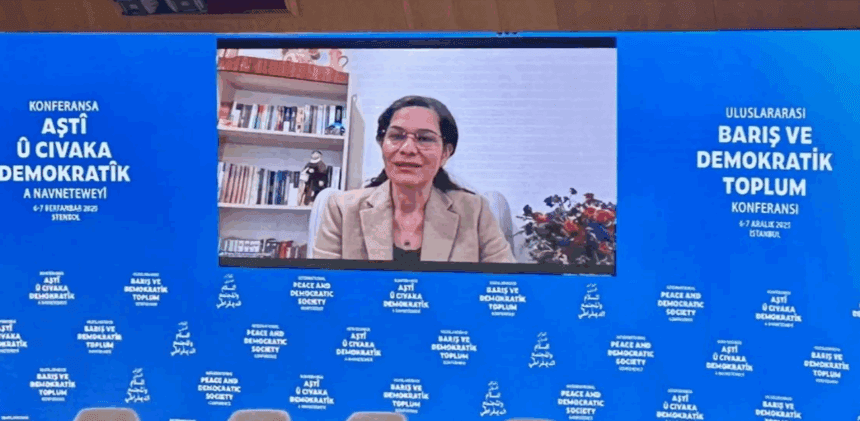
A senior Syrian Kurdish political figure addressed a landmark peace conference in İstanbul by video link on Saturday after the Turkish government refused to let her enter the country, underscoring the fragility of a renewed push to end decades of conflict between Ankara and Kurdish militants.
Ilham Ahmed, co-chair of the foreign relations department of the Autonomous Administration of North and East Syria (AANES), delivered the opening speech of the “International Peace and Democratic Society Conference” from northern Syria. She had been invited to attend in person by Turkey’s main pro-Kurdish party but was unable to travel after Ankara withheld the necessary permission.
The two-day meeting, held at the Cem Karaca Conference Hall in İstanbul’s Bakırköy district under the auspices of the Peoples’ Equality and Democracy Party (DEM Party), is structured around a February message from jailed Kurdistan Workers’ Party (PKK) founder Abdullah Öcalan. In that statement, Öcalan called for a new “peace and democratic society” process and urged the PKK to lay down its arms and disband, signalling the most significant rhetorical shift from the imprisoned leader in years.
In her remarks, Ahmed thanked Öcalan for his role in past talks between the Turkish state and Kurdish representatives, saying those contacts had begun “thanks to Abdullah Öcalan.” She argued that a just peace in Syria would directly shape Turkey’s own future and appealed for dialogue between Ankara and the Kurdish-led administration in northeast Syria. “We are trying to build a democratic administration. We need dialogue. We want to be in dialogue with Turkey. We want our borders to open. We want the peace process in Turkey to reach its end,” she said, according to Kurdish outlets covering the event.
Ahmed described a social contract in the AANES-run region that she said guarantees rights for Kurds, Arabs, Turkmens, Armenians and other groups and enshrines equality between men and women. She argued that the relatively limited destruction in Rojava, compared with other Syrian battlefields, stemmed from this system and from joint self-defence against attacks. “We are not for the breakup of countries, neither in Syria nor elsewhere,” she stressed, insisting that the administration seeks coexistence rather than partition.
The Syrian Democratic Forces (SDF), the multiethnic coalition that led ground operations against the Islamic State in Syria with US support, evolved out of the Kurdish People’s Protection Units (YPG), which Turkey regards as the PKK’s Syrian branch. Ankara views the AANES as a PKK-linked entity on its southern border and has conducted multiple military operations in northern Syria that it says aim to push Kurdish fighters away from Turkish territory and protect Syria’s territorial integrity.
That security lens shaped the government’s response to Ahmed’s planned visit. Earlier in the week, DEM Party co-chair Tuncer Bakırhan publicly invited her to attend the conference in İstanbul and urged the government to “take the hand of friendship” extended from northeast Syria. DEM parliamentary group chair Ayşegül Doğan went further, calling on Ankara to allow both Ahmed and SDF commander Mazlum Abdi to come, arguing that any legal obstacles were political in nature.
Ruling Justice and Development Party (AKP) spokesperson Ömer Çelik rejected the idea, saying the issue was not about individuals but about ending “terrorist activities.” Referring to Ahmed, he claimed she was “someone who says ‘we cannot lay down arms’” and argued that the official title she uses runs counter to Syria’s territorial integrity. “Let them give up terrorism, then let them come,” he said in comments carried by Turkish media.
Cengiz Çandar, a DEM Party lawmaker from Diyarbakır and veteran columnist who spoke at the conference, said Ahmed’s physical attendance required bureaucratic permission that was not granted. He linked the refusal to what he described as the government’s uncertainty over how to deal with the SDF and concluded that “the government is not yet ready” to take that step. At the same time, he argued that Ahmed’s participation via teleconference created the perception that, if talks around Öcalan’s initiative proceed, both she and Abdi could eventually be allowed to travel to Turkey.
Ahmed used her address to speak directly to Turkish society as well as to foreign capitals. She drew attention to the shared suffering of Kurdish and Turkish “mothers” and called for an end to bloodshed, saying, “We want to see ourselves in Turkey and Turkey here.” She also urged regional and international actors, including the United States, to support a meaningful peace process so that “mothers will not cry and blood will not be shed again,” echoing past appeals she has made for Washington to back a long-term settlement between Ankara and the Kurdish movement.