
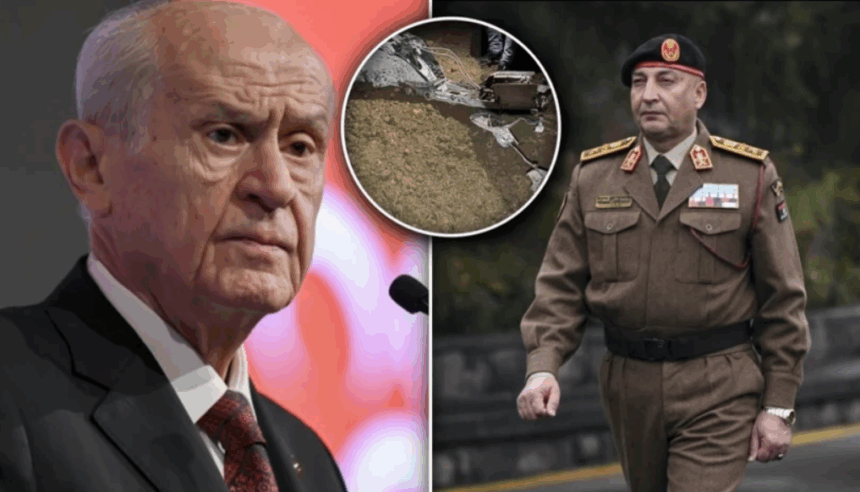
Turkey has recovered and begun examining the cockpit voice recorder and flight data recorder from a private jet crash near Ankara that killed Libya’s top military officer and seven others, as Devlet Bahçeli — President Recep Tayyip Erdoğan’s nationalist ally — publicly emphasized the incident’s timing in comments that amplified sabotage speculation online.
The victims included Gen. Muhammad Ali Ahmad al-Haddad, chief of staff for Libya’s Tripoli-based Government of National Unity, along with four other Libyan military officials and three Turkish crew members, all of whom died when their Dassault Falcon 50 went down on Tuesday after departing Ankara’s Esenboğa Airport for Tripoli.
Turkish officials said the aircraft reported an electrical problem and sought an emergency landing after air traffic control redirected it back toward Esenboğa, but the jet disappeared from radar while descending and later crashed in Ankara’s Haymana area, near Kesikkavak village.
Interior Minister Ali Yerlikaya said the voice recorder was found at 0245 GMT and the flight data recorder at 0320 GMT, and that analysis has begun. Separately, Transport and Infrastructure Minister Abdulkadir Uraloğlu said the recorders would be examined in a neutral country, a step officials framed as part of a transparent technical investigation.
Libyan officials have said the aircraft was leased and registered in Malta, and that investigators are reviewing its ownership and technical history — a detail that has fueled heightened public suspicion in Turkey even as authorities have not presented evidence of foul play.
Bahçeli’s “timing” emphasis drives intrigue
While issuing condolences, Bahçeli — leader of the Nationalist Movement Party (MHP), a key partner in Erdoğan’s governing alliance — described the crash as deeply saddening but also “thought-provoking” in terms of its timing, noting it occurred as Ankara and Tripoli were increasing coordination and dialogue. Turkish commentary widely read the phrasing as a deliberate “hint” without an explicit allegation.
Turkish authorities, however, have publicly focused on the aircraft’s emergency call and the ongoing forensic and technical review, with the crash investigation being handled by relevant agencies and prosecutors.
A crash amid expanding Turkey–Libya defense engagement
The Libyan delegation had been in Ankara for high-level defense talks aimed at expanding military cooperation — part of a relationship in which Turkey has provided substantial backing to Tripoli-aligned authorities since the 2019–2020 conflict around the capital.
The crash also occurred one day after Turkey’s parliament approved an extension of the mandate for Turkish forces in Libya, authorizing the deployment for 24 more months, starting January 2, 2026.
Regional backdrop: Eastern Mediterranean alignments
In the days around the crash, Turkish commentators also pointed to regional signaling in the Eastern Mediterranean — including a Jerusalem trilateral summit involving Israel, Greece and Cyprus that highlighted energy and infrastructure cooperation and underscored closer coordination on security issues.
Turkey’s alignment with Tripoli has long carried added weight because Ankara and Libya signed a 2019 maritime delimitation memorandum that underpins Turkey’s contested Eastern Mediterranean claims — an agreement Greece and Cyprus have strongly opposed.
No official evidence of sabotage
Despite the political interpretations sparked by Bahçeli’s remarks and the broader geopolitical context, neither Turkish nor Libyan authorities have publicly provided evidence indicating an attack. Libyan officials cited by international reporting have characterized the crash as likely stemming from a technical malfunction, and Turkey’s public account has centered on the electrical emergency call and the sequence of events preceding the loss of contact.