

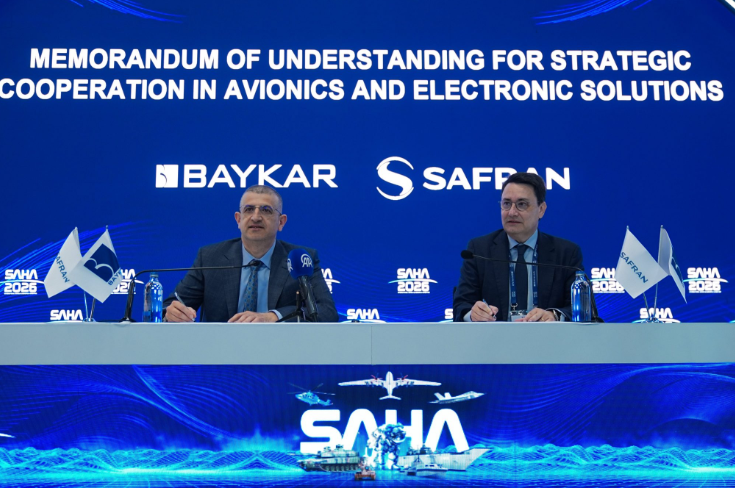
French defense company Safran Electronics & Defense has signed a strategic partnership with Turkish drone manufacturer Baykar, marking another important step in Turkey’s growing integration with the European defense industry.
The agreement, announced last week, covers cooperation in smart weapons, advanced navigation technologies, optronic sensors, and guided munitions for unmanned aerial platforms. Under the deal, Safran’s Euroflir optronic systems will be integrated into Baykar’s Bayraktar TB2 drones, improving their surveillance, reconnaissance, and targeting capabilities.
The partnership is significant not only as a commercial defense agreement but also as a geopolitical signal. France and Turkey have had difficult relations in recent years, especially over the Eastern Mediterranean, Greece, Cyprus, and Libya. In 2024, then-French Chief of Defence Staff Gen. Thierry Burkhard reportedly listed Turkey among France’s “strategic competitors,” alongside Russia, China, and Iran.
Despite those tensions, the Safran–Baykar deal suggests that defense-industry interests may be creating new channels of cooperation between Paris and Ankara. Safran and Baykar said the agreement includes the co-development of integrated solutions combining optronic sensors, navigation systems, and guided-weapons capabilities for drone platforms and air-to-ground operations.
For Baykar, the deal represents another step in upgrading its unmanned platforms with European technologies. The TB2 has already become one of the most recognizable combat drones in the world, gaining attention through its use in conflicts including Ukraine, Azerbaijan, Libya, and Syria. By integrating Safran’s Euroflir systems, Baykar can offer improved targeting and intelligence capabilities to international customers.
For Safran, the agreement opens access to Baykar’s expanding global drone market. The French company will not only supply key technologies but also work with Baykar to jointly promote the systems developed under the partnership to international clients. This gives the deal a clear commercial dimension beyond Franco-Turkish bilateral relations.
However, the agreement is likely to be watched carefully in Greece. Athens has strengthened its defense relationship with France in recent years, including through the purchase of French Rafale fighter jets and other systems. Greece has also ordered Safran’s Patroller tactical drones. From the Greek perspective, the fact that a French defense company is now helping enhance Turkish drones may raise political sensitivities.
The Safran agreement follows an earlier and broader partnership between Baykar and Italy’s Leonardo. In March 2025, Leonardo and Baykar signed a memorandum of understanding to establish a joint venture in unmanned aerial systems. The agreement was based on combining Baykar’s drone platforms with Leonardo’s mission systems, payloads, certification capacity, and access to European defense markets.
That cooperation was later formalized in June 2025 with the creation of LBA Systems, a 50-50 joint venture between Leonardo and Baykar, headquartered in Italy. The new company was designed to work across the full lifecycle of unmanned aerial systems, including design, development, production, and maintenance.
Seen together, the Leonardo–Baykar and Safran–Baykar agreements show that Baykar is no longer operating only as a Turkish drone exporter. It is increasingly becoming a partner for major European defense companies seeking to strengthen their position in the rapidly growing unmanned systems market.
Italy moved first by creating an institutional joint venture with Baykar. France is now entering through high-end sensors, optronics, navigation, and guided-weapons technologies. These two developments suggest a broader European recognition that Turkey’s drone industry has become too important to ignore.
The deals also reflect a changing defense environment in Europe. The war in Ukraine has shown the importance of drones, loitering munitions, and cheaper unmanned systems on the battlefield. European defense companies are under pressure to develop such capabilities quickly. Baykar, with its combat-tested platforms and large production capacity, offers a shortcut into this market.
At the same time, the partnerships create political risks. Turkey remains a difficult partner for several European countries. If Turkish drones enhanced with European technology were used in a future crisis involving a European partner, companies like Safran and Leonardo could face political backlash.
This is especially sensitive because both France and Italy are members of the European Union and NATO, while Greece is also a close partner in both institutions. Defense cooperation with Baykar therefore sits at the intersection of commercial opportunity, NATO pragmatism, and intra-European political tension.
Still, the direction is clear. Baykar is becoming more deeply connected to Europe’s defense-industrial ecosystem. The Leonardo joint venture gave the Turkish company a stronger industrial presence in Italy and access to European production and certification channels. The Safran agreement now adds a French technological layer to Baykar’s drone portfolio.
For Ankara, this is a strategic success. Turkish drones, once seen mainly as cost-effective alternatives to Western systems, are now being integrated with some of Europe’s most advanced defense technologies. For European firms, working with Baykar offers access to proven unmanned platforms at a time when demand for drones is rapidly expanding.
The Safran–Baykar agreement therefore represents more than a technical upgrade for the TB2. It is part of a wider shift in which Turkey’s defense industry is moving from the margins of the European market toward its center. Whether this cooperation will remain purely commercial or evolve into a deeper strategic realignment remains uncertain. But with Leonardo and Safran now both working with Baykar, Turkey’s drone industry has clearly entered a new phase in its European expansion.