
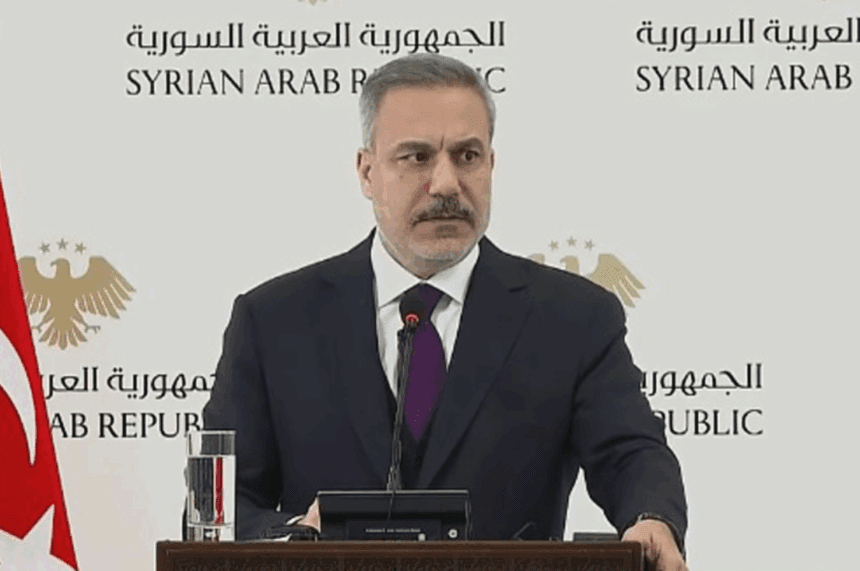
Turkish Foreign Minister Hakan Fidan was abruptly cut off mid-answer during a joint press conference in Damascus after an in-hall announcement declared the briefing over while he was responding to a question about Gaza—an awkward, widely shared moment that has since fed speculation about message discipline and internal hierarchy in Ankara.
Fidan was in the Syrian capital on Dec. 22 as part of a high-level Turkish delegation that also included Defense Minister Yaşar Güler and National Intelligence Organization (MİT) chief İbrahim Kalın. The visit featured meetings with Syria’s interim leadership, including President Ahmed al-Sharaa and Foreign Minister Asaad Hasan al-Shibani, and focused heavily on security arrangements and the future of Kurdish-led forces in northern Syria.
At the press conference, Fidan emphasized Turkey’s view that the Syrian Democratic Forces (SDF) are dragging their feet on a promised integration into Syrian state structures, and he accused the group of coordinating some activities with Israel.
But the moment that grabbed attention came during the Q&A. Multiple Turkish outlets reported that an Anadolu Agency journalist asked Fidan about Gaza, and as he began answering, a voice over the public-address system interrupted: “I would like to state that the press conference has ended. Thank you very much to the ministers.” Fidan’s visible surprise was caught on camera; he did not comment, then shook hands with al-Shibani and posed for the customary closing photo.
On Dec. 23, Turkey’s Foreign Ministry sought to defuse the optics. Spokesperson Öncü Keçeli said a “technical malfunction” prevented the interpreter’s audio from reaching headsets while Fidan was answering the Gaza question, prompting the Syrian official moderating the session to assume Fidan had finished and to end the briefing early; Keçeli added that the Syrian side apologized.
Why critics link it to “Bilal succession” narratives — and to Fidan being managed
Fidan, a former intelligence chief turned foreign minister, has become one of Ankara’s most consequential operators on Syria and regional security. International profiles have described him as a heavyweight whose visibility has grown sharply—and as someone some observers view as a potential post-Erdoğan contender inside the ruling ecosystem.
That matters because, for Erdoğan’s critics, the succession question is increasingly framed not as an open contest among loyalists but as a slow, deliberate construction of a family-centered pathway—most prominently around his son Bilal Erdoğan. Bilal does not hold elected office, but he has been repeatedly positioned in high-visibility “civil society” and mobilization roles, including through TÜGVA-linked events. Turkish media reported this week that organizers are preparing a Jan. 1, 2026 “Gaza” rally on Istanbul’s Galata Bridge, promoted at a launch event featuring Bilal Erdoğan and high-profile attendees from major football clubs—an optics-heavy tableau that critics read as soft political normalization.
Put together, critics argue, the Damascus interruption fits a pattern: keep a potentially “presidential-looking” figure like Fidan tightly within scripted boundaries, while expanding Bilal’s public legitimacy through emotive, mass-mobilization themes (like Gaza) that play well on television and avoid direct accountability for state policy.