
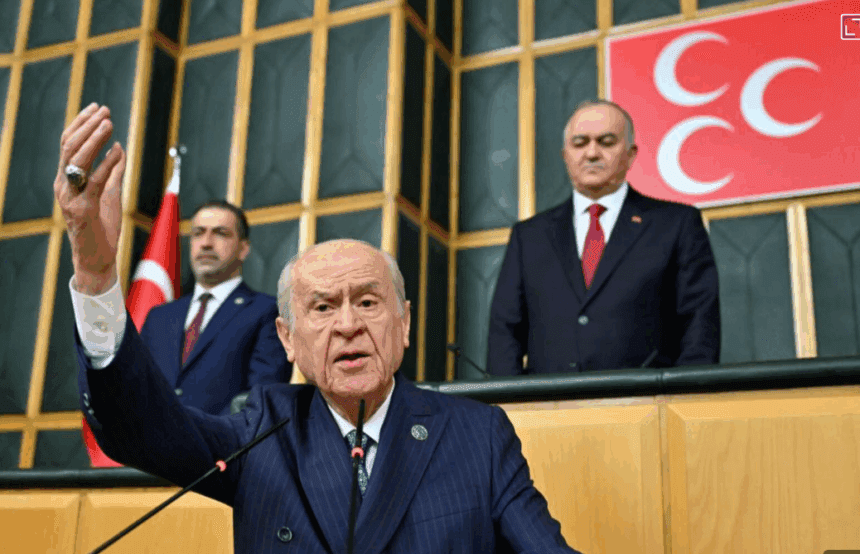
Turkey’s nationalist leader Devlet Bahçeli sharpened his rhetoric against the Kurdish-led Syrian Democratic Forces (SDF) on Tuesday, calling its commander Mazloum Abdi an “Israel’s puppet” and arguing that any proposal to invite the SDF for talks in Ankara reflects “a loss of reason,” as the fallout from deadly clashes in Aleppo spills into Turkey’s already-fragile domestic “terror-free Turkey”/peace discourse.
Bahçeli, who leads the Nationalist Movement Party (MHP) and is a key ally of President Recep Tayyip Erdoğan’s ruling bloc, used his TBMM parliamentary group speech to frame the Aleppo fighting as part of a broader struggle over Syria’s unity and Turkey’s internal security. He repeated Ankara’s long-standing position that the SDF/YPG is an extension of the outlawed Kurdistan Workers’ Party (PKK), and said that if the PKK’s organizational existence has ended and weapons have been laid down, then “its offshoot” in Syria should meet the same fate.
“Our interlocutor is no one but the PKK’s founding leader”
At the center of Bahçeli’s message was a claim about who, in his view, can legitimately represent the process: “Our interlocutor is no one but the PKK’s founding leader,” a reference to jailed PKK leader Abdullah Öcalan.
Bahçeli argued that Öcalan’s 27 February call—which Turkish officials and pro-Kurdish politicians have portrayed as a pivotal reference point for disarmament—binds all PKK-linked structures and therefore must also apply to the SDF/YPG.
He then singled out Abdi (Ferhat Abdi Şahin), saying: “Mazloum Abdi… is a supporter of Zionism, Israel’s puppet,” and accusing him of “disrespect and disloyalty” toward the PKK’s founding leadership.
(These are Bahçeli’s allegations; neither Israel nor the SDF immediately responded in the cited sources.)
DEM Party criticism and Aleppo narrative battle
Bahçeli also targeted Turkey’s pro-Kurdish DEM Party over its public comments about the Aleppo fighting. He said no one—“especially DEM”—could credibly claim that “Kurdish brothers” were attacked in Aleppo, insisting instead that civilians were endangered by the SDF/YPG and that Syrian government forces evacuated civilians without harming them.
In the same section, Bahçeli rejected the idea—raised in Turkish political debate—that the SDF/YPG should be invited to Ankara for negotiations, calling it either a rushed statement or a failure to grasp realities, and asking how Turkey could bargain with what he described as an “Israel-directed” organization.
Aleppo clashes: what happened on the ground
Bahçeli’s remarks came days after intense fighting erupted in Aleppo between Syrian government forces and the Kurdish-led SDF, centered on the Kurdish-populated districts of Sheikh Maqsoud and Ashrafiyah.
The clashes, which began after negotiations stalled over integrating Kurdish forces and administration into Syria’s new post-war order, displaced tens of thousands and killed at least two dozen people, according to the Associated Press.
Under an internationally mediated arrangement, Kurdish fighters were evacuated from Aleppo’s contested neighborhoods to SDF-controlled areas in northeastern Syria, and Syrian government forces took full control of the districts.
By Monday, hundreds of displaced residents began returning to the neighborhoods.
Even after the evacuation, tensions remained high east of Aleppo. The Syrian army declared an area east of the city a “closed military zone,” accusing the SDF of mobilization, while the SDF denied it and accused government forces of shelling.
AKP: Aleppo was “sabotage” of the “terror-free Turkey” goal
The Aleppo violence also triggered competing political narratives in Ankara.
On Monday, Ömer Çelik, spokesperson for Erdoğan’s ruling AKP, said the SDF/YPG’s actions and “the operation in Aleppo” were “an attempt to sabotage” Turkey’s goal of a “terror-free Turkey,” a label Ankara uses for its renewed effort to close out the four-decade PKK conflict.
Çelik’s statement echoed the government’s broader insistence that any PKK disarmament process must include armed Kurdish groups in Syria that Turkey views as PKK offshoots.
PKK: Aleppo attacks “call into question” the ceasefire
On Tuesday, the PKK responded with a sharply different framing.
In a statement carried by outlets citing the Fırat news agency, the PKK said the Aleppo attacks on Kurdish neighborhoods—and the attitude of state officials toward the movement—were sabotaging its “Peace and Democratic Society” process, warning the developments “call into question” the ceasefire between Turkey and the PKK and urging the AKP and MHP to avoid steps that would derail the track.
The stalled integration deal at the heart of the Syria dispute
A central driver of the Aleppo crisis has been the unresolved question of how—and on what political terms—the SDF and the Kurdish-led administration in northeastern Syria would be integrated into the new Syrian state.
The March 2025 agreement aimed to integrate the SDF into Syria’s national army, but its implementation has faced repeated delays due to disagreements over conditions and governance, particularly regarding Kurdish demands related to decentralization and guarantees.
Turkey, which considers the SDF a national-security threat along its border, has long demanded that the group be folded into Syrian state structures and has warned it may act militarily if it does not comply with integration arrangements.
Earlier in the crisis, Turkey signaled support for Damascus’s push to restore order.
Turkish media reported on Jan. 8 that Turkish officials said Ankara stood ready to help end the conflict in Aleppo, while Turkey’s Defense Ministry emphasized that Syrian government forces launched the operation independently and that Turkey was not involved.
Bahçeli’s broader frame: global disorder, Trump, and “external provocation”
In his group speech, Bahçeli also placed the Syria file into a wider critique of international politics, citing remarks he attributed to U.S. President Donald Trump about being constrained only by his own morals and mind and “not needing international law,” and warning that unchecked power politics could push the world toward wider war.
He referenced U.S. actions and pressures in places such as Venezuela and Greenland, and argued that regional destabilization—including unrest in Iran—could be magnified by outside manipulation, urging caution and unity.
He also claimed that in Aleppo, “Trump sold them out on the spot,” a line used to reinforce his argument that Kurdish forces cannot rely on external patrons.