
On 15 January 2026, the first hearing in Ekrem İmamoğlu’s lawsuit challenging the annulment of his university diploma was held inside the Marmara Prison complex in Silivri, where he is detained. The court is expected to issue its decision within 15 days under the relevant administrative procedure rule. In other words, the case is not a distant political quarrel; it is a near-term legal turning point with direct consequences for eligibility, legitimacy, and opposition strategy.
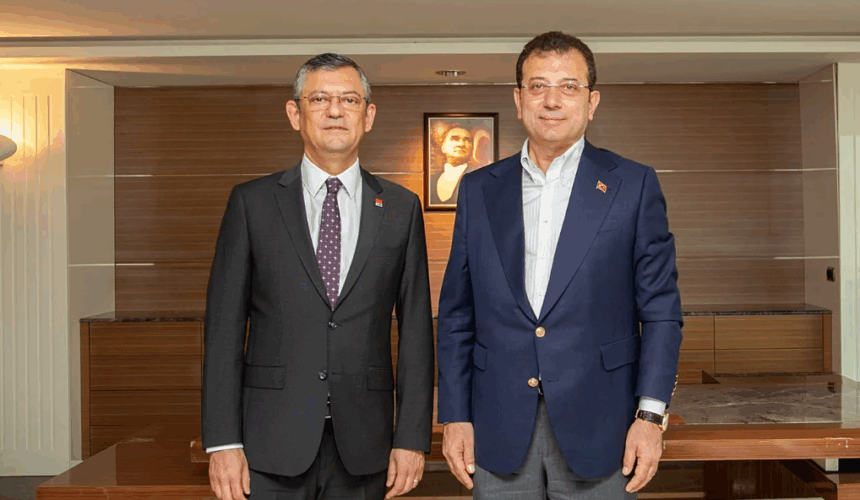
That is exactly why Özgür Özel’s post-hearing performance matters. After the hearing, the CHP leader tried to frame the episode as an assault on the rule of law and as a politically motivated effort to block a rival who has repeatedly defeated Erdoğan-backed candidates. But the way he chose to dramatize that claim—through a cascade of lurid, legally muddled hypotheticals—risks doing the opposite of what he intended: strengthening the government’s preferred frame that the diploma is “problematic” and that something “shady” must have happened.
The core problem is not that Özel was emotional. It is that he selected examples that contaminate the narrative. When the public hears “diploma,” the opposition’s most defensible ground is administrative legality: due process, non-retroactivity, institutional competence, equal treatment, and separation of powers. That’s the terrain where the ruling bloc is weakest—especially when credible reporting has stressed the political stakes, including that presidential candidates must have higher education.
Instead, Özel introduced analogies that pull the audience away from administrative law and into criminal imagery and absurdity. On the CHP’s own site, he likened the state’s approach to a scenario where someone confesses to a killing from 35 years ago, the body is found, yet prosecution fails due to limitation periods—and he even adds different limitation periods depending on whether torture was involved. This is rhetorically explosive, but strategically self-sabotaging. It invites a simple counter-thought in the minds of undecided voters: “Why are we talking about murder and torture in a diploma case—unless the speaker is trying to cover something enormous?” Even if no one says that out loud, the association is planted.
Then came the “appendix” line—Özel’s warning that if annulments spread, would surgeons have to “return the appendix” to the patient? The intent is obvious: to ridicule retroactive invalidation and show how destabilizing it could be. But politics does not reward “obvious intent”; it rewards clean framing. Grotesque medical imagery does not clarify due process. It produces a fog of mockery that can rebound as unseriousness—precisely what an embattled opposition cannot afford when facing an allegation (fair or not) that a legal document is invalid.
In Turkish, the idiom for this kind of self-inflicted harm is perfect: “Kaş yapayım derken göz çıkarmak”—literally, “while trying to shape an eyebrow, you end up poking out the eye.” The closest English equivalents are “to do more harm than good,” “to make matters worse,” and “the cure is worse than the disease.” Özel’s rhetoric is a textbook case: in trying to strengthen İmamoğlu’s moral position through hyperbole, he risks damaging the credibility of the defense by making the whole affair sound like a carnival of insinuations and grotesque comparisons.
This is where another proverb fits: “Better a wise foe than a foolish friend.” In Turkish usage, it is often rendered as “Akıllı düşman, akılsız dosttan iyidir.” The point is not personal insult; it is a political function. A “foolish friend” harms you not by opposing you, but by misframing your best arguments, handing your opponent openings you didn’t need to give.
And in this case, the opening is glaring. The government’s most useful narrative is not even “İmamoğlu is guilty.” It is subtler: “There is controversy; there are irregularities; you can’t be sure.” Once doubt is normalized, the regime doesn’t have to prove anything in the court of public opinion; it only has to keep the opposition defending itself in the mud. By pivoting from procedural legality to sensational hypotheticals, Özel helps shift the debate from “Was the annulment lawful?” to “What’s wrong with this diploma story anyway?” That is a gift.
If Özel is not acting out of sheer misjudgment, then the alternative question becomes unavoidable: is he doing this deliberately—functionally, if not formally—in ways that serve Erdoğan’s regime? If these were not simple lapses of judgment, they would amount to a remarkable act of strategic self-sabotage: a self-inflicted wound that, in practice, strengthens the governing bloc’s narrative control. That is precisely why such suspicions surface—not because the opposition should be consumed by paranoia, but because the error is too consequential to dismiss, and because the timing matters. Coming immediately after a high-stakes hearing, with a decision imminent, the margin for rhetorical carelessness shrinks to near zero, and the political price of a single misstep rises accordingly.
A disciplined leadership would aim to reduce noise, isolate the legal issues, and keep the public focused on institutional boundaries and procedural fairness. Özel did the opposite: he created noise so loud that it risks drowning out the very claim he wanted to amplify.
Now consider the political mechanics of authoritarian resilience. The authoritarian systems rarely rely on a single blunt act. They often operate through cumulative “plausible doubts”: maybe a document is flawed, maybe a process was irregular, maybe disqualification is legally justified, maybe courts are simply “doing their job.” The objective is not to convince everyone. It is to create enough confusion that a decisive intervention can be tolerated, rationalized, or normalized.
So the responsible way to put it is this: either Özel is strategically undisciplined, or he is strategically accommodating. The first possibility is bad enough: it suggests a leadership unable to protect its own candidate’s strongest framing at the most sensitive moment of the case. The second possibility would be worse: it would suggest that the opposition’s top communicator is, deliberately or not, participating in the regime’s core tactic—manufacturing doubt by polluting the narrative.
Either way, the practical conclusion is the same. The CHP cannot afford an advocacy style that turns a due-process dispute into a carnival of grotesque hypotheticals. The diploma case is already structurally dangerous because it touches eligibility; the opposition must therefore be structurally careful. It should speak in the language of administrative legality and legal security, not in the imagery of murder confessions and surgical organs. Özel’s duty is not to win applause outside Silivri; it is to protect İmamoğlu’s legitimacy frame in a political environment designed to corrode legitimacy through insinuation.
Silivri was a moment that demanded rhetorical discipline. Özel delivered rhetorical excess. In trying to strengthen the defence, he risked strengthening the suspicion. That is why these proverbs apply: in a system that weaponizes doubt, a careless ally can be more useful to the regime than an intelligent opponent.
By: News About Turkey (NAT)