
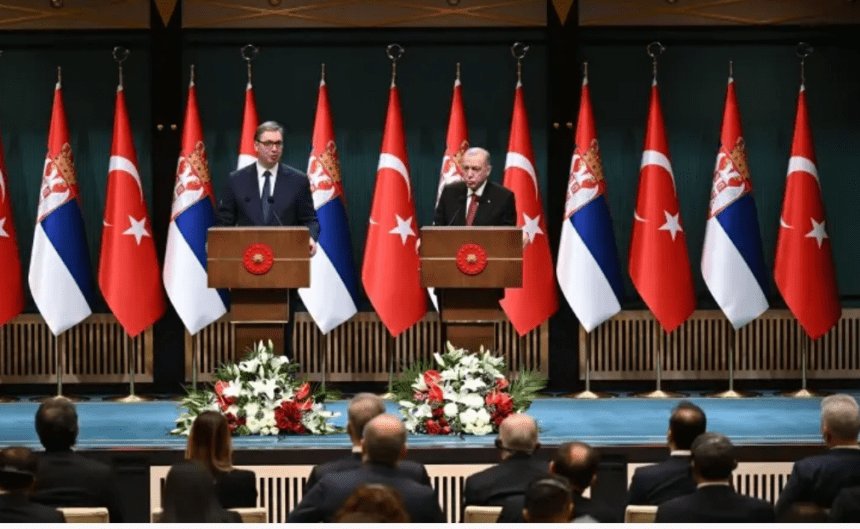
Turkey and Serbia moved to reinforce their expanding economic relationship on Thursday, with Recep Tayyip Erdoğan and Aleksandar Vučić signing a joint declaration that set a new trade target and placed fresh emphasis on defense-industry cooperation.
The declaration welcomed a rise in bilateral trade to $3.5 billion in 2025 and said both governments would coordinate more closely to reach a $5 billion goal. The two sides also agreed to convene the next meeting of their joint economic commission “at the earliest opportunity,” describing the mechanism as central to the trade and investment relationship.
Beyond trade, the statement portrayed the partnership as increasingly multi-dimensional, listing areas for deeper cooperation that ranged from foreign policy coordination and infrastructure connectivity to energy, tourism, education, advanced technologies, and environmental issues. It also praised Turkish construction firms for major projects in Serbia—particularly in transportation and energy—while noting growing two-way tourism as another driver of closer ties.
At a joint news conference in Ankara, Erdoğan framed the meeting as part of Turkey’s broader effort to safeguard regional stability during what he called a period of heightened global uncertainty, saying Ankara was determined not to neglect the Balkans. He said the leaders reviewed how current regional and international developments could affect their cooperation and discussed steps to keep Balkan stability and economic development on track.
Erdoğan also highlighted the cultural and educational dimension of the relationship, pointing to growing interest in learning Turkish in Serbia and citing the work of Yunus Emre Institute and the Turkish Maarif Foundation in meeting that demand. He referenced development efforts in the Sandzak region—often described by Turkish officials as a bridge between the two countries—and offered Ramadan greetings to Serbia’s Muslim community.
Vučić, meanwhile, delivered a strikingly warm endorsement of Erdoğan, describing him as a leader with influence extending beyond Turkey and the region. He said Turkey was an important partner for Serbia not only politically and economically, but also in technology and the defense sector, and he pointed to Turkish investment—especially in less developed areas of southern Serbia—as a source of jobs and local growth.
He also said the two sides discussed infrastructure projects in detail, including highway and railway initiatives, and signaled that new agreements on key transport corridors were expected to advance. Vučić welcomed Turkey’s decision to participate in EXPO 2027 in Belgrade, framing the event as an opportunity to deepen economic, commercial, and cultural ties.
Defense cooperation and regional platforms
One of the most notable features of Thursday’s messaging was the explicit reference to defense-industry collaboration. The joint declaration reaffirmed an intention to expand cooperation in this area and linked it to understandings reached during earlier high-level talks between the two governments.
The leaders also expressed satisfaction with the first two meetings of the Balkan Peace Platform—held on July 26, 2025 and Jan. 23, 2026—and said they were ready to continue working together in bilateral and regional forums aimed at strengthening peace and stability across the Balkans. Both sides emphasized the value of regular high-level visits and said they intended to convene the next council meeting as soon as possible.
The lingering backdrop: Kosovo and sharp words
The upbeat tone in Ankara came after a period in which Vučić’s public language toward Turkey had turned notably harsher, driven largely by tensions surrounding Kosovo and Serbia’s long-running dispute with Pristina.
As recently as October 2025, Vučić publicly criticized Turkey over defense-related cooperation with Kosovo, arguing that such steps undermined regional stability and framing the issue in legal and security terms. In that episode, he used unusually pointed rhetoric—language that stood out against the otherwise pragmatic tone that has often characterized Ankara–Belgrade engagement in recent years.
Thursday’s meeting suggested both governments are now trying to compartmentalize: pressing ahead with trade targets, investment, tourism, and connectivity projects, while keeping political disputes from derailing the broader relationship. Still, the contrast between the recent flare-up and the current praise underlined how quickly Balkan fault lines—especially Kosovo—can spill into public messaging, even as economic and diplomatic cooperation continues to deepen.