

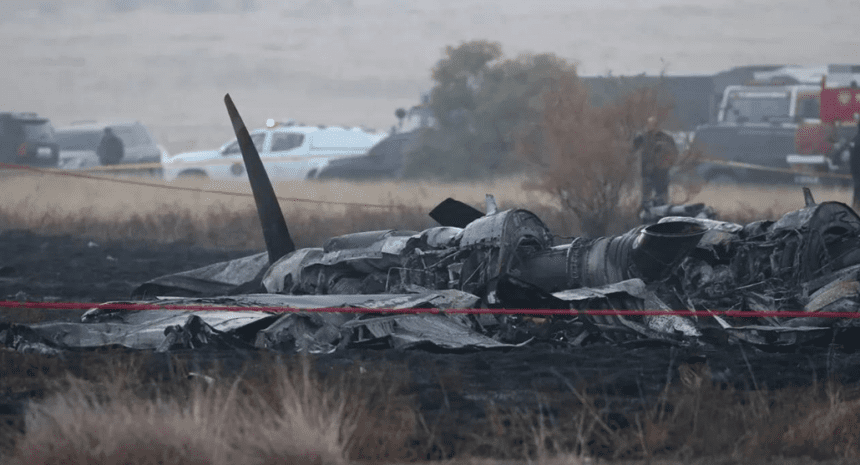
A forensic report prepared as part of the investigation into the November 2025 crash of a Turkish military C-130 cargo plane near the Georgia-Azerbaijan border found no evidence of external intervention, shrapnel damage or explosive residue on the wreckage, according to Turkish media reports on Friday.
The report, prepared by the gendarmerie criminal laboratory for the Ankara Chief Public Prosecutor’s Office, said investigators found no traces consistent with a nearby munition blast, a direct hit by ammunition or an improvised explosive device. It also said no suspicious chemical substance, fuel-based fire starter or fire accelerant was detected in the wreckage.
The findings undermine recent claims by Patriotic Party (VP) leader Doğu Perinçek, who alleged that the aircraft had been brought down by Israel. Turkey’s Defense Ministry rejected that accusation earlier this week as disinformation, said the armed forces were being targeted with baseless claims and announced legal action.
But the report’s timing is likely to raise as many questions as its contents. The ministry said shortly after the November 11 crash that black box analysis and initial findings would take at least two months. Yet the forensic report surfaced only nearly five months later, and only after Perinçek’s allegation had triggered a political controversy and forced a public rebuttal from the authorities.
That delay is likely to fuel criticism over the pace and transparency of the investigation. A report ruling out sabotage or an external strike would appear to be one of the most basic and urgent findings in a crash that killed 20 soldiers. Instead, it emerged months later, after speculation had already spread and after the issue had been pulled into a wider political dispute.
Defense Minister Yaşar Güler said days after the crash that preliminary findings suggested the aircraft’s tail may have broken off before the plane split into three pieces. But despite those early remarks, authorities still have not provided a full public explanation of what caused one of the deadliest recent Turkish military aviation disasters.
Turkish media said the broader cause of the crash remains under investigation by the Air Force Command’s evaluation and inspection authorities. Technical work is continuing in both Turkey and Georgia, with data being analyzed by the Scientific and Technological Research Council of Turkey, Turkish Aerospace Industries, the Mechanical and Chemical Industry Corporation and Air Force units.
The latest forensic findings may have closed off one politically explosive theory, but they do not resolve the larger issue. Nearly five months after the crash, the public still does not know what brought the aircraft down, and the late release of even a limited forensic conclusion risks deepening doubts about how the investigation has been handled. For the families of the 20 soldiers killed, the wait for a clear and credible account continues.