
Turkey is preparing a draft law that would consolidate Ankara’s maritime jurisdiction claims in the Aegean Sea, the eastern Mediterranean and the Black Sea into domestic legislation, while maintaining the country’s territorial waters in the Aegean at six nautical miles.
The proposal was presented Tuesday at a news conference organized by Ankara University’s National Center for Sea and Maritime Law, known as DEHUKAM. Officials described the draft as a framework law covering Turkey’s internal waters, territorial waters, contiguous zone, continental shelf and exclusive economic zone.
The presentation followed reports that Ankara was working on legislation to formalize its maritime claims, a step that could add a domestic legal dimension to long-running disputes with Greece and Cyprus over maritime boundaries and offshore energy resources.
DEHUKAM director Mustafa Başkara said the bill would establish basic rules for determining the breadth and limits of Turkey’s maritime zones and would define presidential powers related to those areas. The draft would also address maritime crimes, narcotics cases, innocent passage through Turkish territorial waters and legal rules for activities in zones claimed by Turkey.
Officials said the bill would not conflict with the 1936 Montreux Convention, which regulates passage through the Bosporus and the Dardanelles. They also said it would reinforce Turkey’s position that the Dardanelles, the Sea of Marmara and the Bosporus are internal waters.
According to DW Turkish, citing senior officials from the ruling Justice and Development Party, work on the bill is nearly complete and it could be submitted to parliament after Eid al-Adha. The Turkish Armed Forces, navy and coast guard have reportedly provided technical opinions on the draft.
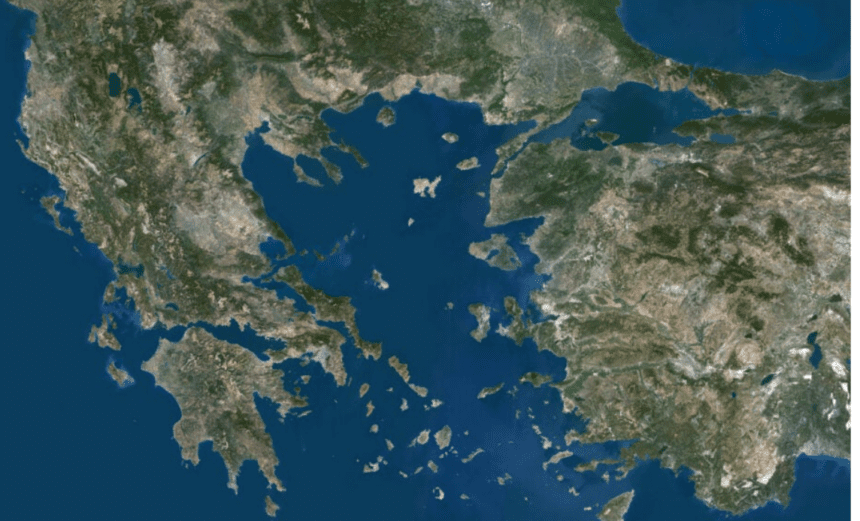
The bill would apply to all seas bordering Turkey. It would record territorial waters at 12 nautical miles in the Black Sea and the Mediterranean, while keeping the Aegean limit at six nautical miles.
Yücel Acer, a member of the presidency’s Legal Policies Council, said the draft would not create a new situation for Greece. He said Turkey’s position that the Aegean limit should remain at six nautical miles has not changed.
The Aegean has long been a source of tension between Turkey and Greece, including disputes over territorial waters, continental shelf rights and the maritime zones generated by Greek islands near Turkey’s western coast. Greece argues that islands have rights to continental shelves and exclusive economic zones under international law. Turkey disputes the automatic application of that principle in the Aegean, citing the region’s geography.
Turkey is not a party to the United Nations Convention on the Law of the Sea, arguing that some of its provisions do not reflect Turkey’s particular circumstances in the Aegean.
Another provision of the draft would allow the president to declare special-status maritime areas in zones where Turkey has not proclaimed an exclusive economic zone. Başkara said such areas could be designated for fishing, environmental protection or other purposes.
The proposal comes amid continued competition over offshore energy in the eastern Mediterranean. Turkey has objected to energy agreements and exploration activities involving the Republic of Cyprus, arguing that Turkish Cypriots also have rights to resources around the island.
The Republic of Cyprus is internationally recognized as sovereign over the whole island, while the Turkish Republic of Northern Cyprus is recognized only by Turkey.
Turkey’s 2019 maritime boundary agreement with Libya’s Tripoli-based government remains another point of dispute. Greece, Cyprus and the European Union rejected the deal, while Ankara says it supports Turkey’s maritime rights in the eastern Mediterranean.
The draft has drawn criticism from Greece and Cyprus. Greek government spokesperson Pavlos Marinakis said unilateral legislation by one country carries no weight under international law. Cyprus has also objected to Turkish maritime claims that overlap with offshore energy blocks licensed by Nicosia.
Supporters of the bill argue that Turkey needs a comprehensive maritime jurisdiction law, noting that the country has not had a broad statute in this field since the 1982 Territorial Waters Law.
Çağrı Erhan, deputy chair of the presidency’s Security and Foreign Policies Council, said the draft was not prepared against any specific country.
The bill has not yet been submitted to parliament, and its full text has not been released. If enacted, it would represent Turkey’s first attempt to place its broader maritime jurisdiction claims into a single domestic legal framework.