

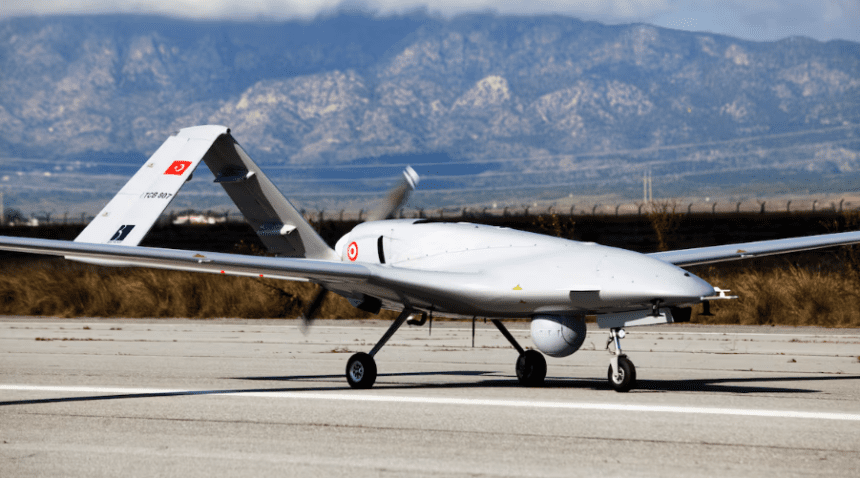
Canada and Turkey appear to be entering a new phase in defense cooperation after years of tension over drone technology and arms export restrictions.
Ottawa is now exploring possible cooperation with Ankara in several key areas, including ammunition production, unmanned aerial vehicles and counter-drone systems. The discussions suggest that Canada may not only consider purchasing Turkish defense products in the future, but could also take part in joint development projects with Turkey’s defense industry.
One of the most important areas of interest is medium-altitude, long-endurance drones. Canada is reportedly looking at Turkish UAV capabilities as it seeks to strengthen its own surveillance, reconnaissance and operational capacity. The talks are still at an early stage, and no final procurement decision has been made.
The shift is significant because Canada-Turkey defense relations were deeply strained only a few years ago. In 2019, following Turkey’s military operation in northern Syria, Canada suspended new arms export permits to Ankara. Later, Ottawa cancelled several export licenses after concerns that Canadian-made electro-optical systems used on Turkish drones had been transferred to Azerbaijan and used during the Nagorno-Karabakh conflict.
At the time, Turkish drones such as the Bayraktar TB2 relied heavily on Canadian-made WESCAM camera systems. Canada’s restrictions created a serious challenge for Turkey’s drone program, effectively threatening to deprive its UAVs of one of their most important components: their eyes.
However, the restrictions also pushed Turkey to accelerate its domestic defense production. Turkish companies, especially Aselsan, moved quickly to develop local alternatives to foreign electro-optical systems. This allowed Turkey to reduce its dependence on Canadian components and strengthen the autonomy of its drone industry.
Now, the relationship appears to be moving in the opposite direction. A country that once restricted critical components for Turkish drones is now considering Turkish UAVs and defense cooperation as part of its own modernization strategy.
This change is also linked to Canada’s broader effort to reduce its dependence on the United States. Donald Trump’s return to power and his pressure on allies have increased concerns in Ottawa about relying too heavily on American weapons, technology and political guarantees. As a result, Canada is looking more seriously at alternative defense partners among NATO members and other middle powers.
That does not mean Canada can easily move away from U.S. systems in every field. In areas such as fighter aircraft, Ottawa remains tied to programs like the F-35, where realistic alternatives are limited. But in areas such as drones, ammunition, counter-drone systems and autonomous platforms, Canada has more room to diversify.
For Turkey, this creates an important opportunity. Its defense industry has grown rapidly over the past decade, especially in UAV technology, and Ankara is increasingly positioning itself as a supplier and development partner for countries looking beyond traditional Western defense giants.
The emerging Canada-Turkey dialogue therefore marks more than a simple procurement discussion. It reflects a broader transformation in both countries’ strategic calculations. Canada is searching for greater defense autonomy, while Turkey is seeking to expand the global reach of its defense industry.
After years of drone-related disputes, the two countries may now be moving toward a more pragmatic partnership — one shaped less by past restrictions and more by shared interests in drones, ammunition production and next-generation battlefield technologies.