
Many journalists and political scientists have recently noted that Turkey is not naturally hospitable terrain for dynastic succession. The “leader’s son” is seldom embraced as “the next leader”—not because Turkish politics is unusually ethical or meritocratic, but because the electorate is culturally and politically allergic to ready-made heirs. Modern Turkish political memory is littered with sons who inherited famous surnames and instant visibility, only to discover that a name is not a constituency and proximity to power is not legitimacy.
But that is only the cultural and historical layer. The missing layer is structural: Turkey’s current political conditions—state capture, media discipline, judicialized politics, and an election system engineered to narrow real contestation—can reduce the friction that normally blocks an heir. And there is an external lubricant as well: Western and Israeli preferences for predictable continuity can make an heirship project viable.
The System Erdoğan Built: Succession Without Consent
If Turkey doesn’t do princes, Erdoğan’s answer is to avoid persuading Turkey. It is to redesign the system so that Turkey no longer gets a vote in the old sense. Elections can still be held, ballots can still be counted, results can still be announced—just not in a way that keeps the contest meaningfully open.
That is precisely why Erdoğan’s succession plan cannot rely on Bilal’s appeal. It must rely on Erdoğan’s system.
The 2017 constitutional referendum is the hinge—the inflection point when Erdoğan converted a strained parliamentary system into a hyper-centralized presidency and, crucially, thinned out the institutional shock absorbers that might have forced a genuine, rules-bound transfer of power. It did not merely expand executive authority; it reordered the state’s internal balance, weakening the legislature, narrowing meaningful oversight, and tightening executive influence over appointments across the judiciary and bureaucracy. In that sense, 2017 is less a single vote than the moment the system’s default setting shifted: from competitive politics with manipulation at the margins to a political architecture designed to manage outcomes.
The referendum remains contested in public memory not only because it passed by a narrow margin, but because of the controversy surrounding unstamped ballots and the broader atmosphere in which the vote took place—the so-called post-coup emergency conditions, a lopsided media environment, and the criminalization of dissent that blurred the line between campaigning and coercion. Even for many Turks who accepted the official result, the episode planted a durable suspicion: that the rules could be reinterpreted mid-game when the stakes were existential for the presidency. Once that precedent is internalized, elections stop being a shared civic ritual and become a test of who controls the levers that certify reality.
That logic hardened in 2019, when the Istanbul mayoral race—won by the opposition by a razor-thin margin—was cancelled and rerun. Whatever one’s partisan reading, the sequence carried a clear message: victory is not final until it is accepted by the system, and the system can demand a second round if the first round produces the “wrong” winner. The rerun backfired politically, but institutionally it functioned as a rehearsal for a deeper principle: legitimacy is no longer anchored in the ballot alone; it is anchored in the state’s power to validate, invalidate, and exhaust.
By 2023, when the opposition coalesced behind Kemal Kılıçdaroğlu, this post-2017 architecture shaped the entire contest. In the final stretch, some of the most closely watched polling still showed Kılıçdaroğlu leading—at times by notable margins—creating a widespread expectation of change. Yet Erdoğan ultimately prevailed and extended his rule, and Kılıçdaroğlu described it as “the most unfair election in years” even as he did not dispute the official outcome.
Finally, fresh questions have emerged following Erdoğan’s private meeting with Turkey’s top election official last month—exactly the kind of behind-the-scenes interaction that makes the term “free and fair” seem more ceremonial than a genuine democratic assurance.
This is the core shift: elections may continue, but increasingly like elections in hard authoritarian systems—events held on paper, while the result is stabilized in advance by control of media, judiciary, security bureaucracy, campaign finance, and the legal definition of what counts as “acceptable” opposition.
The “No Princes” Rule Meets the İmamoğlu Test
The same instinct that makes Turkish voters wary of inherited leadership also shapes the debate over İmamoğlu. The same commentators keep reaching for the familiar parallel: Erdoğan was wronged, and the injustice helped propel him; now İmamoğlu is being wronged, so Erdoğan is supposedly “manufacturing” his own successor. It sounds persuasive—until you remember that the story of Erdoğan’s rise was not just about sympathy. It was about the existence of a political arena where sympathy could still be converted into organization, coalition-building, media amplification, and ultimately electoral takeover.
That conversion is precisely what has changed. In the era when Turkey repeatedly refused ready-made heirs—when “sons of leaders” discovered that a surname does not equal a constituency—the contest was still meaningfully open. The public could reject a prince not only because it disliked dynastic entitlement, but because the system still allowed that dislike to carry consequences. Today, the question is no longer whether Turkish political culture embraces princes or rewards victimhood. The question is whether the arena is being redesigned so those cultural instincts cannot translate into outcomes.
Seen from this angle, the “no princes” rule doesn’t disappear—it mutates. Turkey’s electorate may still be allergic to automatic heirs, and still instinctively resist the idea of leadership by inheritance. But if the system is engineered to narrow the menu of real choices, then voter allergy becomes a sentiment without leverage. The public can dislike a prince, admire an underdog, even vote against the palace’s preferred outcome—and yet find that the decisive parts of politics have already been moved out of reach: candidate eligibility, media access, court rulings, party control, administrative pressure, and the rules that define what “winning” even means.
So, you don’t build a dynasty in Turkey by winning hearts; you build it by narrowing options.
The Galata Bridge Test: Rallies That Looked Like an Audition
For three New Year’s mornings in a row, the same ritual has been staged in Istanbul: dawn prayers, tightly organized columns, and a pilgrimage of banners and flags converging on the Galata Bridge—Turkey’s most cinematic political catwalk. The message is packaged as mass ‘solidarity’ with Gaza, a civic chorus insisting it will not be silent and will not forget. This year’s march was again framed as a broad civil-society coalition, with hundreds of organizations mobilized under umbrellas like the National Will Platform/Humanity Alliance.
Just as telling is who is allowed to “perform Gaza” at Galata—and who is not. When the CHP sought to organize a pro-Palestinian march and rally at the Galata Bridge in February 2025, the İstanbul Governorate refused permission, arguing that the bridge is not among the officially designated meeting/demonstration routes under the relevant rules (often cited through Law 2911 and the governorate’s predetermined locations).
The Galata Bridge event has evolved into a dual event, and the significance lies in the intersection of these two elements. On the surface, it is a Palestine rally. Underneath, it increasingly reads like a visibility drill for Bilal Erdoğan: a carefully lit stage where he is presented not as a party apparatchik but as the “civil society” face of continuity—an acceptable, pious, ostensibly nonpartisan bridge between the Erdoğan era and whatever comes after. Even critical coverage that disputes the spectacle’s authenticity tends to agree on one point: the rally functions as a promotional vehicle for Bilal’s public positioning.
The timing sharpened that duality. The latest rally took place against the backdrop of the October 2025 ceasefire framework—an agreement that did formally pause major operations, on paper, starting October 10. Yet the ceasefire has been widely described as fragile, with continuing violence and alleged violations reported in the months that followed.
Official and pro-government accounts emphasized the scale, claiming a crowd of around 520,000. However, critics widely dispute this figure.
In addition, several names frequently discussed in “post-Erdoğan” scenarios—Foreign Minister Hakan Fidan, former Finance Minister Berat Albayrak, and Baykar’s Selçuk Bayraktar—and several ministers were not seen at the rally, along with the broader impression that key power centres did not uniformly line up behind Bilal’s showcase.
In this regard, the Galata Bridge rally also works like a test because it is designed to produce a simple binary: you are either in the picture, or you are a question mark. Absences may be banal (scheduling, health, tactical discretion), but in Erdoğan’s Turkey the optics are rarely allowed to remain banal for long. A rally that is marketed as a moral cause becomes, simultaneously, a roll-call.
And Erdoğan has helped create the conditions for that inward turn. The more the opposition is boxed in by legal warfare—İstanbul’s Ekrem İmamoğlu remains jailed, and Ankara’s Mansur Yavaş has faced successive investigation authorizations—the more politics shifts from open competition to managed succession inside the ruling ecosystem. So in the coming months, we should expect more legal and administrative operations aimed at silencing internal dissent within the regime—and at quietly rotating out figures who look insufficiently obedient to Bilal, replacing them with figures even younger than him.
From Son to Grandson: The Third-Generation Rehearsal
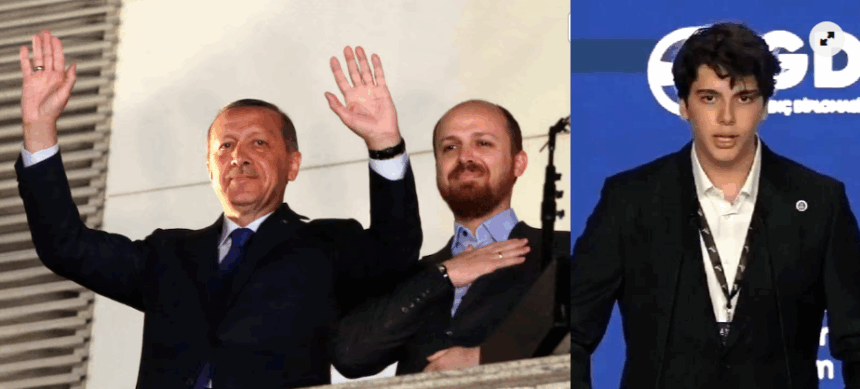
And then there is the detail that turns a “Bilal project” into something more dynastic: the visible promotion of Erdoğan’s grandson, Bilal’s son, Ömer Tayyip Erdoğan, in a public forum setting.
Turkish media reported that Ömer Tayyip Erdoğan spoke at the Bosphorus Diplomacy Forum (under the Turkish Presidency’s auspices) held last October, alongside his grandfather, with photo-ops and messaging about youth, diplomacy, and Gaza aid.
Taken alone, that could be dismissed as harmless: a politically connected young man appears at a conference. But in sequence—Bilal’s staged centrality, then the grandson’s visibility—it reads like a succession pipeline rather than a one-off.
Turkey doesn’t do princes—so the palace is trying to do generations.
The External Lubricants: The West and Israel
Internal engineering is only half the story. The other half is external permissiveness—how Erdoğan’s system is normalized, rewarded, and quietly ensured by the very actors who still speak the language of “rules” and “values” in public.
Turkey’s democratic erosion has been met with remarkably few material consequences, because Ankara remains too useful—NATO weight, migration leverage, intelligence cooperation, regional reach, and an expanding defense-industrial footprint that European capitals increasingly treat as an asset rather than a problem. The result is a familiar Western pattern: ritual statements about the rule of law on camera, business-as-usual off camera—arms cooperation, trade, and strategic coordination continuing largely intact. In that framing, “acceptance” is not applause; it is accommodation dressed up as pragmatism, a shift from trying to constrain Erdoğan to simply managing him.
This is where the remarks of US envoy Tom Barrack matters—not only for what it says, but for the permission structure it implies. In remarks delivered at the IISS Manama Dialogue, Barrack cast Western post-Ottoman state-building as a long string of failures—arguing that externally imposed templates “on tribes and flags” did not work and that centralized imported models repeatedly collapsed. What he presented instead as the region’s “working” formula was the idea of “benevolent monarchies,” justified by the alignment of religious and political authority and the capacity of rulers to distribute resources without the friction of contestation.
And then come the incentives. Trump’s remarks last week about Turkey and the F-35s illustrate how quickly “values talk” can be subordinated to transactional reassurance. Trump publicly floated that his administration was “seriously thinking” about approving an F-35 sale to Turkey, explicitly tried to calm Israel by promising the jets would not be used against it, and framed Erdoğan not as a democratic problem but as a trusted counterpart—while also crediting Erdoğan for helping bring down Assad and even claiming Netanyahu agreed with that assessment. In strategic signalling terms, this is not a footnote. It tells Erdoğan’s inner circle that authoritarian continuity is not necessarily punished; it may even be compensated—if Ankara remains “useful,” and if Turkey can be positioned as the main pillar of the new regional architecture.
In that environment, a dynasty becomes easier when your most powerful ally stops treating dynastic governance as disqualifying.
The other external lubricant—probably the most effective—is Israel. Israel’s security discourse has long depended on a rotating cast of enemies—some real, some artificial and some inflated—to expand territorially and exploit the U.S. financially, politically, and militarily.
After Assad’s fall—enabled in most part by Turkey’s backing of Syrian opposition forces—the “New Iran” frame has become a convenient rebranding: Turkey is recast as the next systemic antagonist, and “Erdottoman” imagery supplies the civilizational drama that makes that recasting sellable.
The result is a useful external cover: Israel can argue that expanded freedom of action in the Middle East, particularly in Syria, deeper military intrusions, and constantly heightened alert postures are not optional but structural necessities. In this perspective, a controlled, theatrical “Islamist strongman” is not only acceptable but can also be beneficial—especially if his survival helps structure the region into predictable bargaining channels.
In this regard, external actors acting in pursuit of their own interests often prefer a manageable autocrat to an unpredictable democratic opening, which carries the risk of policy volatility and strategic uncertainty. Continuity can be negotiated and contained; transition cannot.
By: News About Turkey (NAT)