
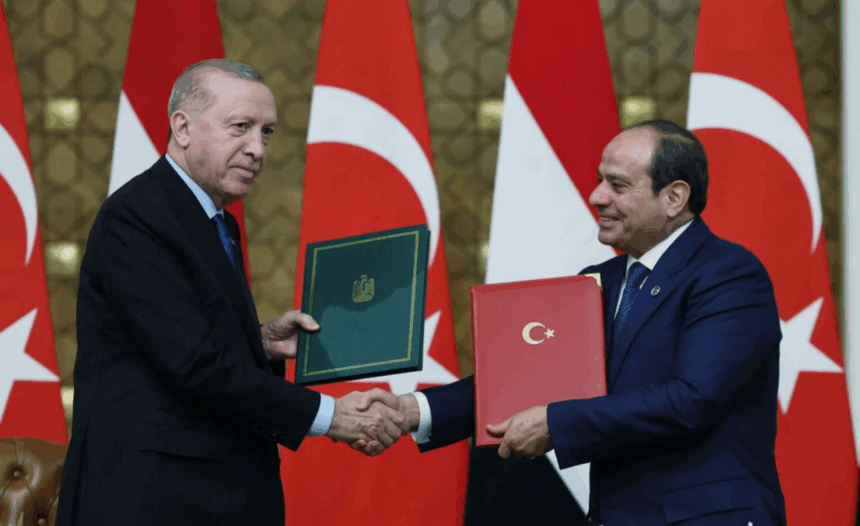
Recep Tayyip Erdoğan met Abdel Fattah al-Sisi in Cairo on Wednesday, as the two governments signed a new package of cooperation agreements and highlighted converging positions on regional flashpoints ranging from Gaza and Sudan to rising tensions around Iran.
The meeting, held under the High-Level Strategic Cooperation Council, was presented by both sides as evidence that the post-2023 normalization is shifting from political symbolism to institutional coordination. In a joint declaration, the two governments described “positive momentum” in relations and said they plan to hold the next council meeting in 2028 in Ankara.
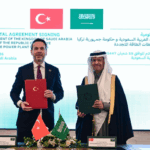
At the center of the visit were economic and sectoral agreements. The Egyptian presidency said memoranda of understanding were signed in fields including defense, investment, trade, agriculture, health, youth and sports, and social protection, while Sisi told reporters that ministers signed 18 agreements spanning areas such as defense, tourism, health and agriculture. The joint declaration also set a trade target of $15 billion by 2028, building on what it said was trade approaching $9 billion.
Officials framed the commercial agenda as a stabilizer in a relationship that was deeply strained for much of the past decade. Ties ruptured after the 2013 ouster of Mohamed Morsi and the subsequent crackdown on the Muslim Brotherhood, with Ankara publicly backing Morsi’s government and sharply criticizing the new leadership in Cairo.
That public hostility has gradually given way to what both sides now describe as pragmatic cooperation, with the Gaza war and regional security pressures pushing them into closer contact. On Gaza, Sisi said the leaders agreed on the need to implement all phases of the U.S.-brokered truce framework and rejected attempts to “circumvent or obstruct” the implementation of Donald Trump’s peace plan, while also calling for international support for early recovery and reconstruction.
The Gaza file has also created an arena where both governments can claim diplomatic relevance. According to reporting cited by Asharq Al-Awsat, Egypt and Turkey now constitute half of the mediating bloc involved in the current truce efforts, alongside other regional and international actors.
Sudan featured prominently as well, with Sisi calling for a humanitarian truce that would lead to a ceasefire and a broader political process. The issue has become increasingly intertwined with the defense dimension of Turkish-Egyptian ties after Reuters reported that Egypt deployed Turkish-made drones to a remote airstrip near the Sudan border, a move described as raising the stakes in the conflict and signaling deeper external involvement.
On Iran, both leaders emphasized diplomacy and warned against escalation. The joint declaration said Cairo and Ankara would intensify coordination with other regional states to support de-escalation and help create conditions for renewed negotiations between the United States and Iran. Erdoğan, speaking separately to reporters, said Turkey was doing its best to prevent a U.S.-Iran conflict and underscored the importance of high-level talks, after nuclear discussions initially expected to be hosted in Turkey were shifted to Oman at Tehran’s request.
The visit also addressed the Horn of Africa and the Red Sea, where both governments have growing security and economic interests. In their joint declaration, they reaffirmed support for Somalia’s sovereignty and territorial integrity and rejected measures that undermine it, while also stressing the need to secure the Red Sea and restore normal maritime navigation through it.
Defense cooperation has emerged as one of the most consequential markers of the rapprochement. Reuters reported during Erdoğan’s 2024 trip to Cairo that Turkey had said it would provide Egypt with armed drones, part of a broader push to expand energy and defense cooperation and lift trade toward $15 billion. More recently, Turkish defense firm Havelsan announced a strategic cooperation agreement with Arab Organization for Industrialization for joint unmanned aerial vehicle production, reflecting an effort to translate normalization into long-term industrial projects rather than one-off sales.
Erdoğan’s Cairo stop came immediately after a visit to Riyadh, part of a regional tour that Turkish officials have linked to expanding economic and energy cooperation across the Middle East. The timing also placed Turkey’s diplomatic ambitions under a spotlight, as U.S.-Iran contacts that Ankara had hoped to host were re-routed to Oman, reinforcing both Turkey’s desire to be a convening venue and the continued sensitivity of the file for Washington and Tehran.