
Turkey and Greece signed a series of bilateral documents in Ankara on February 11, 2026, after talks between Turkish President Recep Tayyip Erdogan and Greek Prime Minister Kyriakos Mitsotakis, extending a rapprochement effort built around sustained dialogue and concrete cooperation areas even as long-running maritime disputes remain unresolved.
A standout moment came when Mitsotakis offered an unusually direct reference to Mustafa Kemal Ataturk, saying the two sides should “uphold the legacy” of Atatürk and Eleftherios Venizelos—former wartime rivals who later helped engineer a reconciliation in the early 1930s. The remark was widely seen as symbolic because Atatürk is revered in Turkey but can be a divisive historical figure in Greece due to the memory of the 1919–1922 conflict.
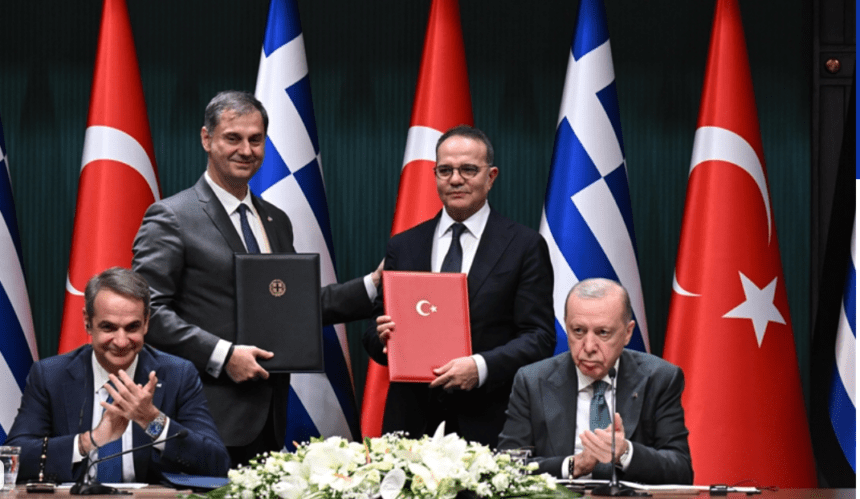
The leaders co-chaired the sixth meeting of the Türkiye–Greece High-Level Cooperation Council, held a one-on-one session, and then presided over a signing ceremony that included a Joint Declaration between the Government of the Turkey and the Government of the Greece. In their public remarks, both emphasized dialogue and international law, while reiterating an ambition to raise bilateral trade to $10 billion and pointing to closer operational coordination on migration as part of the recent de-escalation.
Migration was a particularly urgent backdrop after a fatal incident off Chios on February 3, when a dinghy carrying migrants capsized following a collision with a vessel of the Hellenic Coast Guard, leaving 15 people dead and prompting an ongoing investigation. The episode sharpened attention on Aegean crossings—an issue that regularly spills into broader diplomacy between the two neighbors.
The cooperation package focused on sectoral deliverables. One memorandum of understanding was signed between the Investment and Finance Office of the Presidency of Türkiye and Enterprise Greece, aimed at strengthening institutional cooperation on investment and trade promotion. It was signed by Burak Daglioglu and Greek Deputy Foreign Minister Haris Theoharis.
Another memorandum sought to encourage Ro-Ro ferry services between the Port of Izmir and the Port of Thessaloniki, a move presented as improving commercial connectivity. It was signed by Turkish Deputy Foreign Minister Mehmet Kemal Bozay and Theoharis, who also signed a separate memorandum aimed at strengthening cooperation within the framework of Black Sea Economic Cooperation.
Disaster preparedness featured prominently as well. A memorandum on enhancing bilateral cooperation in earthquake readiness was signed by Turkish Interior Minister Mustafa Ciftci and Greek Minister for Climate Crisis and Civil Protection Ioannis Kefalogiannis, underscoring a shared interest in practical coordination among two seismically active countries.
The two sides also formalized cooperation in culture and innovation. A cultural memorandum was signed by Turkish Culture and Tourism Minister Mehmet Nuri Ersoy and Greek Culture Minister Lina Mendoni. In science and technology, a declaration of intent on cooperation was signed by Turkish Industry and Technology Minister Mehmet Fatih Kacir and Greek Development Minister Takis Theodorikakos.
Even with the new agreements, the meeting did not alter the fundamentals of the Aegean dispute. Greece has continued to emphasize its position that international law allows it to expand territorial waters from six to 12 nautical miles, while Turkey’s 1995 parliamentary decision framed such a move in the Aegean as a casus belli. Mitsotakis again pressed for removing what Athens describes as the “war threat,” while Erdogan stressed that disputes were complex but manageable through continued dialogue.
The day’s outcome was less about breakthroughs on maritime delimitation than about keeping the détente track alive: pairing symbolic messaging—highlighted by Mitsotakis’ Atatürk reference—with incremental cooperation in transport, investment promotion, disaster management, culture, and technology, while reserving the hardest sovereignty questions for longer, more politically sensitive negotiations.