
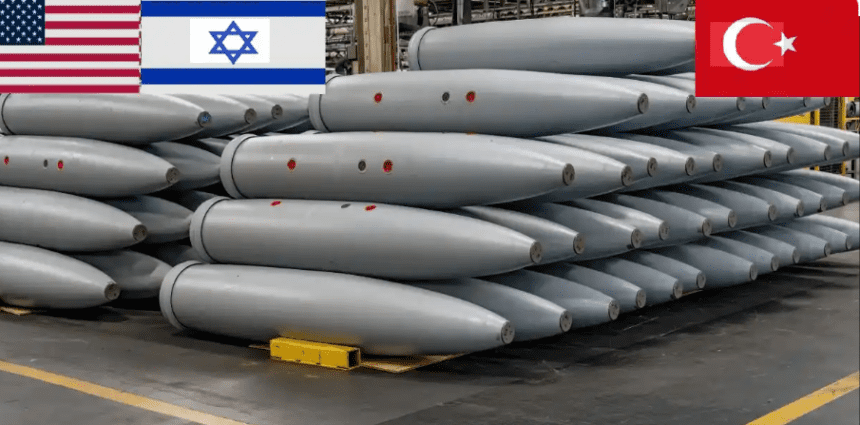
The United States has approved an emergency Foreign Military Sales package for Israel centered on 12,000 BLU-110A/B 1,000-pound general-purpose bomb bodies, valued at about $151.8 million, with Repkon USA named as the principal contractor. Secretary of State Marco Rubio waived the usual congressional review process, saying an emergency existed and that the transfer was in the national security interests of the United States. The bombs will come both from new production and from existing U.S. stockpiles.
The approval comes as Washington deepens military support for Israel during the latest regional escalation. Reuters reported that the BLU-110 sale forms part of a broader emergency move involving more than 20,000 bombs worth around $650 million, while Israeli outlet Ynet said the wider package totals roughly $660 million and includes additional 500-pound and small-diameter bombs. Reuters also reported that Israel is expected to purchase a further $298 million in critical munitions through direct commercial sales
The transaction has drawn unusual attention because Repkon USA is the American subsidiary of Turkish defence company Repkon, creating political sensitivity given Ankara’s harsh rhetoric against Israel. Under the Foreign Military Sales system, however, the U.S. government — not the contractor — is the exporter and contracting authority, with companies supplying the U.S. side rather than selling directly to the foreign customer. Repkon said it had no role in requesting or deciding the transfer and denied that it had conducted a direct sale to Israel.
This is not the first Israel-related U.S. arms notification to feature Repkon USA. In a February 28, 2025 notice, the Defense Security Cooperation Agency said the State Department had approved a separate $675.7 million emergency sale to Israel that included 201 MK 83 bomb bodies, 4,799 BLU-110A/B bomb bodies and 5,000 JDAM guidance kits, with Repkon USA and Boeing listed as principal contractors.
Democratic Congressman Gregory Meeks criticized Rubio’s use of emergency authority, saying it undercut the administration’s claim that it was prepared for the conflict with Iran. Reuters said the approval came about a week after the United States and Israel began joint strikes on Iran, further heightening tensions across the region.
The disclosure is also likely to intensify scrutiny of Turkey’s indirect commercial links to Israel. In January, Reuters reported that Israeli imports of Azerbaijani crude shipped from Turkey’s Ceyhan port rose to a three-year high in 2025 despite Ankara’s official trade ban. That report already fueled accusations that President Recep Tayyip Erdoğan’s public posture on Gaza diverges from the realities of trade and supply chains.
Heavy bomb bodies of the BLU-110/Mk-83 class have been under particular scrutiny because they can be fitted with precision-guidance kits and used in dense urban warfare. Reuters, citing a December 2024 U.N. report, said Israeli forces likely used such heavy munitions in densely populated parts of Gaza. Human rights groups and U.N.-linked investigators have gone further: Amnesty International said in December 2024 that Israel is committing genocide in Gaza; Human Rights Watch said Israeli policy amounted to extermination and acts of genocide; B’Tselem later concluded Israel was committing genocide; and a U.N. commission in September 2025 said Israel had committed genocide in Gaza. Israel rejects such allegations and says its campaign is an act of self-defence following the Hamas-led October 7, 2023 attack.
Taken together, the episode underscores how globalized defence production has complicated traditional political narratives. Even as Ankara casts itself as one of Israel’s fiercest critics, a U.S.-based subsidiary of a Turkish defence firm now sits inside the supply chain of an emergency bomb package for Israel — through a deal structured, authorized and executed by Washington.