

The Trump administration is free to proceed with a proposed sale of more than $700 million in GE Aerospace F110 engines and related technical support to Turkey after a statutory congressional review period expired without lawmakers enacting legislation to block the transaction.
The administration formally notified Congress on June 24 of its intention to move forward with the package, which is intended to support Turkey’s domestically developed KAAN fighter aircraft. Because Turkey is a NATO member, the Arms Export Control Act provides Congress with a 15-calendar-day review period before the proposed Foreign Military Sale can advance. That period ended on July 9.
The expiration of the deadline does not constitute an affirmative congressional endorsement. It means only that Congress failed to enact a joint resolution of disapproval within the period established by law, removing the principal statutory obstacle to the administration’s proceeding with the sale.
Rep. Dina Titus, a Nevada Democrat, introduced H.J.Res. 200 on July 2 in an attempt to prohibit the transaction. The measure was backed by eight Democratic cosponsors, including Reps. Chris Pappas, Bradley Schneider, Josh Gottheimer, Mike Quigley, Jim Costa, James McGovern, George Latimer and Brad Sherman.
The resolution was referred to the House Foreign Affairs Committee but received no committee hearing or vote before the deadline. It never reached the House floor, and no corresponding resolution advanced through the Senate.
Merely introducing a resolution does not suspend an arms transfer. To legally block the sale, a joint resolution would have had to pass both chambers and become law—either with the president’s signature or through a congressional override of a presidential veto. The administration was therefore able to outlast the review period without securing an affirmative vote from Congress.
The proposed transaction is described in Transmittal No. 24-051, submitted under Section 36(c) of the Arms Export Control Act. According to the text of H.J.Res. 200, the package includes defense articles, defense services and technical data supporting the “integration, installation, external modification, qualification, certification, assembly and test” of F110-GE-129E/F engines for the TF-X aircraft, now known as KAAN.
The package is expected to cover dozens of engines and associated support, according to reporting on the administration’s notification. The broader transfer goes beyond providing physical engines and includes the technical assistance and certification work necessary to integrate them into the KAAN platform.
The end of the review period does not mean that a final contract has been signed or that deliveries will begin immediately. US and Turkish officials must still conclude the government-to-government Foreign Military Sales process, including a Letter of Offer and Acceptance, commercial arrangements, production schedules, technical requirements and delivery terms.
US engines remain critical to KAAN
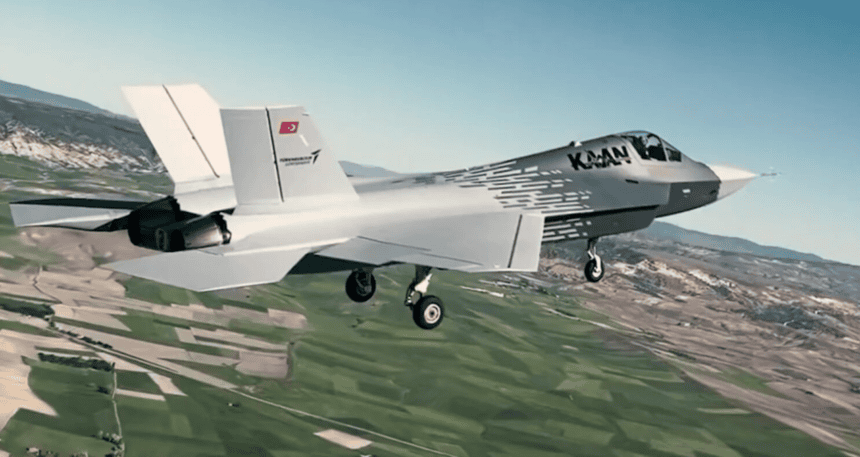
KAAN is being developed by the state-controlled Turkish Aerospace Industries as the centerpiece of Turkey’s effort to produce an advanced combat aircraft and reduce its long-term dependence on foreign weapons suppliers.
The first KAAN prototype completed its maiden flight on February 21, 2024, powered by two GE Aerospace F110 engines. It remained airborne for 13 minutes, reaching an altitude of 8,000 feet and a speed of 230 knots, according to Turkish Aerospace.
Turkey plans to use the US-made engines for KAAN’s prototypes and initial production aircraft while it develops the TF35000, a domestically designed turbofan engine intended to power later versions.
The TF35000 is being developed by TUSAŞ Engine Industries, or TEI, in partnership with TRMOTOR under the direction of Turkey’s defense industry authorities. The companies say the engine is designed to generate 35,000 pounds of thrust and meet the performance requirements of a fifth-generation combat aircraft.
Until that engine is developed, tested and certified, KAAN remains dependent on American propulsion technology. The F110 sale is therefore essential to Ankara’s goal of delivering the first aircraft to the Turkish Air Force beginning in 2028.
The transaction also has implications beyond Turkey’s domestic requirements. Turkish Aerospace signed a binding agreement in 2025 to supply 48 KAAN aircraft to Indonesia, making Jakarta the program’s first international customer. The agreement includes cooperation in production, engineering and technology sharing.
Although Turkey ultimately plans to equip later aircraft with domestically produced engines, delays in obtaining sufficient numbers of F110s could affect prototype testing, early production and possibly the timetable for the Indonesian order.
Opposition centered on S-400 and regional disputes
Titus and other opponents argued that supplying the engines would reward President Recep Tayyip Erdoğan’s government despite Turkey’s continued possession of the Russian-made S-400 air-defense system and its disputes with Greece, Cyprus and Armenia.
Turkey’s acquisition of the S-400 led Washington to remove it from the F-35 fighter program and impose sanctions on Turkey’s defense procurement agency. US officials have argued that operating the Russian system alongside the F-35 could expose sensitive information about the aircraft’s capabilities.
Titus said the engine transfer would strengthen a government that had threatened US allies and contributed to instability in the Eastern Mediterranean and the wider region. Her resolution targeted the KAAN engine transaction separately from the continuing debate over whether Turkey could eventually be readmitted to the F-35 program.
Rep. Gregory Meeks of New York, the ranking Democrat on the House Foreign Affairs Committee, had also objected during the administration’s informal congressional consultation process. Meeks criticized the administration for moving ahead without adequately briefing him about the implications of the sale, including Turkey’s continued possession of the S-400 system.
Informal objections from senior lawmakers have traditionally delayed major arms transfers, but they do not carry the force of law. The Trump administration chose to proceed to formal notification despite Meeks’ opposition, forcing critics to pass binding legislation within the statutory review period.
They failed to do so.
The administration may now advance the transaction, giving Turkey access to the engines and technical support needed to keep KAAN’s testing and early production plans on schedule. Nevertheless, the sale remains subject to final negotiations, contracting and export-control requirements, and the congressional deadline’s expiration does not guarantee when—or under what precise conditions—the engines will be delivered.