
Turkey has agreed to join the Canada-led Defence, Security and Resilience Bank, or DSRB, resolving several days of conflicting reports about Ankara’s position on the proposed multilateral financial institution.
A Turkish official confirmed that Ankara is on board with the initiative and said earlier reports that Turkey had decided against participating were false.
The clarification indicates that confusion within the Turkish government, rather than a policy reversal or rejection of the project, was responsible for the contradictory accounts that emerged after the NATO summit in Ankara.
Turkey’s participation comes as Ankara and Ottawa also formally launch negotiations for a comprehensive free-trade agreement, marking a broader improvement in relations between the two NATO allies.
Canada had consistently listed Turkey as a participant
The Canadian government announced the DSRB initiative during the NATO summit in Ankara on July 7, naming Turkey among eight countries supporting the Canada-led project.
Canada, Albania, Belgium, Greece, Latvia, Luxembourg, Romania, Turkey and Ukraine declared a shared commitment to work toward establishing the institution and enabling it to begin operating as early as 2027.
A Canadian government statement said the participating countries would help establish the bank’s initial policies and operating directives, shape its activities and ensure that economic benefits flow to member states.
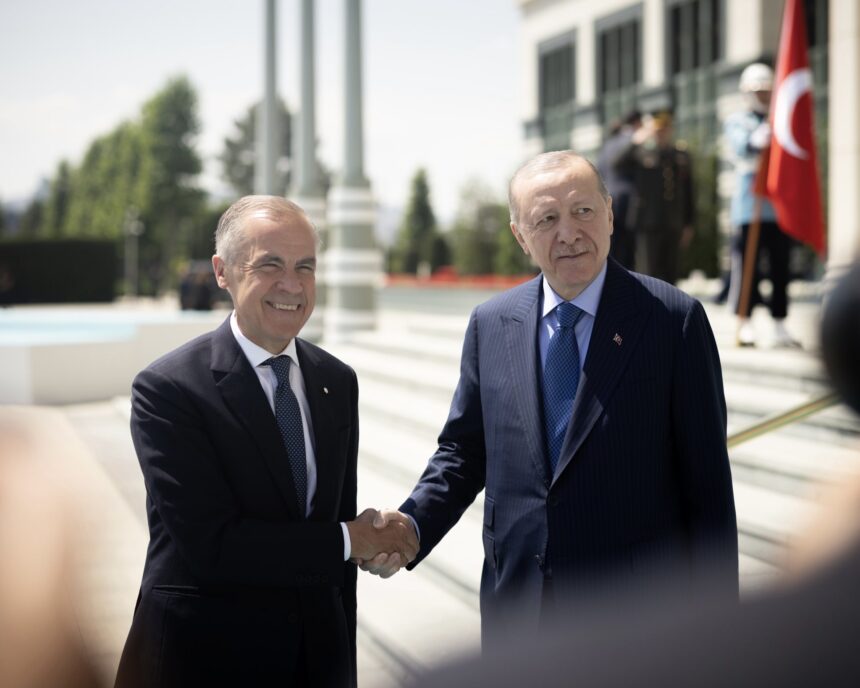
The office of Canadian Prime Minister Mark Carney also said that during his meeting with President Recep Tayyip Erdoğan, Carney welcomed Turkey’s support for the bank and emphasized its potential to strengthen defense production and industrial capacity among allied countries.
Canada did not remove Turkey from its announcements while conflicting reports circulated in Ankara.
The Turkish official’s latest clarification brings Ankara’s stated position into line with the Canadian government’s account and confirms that Turkey intends to participate in establishing the institution.
Earlier reports attributed to confusion in Ankara
Uncertainty emerged after Turkish sources initially indicated that Ankara would not commit to joining the bank “at this stage.”
The reported decision followed consultations involving the Defense Ministry, Foreign Ministry, Treasury and Finance Ministry and Presidency of Defense Industries.
Turkish Defense Ministry sources later said Ankara was still evaluating participation, confirming that Turkish representatives had attended negotiations in Montréal but stopping short of announcing a final decision.
The latest clarification rejects the earlier reports and confirms that Turkey has agreed to join.
The disagreement appears to have resulted from a breakdown in communication among the Turkish institutions involved in evaluating the initiative.
Turkey’s political commitment does not mean that its membership has already completed every legal step. Canada has invited the participating governments to undertake their respective domestic treaty procedures before the bank begins operating.
Bank to finance defense production
The DSRB is intended to operate as a multilateral financial institution that mobilizes public and private capital for defense, security and resilience projects.
The bank would use the combined credit strength of its member governments to provide long-term loans, financial guarantees and lower-cost financing for governments and companies involved in defense production.
It is intended particularly to help small and medium-sized companies that may struggle to obtain affordable financing for expanding production capacity.
Eligible areas could include conventional defense manufacturing, supply chains, cybersecurity, artificial intelligence, quantum technologies, space systems and critical infrastructure.
Canada says the bank will complement rather than replace existing national and multilateral defense-financing mechanisms.
The DSRB’s founding Articles of Agreement were negotiated in Montréal in April 2026. Participating governments unanimously selected Canada as the location of the future headquarters.
The bank is expected to seek a strong credit rating that would allow it to borrow at favorable rates and pass lower financing costs on to member governments and defense companies.
Canada wants the institution to become operational as early as 2027.
Although the project was announced during a NATO summit and is intended to increase allied defense capacity, the DSRB will be a separate multilateral financial institution rather than an official NATO bank. Ukraine is the only country in the initial group that is not a NATO member.
Canada and Turkey launch free-trade negotiations
The confirmation of Turkey’s participation in the bank coincides with the formal launch of negotiations for a Canada-Turkey free-trade agreement.
Carney and Erdoğan announced the start of the negotiations after meeting on the sidelines of the NATO summit in Ankara on July 7.
The two governments described the proposed agreement as “comprehensive, modern, and mutually beneficial.”
Technical teams from the two countries will work in the coming months to determine the scope and level of ambition of the agreement and prepare for the first formal negotiating round.
The Canadian government said closer economic cooperation would promote growth and job creation, improve competitiveness, strengthen supply chains and create new opportunities for businesses, workers and investors in both countries.
The announcement advances discussions initiated in June by Turkish Trade Minister Ömer Bolat and Canadian International Trade Minister Maninder Sidhu.
During their meeting, the ministers agreed to begin exploratory discussions toward a free-trade agreement, saying the initiative reflected their ambition to unlock the full potential of the bilateral commercial relationship.
Cooperation in energy, aerospace and transportation
The June discussions identified energy as one of the most promising areas for expanded cooperation.
The two countries agreed to explore partnerships in renewable energy and nuclear power, including the possible use of Canadian CANDU reactor technology to support Turkey’s energy-diversification plans.
They also discussed closer cooperation in aerospace, defense, security and related industrial sectors.
The ministers welcomed the expansion of the bilateral Air Transport Agreement, saying improved air connections would increase opportunities for travelers, exporters and businesses in both countries.
The combination of free-trade negotiations and Turkey’s participation in the DSRB could open further opportunities for Turkish and Canadian companies in aerospace, energy, defense manufacturing, critical minerals and advanced technologies.
Bilateral trade exceeds $4 billion
Two-way merchandise trade between Canada and Turkey exceeded $4.3 billion in 2024, according to Global Affairs Canada.
Canadian exports to Turkey totaled approximately $1.3 billion, while Canadian imports from Turkey reached approximately $3.1 billion.
Canada’s leading exports included lentils and chickpeas, iron and steel scrap and soybeans. Its leading imports from Turkey included flat-rolled iron products, tugboats and pharmaceutical products.
Carney’s office said bilateral trade also reached $4.3 billion in 2025 and argued that a free-trade agreement would create significant new opportunities for businesses and investors.
Relations improve after defense disputes
Canada and Turkey are NATO allies, but relations have periodically been strained by disagreements over military exports and the use of Canadian technology in regional conflicts.
Canada restricted military exports to Turkey following Ankara’s 2019 military operation in northeastern Syria. It later suspended and cancelled permits after determining that Canadian-made surveillance technology installed on Turkish drones had been used in conflicts outside Turkey.
Ottawa removed its policy of presumptively denying military-export permit applications for Turkey on January 29, 2024, after the two governments reached an understanding concerning end-use controls and the possible transfer of Canadian technology to third countries.
The easing of export restrictions followed Turkey’s ratification of Sweden’s NATO membership and helped create the conditions for renewed defense, economic and political engagement.
Turkey’s decision to join the DSRB and the launch of free-trade negotiations now represent two of the clearest signs yet of improving relations.
Together, the initiatives could deepen defense-industrial cooperation, expand bilateral commerce and place economic ties at the center of a renewed Canada-Turkey partnership.