
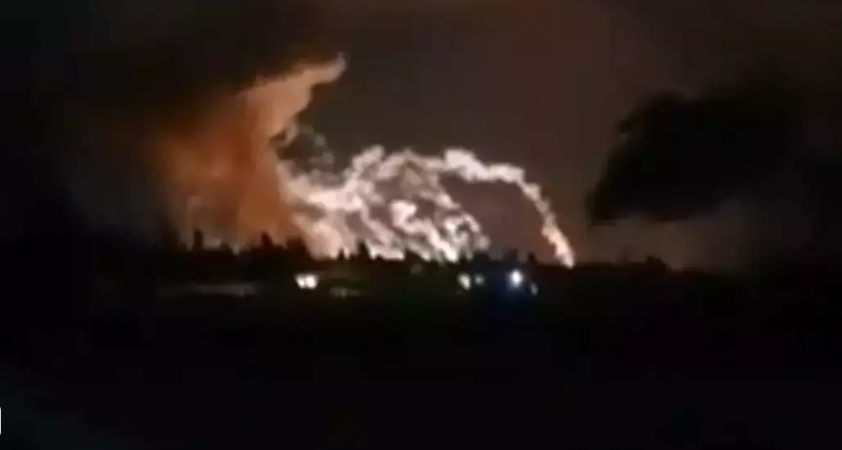
Israeli airstrikes late Monday into early Tuesday hit sites in and around the Syrian cities of Homs and Latakia, with additional blasts reported near Palmyra, according to Syrian state media and regional outlets. Damascus condemned the attacks as a violation of sovereignty and reported explosions and smoke near multiple military facilities.
An Israeli security source, speaking to a Saudi broadcaster, said the Homs attack targeted depots holding Turkish-made missiles and air-defense equipment. The source accused Turkey of “provoking” Israel and said Israel has been holding talks with Syria’s new leadership about security arrangements while reserving the right to use force. The claim that Turkish systems were present at the sites could not be independently verified.
Among the locations struck were the vicinity of the Syrian Air Defense College area near Homs and a barracks near Saqoubin, just north of Latakia. There were no immediate details on casualties or the full extent of damage. The Israel Defense Forces did not issue public comment at the time of publication.
Israel has conducted hundreds of strikes in Syria over the past decade to prevent what it describes as the buildup of advanced weaponry that could threaten its northern frontier. While earlier operations focused largely on Iranian-linked facilities and Syrian air bases, Israel broadened its campaign after the ouster of Bashar al-Assad in December 2024, targeting what it views as any post-war military buildup that could constrain its freedom of action. In the spring, Israeli strikes hit multiple Syrian air installations, including Hama military airport and the T-4 base near Homs, in what Israeli officials framed as efforts to eliminate remaining capabilities at those sites.
Turkey, a NATO member that backs Syria’s new authorities, has moved quickly since Assad’s fall to shape security along its southern border. Regional reporting in recent months has indicated that Turkish military teams inspected Syrian airfields such as T-4 and those near Palmyra—visits that, according to Israeli assessments, helped trigger earlier pre-emptive raids. Israel views the construction of new runways, depots, radar installations, and stockpiles of missiles or drones inside Syria as red lines regardless of the supplier.
Despite sharpening rhetoric over Gaza and Syria, Ankara and Tel Aviv have sought to avoid a direct confrontation. Officials on both sides have held technical talks to establish a deconfliction mechanism specific to Syria, with Azerbaijan acting as a mediator, according to regional diplomatic sources. Those contacts have not halted Israeli action: strikes have continued when Israel judges that new weapons or air-defense systems are being positioned in ways that might limit future operations.