
A newly submitted forensic report has cast serious doubt on the official story behind the 2015 killing of two police officers in the southeastern town of Ceylanpınar, a case long used by Ankara as the justification for ending peace talks with the outlawed Kurdistan Workers’ Party (PKK) and returning to full-scale military operations.
The report, added this month to the case file before Turkey’s Supreme Court of Appeals, links a fellow police officer to the crime scene through multiple fingerprints, contradicting his earlier testimony and reviving long-standing questions about how the investigation was conducted and why key leads appear to have been ignored.
A double murder that reshaped Turkish politics
On July 22, 2015, officers Feyyaz Yumuşak, from Şanlıurfa’s counterterrorism branch, and Okan Acar, from the riot police, were found shot dead in their beds in the apartment they shared in Ceylanpınar, a border town facing Syria. They were killed as they slept, reportedly with a silenced weapon.
The killings came just two days after a suicide bombing in the southern town of Suruç, where an Islamic State in Iraq and the Levant (ISIL) attacker killed 34 mostly young Kurdish and left-wing activists preparing to travel to the Syrian Kurdish town of Kobanê.
Within hours of the Ceylanpınar murders, the ruling Justice and Development Party (AKP) government, which had been negotiating with the PKK since 2013 in a peace process widely known as the “solution process,” publicly blamed the militant group. The attack was swiftly presented as proof that the PKK had abandoned dialogue and returned to violence.
The political consequences were immediate. Within days, Turkey launched intensive airstrikes on PKK bases in northern Iraq. Curfews, street battles and widespread destruction followed in predominantly Kurdish towns and districts across the southeast, marking the collapse of the 2013–2015 peace process and the beginning of a new phase of conflict.
The timing also intersected with a volatile electoral calendar. In the June 2015 general election, the AKP lost its parliamentary majority for the first time since coming to power in 2002, while the pro-Kurdish Peoples’ Democratic Party (HDP) entered parliament with a strong showing. As violence escalated in the wake of Ceylanpınar, then-prime minister Ahmet Davutoğlu argued that Turkey needed a single-party government to fight “terrorism.” In the snap election of November 2015, the AKP regained its majority amid a sharply securitized atmosphere.
Opposition figures and HDP politicians have long accused President Recep Tayyip Erdoğan and his government of leveraging the climate of fear and nationalism created by the renewed conflict to recover electoral dominance and tighten control over state institutions.
Fingerprints point to colleague who denied ever entering flat
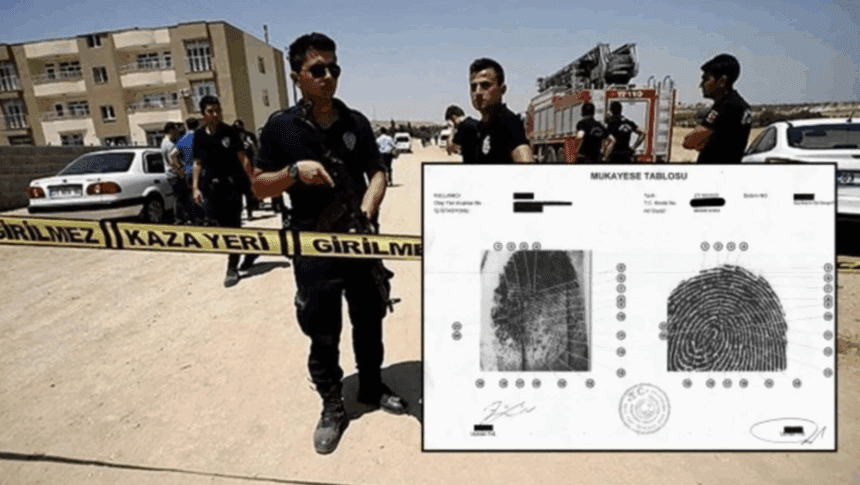
The new forensic report, compiled by the Police Forensic Investigation Department and submitted to the Supreme Court of Appeals on December 2, identifies a fingerprint labeled “L38” from the crime scene as belonging to officer Burak Kuru, a colleague of the slain policemen.
According to comparison tables attached to the report, five of the ten fingerprints lifted from the apartment match prints from Kuru, including the left little finger associated with “L38.”
This directly contradicts Kuru’s earlier testimony, in which he claimed that he had never entered the apartment the officers shared. Defence lawyers had requested the opportunity to question him in court, but those motions were rejected during the original trial.
At the time of the killings, the Şanlıurfa Governor’s Office publicly stated that there were no signs of forced entry into the flat, a detail that has always raised questions over whether the perpetrators were known to the victims or possessed their keys.
Kuru’s newly documented presence at the scene therefore amplifies several unresolved issues: why he was never treated as a central witness or suspect, why defence efforts to call him for questioning were blocked, and how his prints could appear in multiple locations inside a home he insisted he had never entered.
Trial collapsed, suspects acquitted — but no new suspects named
Despite the weight that the state placed on the Ceylanpınar killings as a turning point for national policy, the criminal case itself ended in failure. Ten Kurdish defendants with alleged PKK links were detained, seven of them held in pre-trial detention and later tried on charges that included membership in a terrorist organization and murder.
Human rights lawyers have long argued that the case relied heavily on disputed witness statements and thin circumstantial evidence, while significant forensic and digital leads were either mishandled or not pursued. In 2018, the Urfa 2nd High Criminal Court acquitted all nine remaining defendants for lack of evidence; in 2019, a regional appeals court upheld the acquittals.
Reports from the time highlighted serious irregularities: anonymous tips that could never be verified; phone-traffic analysis that was initially prepared by the anti-terror police and then destroyed without a copy being retained; and allegations that some of the suspects were tortured in custody.
Following those acquittals, no new suspects were formally charged. Until now, no one has been held criminally responsible for the murders of Yumuşak and Acar, even as the incident continued to be cited in official rhetoric as the moment that made renewed war “inevitable.”
Promotions, purges and a politicized investigation
The latest report’s emergence has also refocused attention on the trajectory of officials who played key roles in the original investigation.
Mezopotamya and other outlets report that the first prosecutor assigned to the case was promoted while still drafting the indictment and then transferred to the Ministry of Justice’s IT department, before later being elevated to first-class judge.
The judge who initially ordered the arrests, the prosecutor who attended the autopsies, and 22 police officers serving in Ceylanpınar at the time were later detained and dismissed from public service after the failed 2016 coup attempt, accused of ties to the faith-based Gülen movement.
These subsequent purges have reinforced suspicions among lawyers and rights advocates that the investigation into the Ceylanpınar murders was vulnerable to the broader power struggles within the Turkish state. For critics, the new forensic evidence strengthens the argument that the case was steered toward a politically expedient PKK narrative while other leads – including those involving state officials – were neglected.
New evidence in the shadow of a new peace process
Nearly a decade after the double murder, the Supreme Court of Appeals has had the Ceylanpınar file on its docket for almost six years. It is now expected to review the newly added forensic material, although it is unclear whether this will lead to a broader reopening of the case or a narrow procedural ruling.
The timing of the development is striking. Since late 2024, Turkey has been moving through a new, still-fragile peace process with the PKK. In October 2024, Devlet Bahçeli, leader of the far-right Nationalist Movement Party (MHP) and a key ally of President Erdoğan, unexpectedly called on imprisoned PKK leader Abdullah Öcalan to urge the group to disarm and even suggested that Öcalan could address parliament if he did so.
On February 27, 2025, Öcalan responded through a letter read out by deputies of the pro-Kurdish DEM Party, calling on the PKK to lay down its arms, dissolve itself and shift the struggle onto a purely political and legal track.
Days later, the PKK announced a unilateral ceasefire and said it would implement Öcalan’s call. On May 12, 2025, the group formally declared that it would disband and end more than four decades of armed struggle against Turkey, in a decision widely described as historic.
Subsequent reports have documented symbolic weapons-burning ceremonies in the Qandil mountains and the beginning of a structured process to collect and hand over arms.
Despite welcoming the PKK’s dissolution as a “critical threshold” toward a “terror-free Turkey,” the government has not yet defined a comprehensive framework for the reintegration of former fighters or addressed broader Kurdish demands, including easing Öcalan’s isolation and releasing thousands of political prisoners.
A test of political will and judicial independence
Against this backdrop, the unresolved Ceylanpınar murders have taken on renewed symbolic weight. The killings were a key pretext for ending the last peace process in 2015; today, they resurface just as Turkey is cautiously attempting another.
For the families of Yumuşak and Acar, the new fingerprint report offers both a glimmer of hope and a fresh source of frustration. It suggests that basic forensic work capable of contradicting a crucial witness statement was either not done at the time or not brought to light. At the same time, it remains unclear whether the judicial system will now be allowed to follow this evidence wherever it leads, including toward state actors.
For Kurdish political actors and rights advocates, what happens next in the Ceylanpınar file will be closely watched as an indicator of the sincerity of the new peace process. A serious, transparent investigation into the newly revealed link to officer Burak Kuru and into past investigative failures would signal a limited but important willingness to confront uncomfortable aspects of the state’s own role in the conflict years. A quiet shelving of the report, by contrast, would reinforce the belief that even in an era of disarmament and ceasefires, some of the most consequential episodes of the war will remain shielded from scrutiny.
The PKK remains officially listed as a terrorist organization by Turkey, the United States and the European Union, and the broader conflict has claimed at least 40,000 lives since the 1980s. as the Supreme Court weighs this new evidence, and as Ankara navigates an uncertain peace, the unanswered question of who killed two young policemen in a modest apartment in Ceylanpınar continues to cast a long shadow over Turkey’s search for a political settlement