
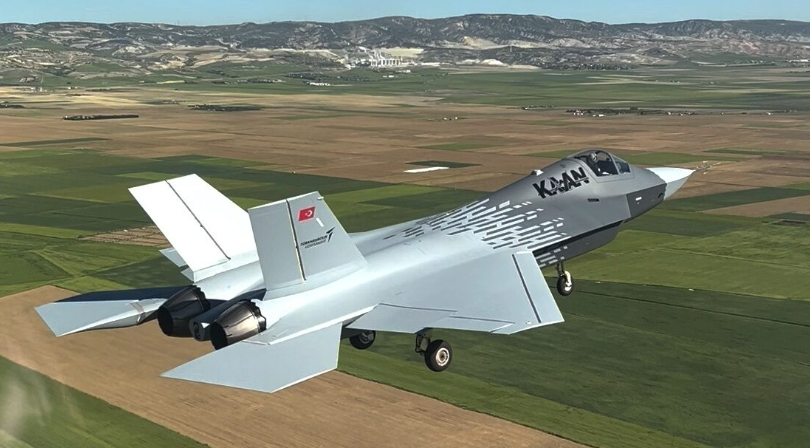
Turkey has taken delivery of the first 10 U.S.-made F110-GE-129E engines intended for its domestically developed fifth-generation KAAN fighter jet, but officials say the larger follow-on package—an additional 80 engines—remains stalled amid ongoing negotiations over U.S. export licenses. Defense Minister Yaşar Güler disclosed the details in a written response to parliament, saying the KAAN program is currently relying on the F110 engine through two subcontracts involving Turkish Aerospace Industries (TUSAŞ) and GE Aerospace, with the initial batch already delivered and a second contract still awaiting U.S. government approval.
The engine uncertainty is closely tied to the political and legal constraints that have shaped U.S.-Turkey defense cooperation since Ankara purchased the Russian-made S-400 air defense system. U.S. sanctions imposed under CAATSA in 2020 continue to cast a shadow over sensitive defense transfers, and Turkish officials have increasingly portrayed the KAAN engine licensing process as a congressional choke point. Foreign Minister Hakan Fidan said in late September that the licensing process was being held up in the U.S. Congress and warned that if restrictions persist, Turkey may be pushed to pursue alternative solutions.
Resistance on Capitol Hill remains strong. In recent months, groups of lawmakers have urged the State Department to maintain CAATSA measures, arguing that Turkey’s continued possession of the S-400 system is incompatible with sanctions relief. Lawmakers have also pointed to U.S. legal requirements that link any waiver to formal certification that Turkey no longer possesses the S-400, reinforcing the view that the fate of the 80-engine follow-on deal will be decided as much in Washington as in Ankara.
Turkey, meanwhile, is pressing ahead with its longer-term goal of an indigenous engine. Güler said Tusaş Engine Industries (TEI) selected its TF35000 concept in March 2024 for KAAN’s Block 30 and Block 40 variants, and that a preliminary design phase contract signed in August 2024 is scheduled to be completed in early 2026. Opposition lawmaker İlhami Özcan Aygun, who had submitted the parliamentary question, criticized the situation as a strategic vulnerability, arguing that Turkey’s production timeline is exposed to U.S. political decisions while the domestic engine remains in the early design stage. Ankara has said it aims to deliver the first KAAN aircraft to the Turkish Air Force by the end of 2028.