
Serbian President Aleksandar Vučić has once again placed Turkey at the center of rising tensions in the Western Balkans, accusing Ankara—alongside the United States—of supporting Kosovo’s military build-up in a way he says threatens Serbia’s territorial integrity. The remarks mark a sharp rhetorical shift from Vučić’s earlier public praise of Turkish President Recep Tayyip Erdoğan, including warm messages surrounding bilateral visits and personal birthday congratulations.
Speaking to foreign diplomats in Belgrade, Vučić claimed that Washington was “openly arming Albanians in Kosovo,” while Turkey was allegedly supplying “heavy weapons and other military elements.” According to the Serbian leader, the goal of these efforts was to undermine Serbia’s sovereignty and expose both civilians and security forces to direct risk. He also argued that a renewed international push was under way to expand recognition of Kosovo’s independence, singling out Turkey and Saudi Arabia as key backers of this alleged process.
The accusations come amid ongoing controversy over Kosovo’s efforts to modernize its security forces, including the acquisition of drones and other defense capabilities. While Kosovo has publicly acknowledged purchases of unmanned aerial systems from Turkey and the United States, Vučić’s claim that Ankara is delivering “heavy weapons” has not been independently substantiated in detail through publicly available sources, leaving a gap between political rhetoric and verifiable information.
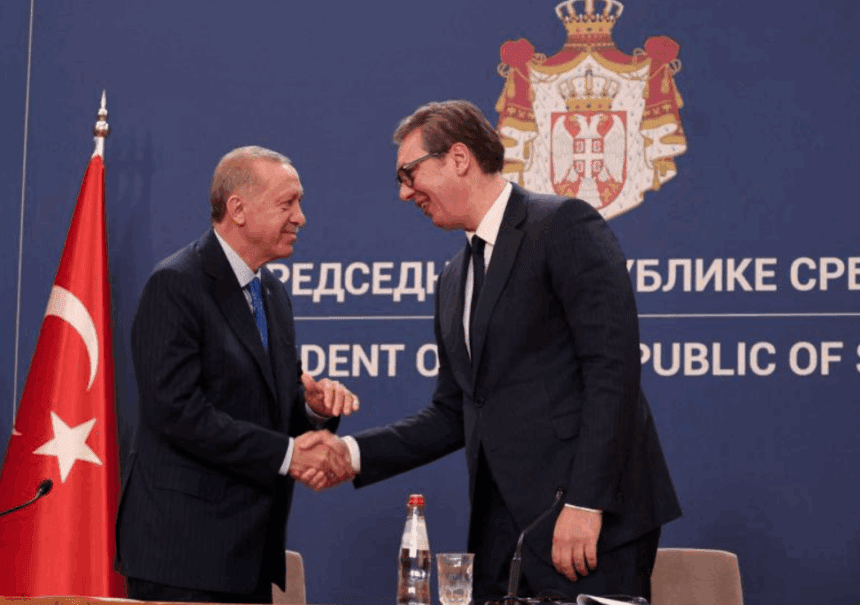
What makes Vučić’s latest statements particularly striking is how starkly they contrast with his earlier tone toward Turkey and Erdoğan. Over the past several years, Vučić has repeatedly emphasized the importance of strong relations with Ankara, describing Turkey as a vital regional partner and portraying Erdoğan as a leader with significant influence in maintaining stability in the Balkans. During Erdoğan’s visits to Serbia, Vučić publicly welcomed Turkish engagement, highlighting economic cooperation, infrastructure projects, and Ankara’s role as a regional power whose views Belgrade took seriously.
The personal dimension of this relationship has also been visible. Vučić has on multiple occasions sent birthday wishes to Erdoğan, praising his leadership and expressing hopes for continued cooperation between the two countries. These gestures were reciprocated, reinforcing an image of cordial ties at the highest political level despite deep disagreements over Kosovo, which Turkey recognized as independent in 2008—a decision Serbia continues to reject.
This duality has surfaced before. When Kosovo announced the delivery of Turkish-made loitering munitions and drones, Vučić initially responded with unusually harsh language toward Ankara, suggesting that such moves destabilized the region. Within days, however, his tone softened, and he reverted to emphasizing respect for Erdoğan and the need to preserve good bilateral relations, underscoring Serbia’s reluctance to jeopardize economic and diplomatic ties with Turkey.
Vučić’s current remarks suggest a return to a harder line, at least rhetorically, as Kosovo’s military modernization again becomes a focal point of regional anxiety. Analysts note that this oscillation between confrontation and conciliation reflects Belgrade’s broader balancing act: appealing to domestic audiences by framing Kosovo as an external security threat, while avoiding a full diplomatic rupture with Ankara, a country that holds economic, political, and symbolic weight in the Balkans.
As tensions rise once more, Vučić’s latest accusations underscore how the Kosovo issue continues to test Serbia’s relationships with key international actors. At the same time, the contrast with his past praise of Erdoğan highlights the fluid and often contradictory nature of Balkan diplomacy, where personal rapport, strategic interests, and unresolved sovereignty disputes collide.