

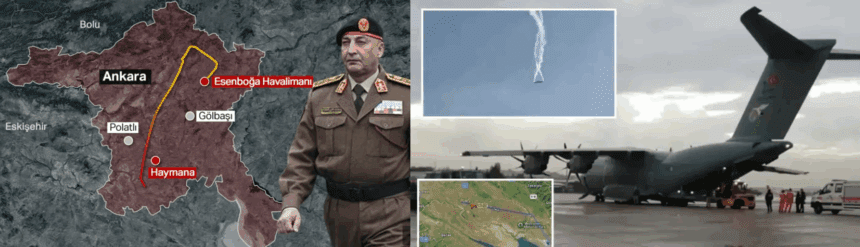
Turkey’s transport minister, Abdulkadir Uraloğlu, has disclosed new technical details from the investigation into the private jet crash near Haymana that killed a senior Libyan military delegation on December 23, 2025—including that cockpit audio has now been decoded in the United Kingdom, while the flight data recorder remains unreadable due to heavy damage.
Yet the unusually detailed public timeline offered for the Libyan crash has renewed criticism of Turkey’s information policy after its own deadlier military disaster: the November 11, 2025 crash of a Turkish Air Force Lockheed C-130 Hercules in Georgia that killed 20 personnel. On that case, officials said the black-box analysis and “initial findings” would take “at least two months”—a window that passed on January 17, 2026—but authorities have still not publicly released a comparable set of findings or a recorder-based readout.
The contrast is sharpened by the calendar. The Libyan jet went down 42 days after the C-130 disaster, yet it is the later crash that has produced the public narrative so far. (As of February 4, 2026, the C-130 crash is 85 days old; the Libyan jet crash is 43 days old.)
According to Uraloğlu’s account of the UK laboratory work, investigators were able to extract and fully decode cockpit voice recordings (CVR), revealing repeated crew discussions of cascading electrical failures. In the first minutes after takeoff, the crew reportedly stated that a generator had been disabled, followed seconds later by the loss of another; later exchanges referenced all generators being down before power partially returned.
Uraloğlu also described the flight’s communications sequence with air traffic control at Ankara Esenboğa Airport. He said the aircraft stayed in contact with the tower after the crew reported an electrical malfunction and requested to turn back, issuing a “PAN-PAN” call—one step below a “MAYDAY” in urgency—before systems failed more completely and controllers attempted increasingly manual forms of guidance. The plane ultimately crashed short of the airport near Haymana.
On the recorders themselves, Turkish officials say both devices were badly damaged, and that only a handful of countries have the capability to attempt recovery from such severe impact. Turkey and Libyan counterparts chose the UK for the work. However, there remains the missing flight-parameter stream: Uraloğlu said the flight data recorder (FDR) could not be decoded—described in Turkish coverage as “very old” and “heavily damaged”—meaning investigators may lack the second-by-second system and control inputs typically used to confirm (or falsify) cockpit recollections and reconstruct the final moments.
In most aviation investigations, cockpit audio without corresponding flight data can answer some questions—what crews believed was happening, what they tried, what alarms sounded—while leaving other questions stubbornly open, including which failures actually occurred, in what order, and whether instrumentation itself was compromised.
The scrutiny now falling on Ankara is less about whether investigators are working and more about why the government’s public communication looks so uneven between the two tragedies.
In the November crash, the Turkish military aircraft went down in Georgia while returning from Azerbaijan, killing 20 service members—described by Turkish and international reporting as Turkey’s deadliest military aviation incident in years. Defense Minister Yaşar Güler said the recorder analysis and initial findings would take “at least two months,” and that preliminary assessments suggested a structural failure sequence in which the tail section may have separated before the aircraft broke into multiple parts.