
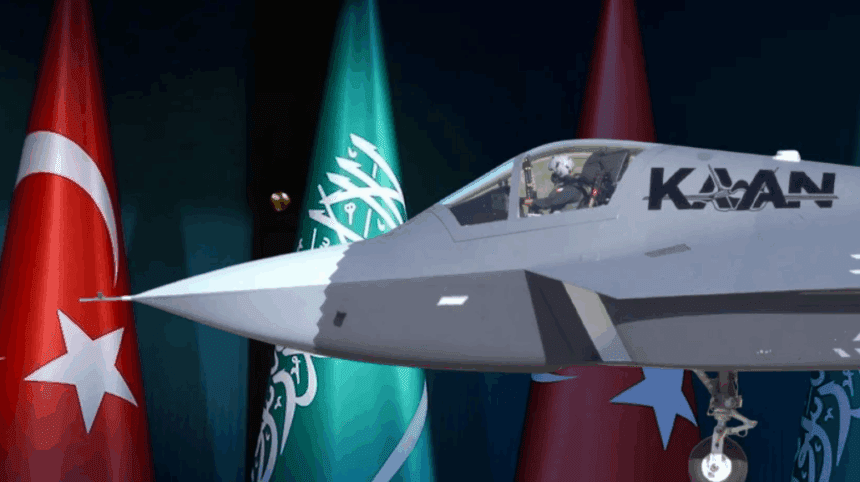
Recep Tayyip Erdoğan said Turkey and Saudi Arabia are discussing a possible joint investment in the KAAN fighter-jet program, signaling a further deepening of defense cooperation as the two countries also expand their economic partnership. The remarks were carried by the state-run Anadolu Agency and made during Erdoğan’s return flight after visits to Saudi Arabia and Egypt this week.
Speaking to journalists, Erdoğan said Ankara has received strong international interest in KAAN and suggested an investment partnership with Riyadh could be concluded quickly. He framed KAAN not only as a platform Turkey hopes to field and export, but also as a political symbol of the country’s defense-industrial ambitions.
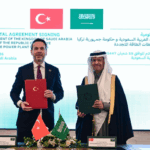
The comments followed talks in Riyadh with Mohammed bin Salman, where the two sides signed agreements and adopted a joint declaration covering several fields, including defense cooperation and investment. In parallel, a statement from the Turkish presidency said the leaders discussed raising cooperation in renewable energy and the defense industry, among other topics.
KAAN is Turkey’s flagship next-generation combat aircraft project led by Turkish Aerospace Industries. The TF-X initiative was launched in 2016, and the KAAN prototype completed its maiden flight on February 21, 2024—an early milestone in a program that Ankara says is intended to reduce reliance on foreign suppliers and eventually support exports. The aircraft currently flies with U.S.-made F110 engines from General Electric, and Turkey has described a goal of moving toward a domestically produced engine as the program advances toward serial production later in the decade.
For Riyadh, the interest comes as it continues efforts to modernize its air force. Saudi Arabia has long relied on U.S.-made aircraft—including F-15s—and has sought access to the stealthy U.S.-made F-35. On November 17, 2025, Donald Trump said the United States planned to approve the sale of F-35s to Saudi Arabia. A move is considered politically sensitive because Washington has historically managed F-35 sales in the region to maintain Israel’s “qualitative military edge.”
Neither side has published details on what a potential KAAN “joint investment” would look like in practice—whether it would involve direct financing, industrial participation, procurement commitments, or some combination. Still, any Saudi stake would be one of the most consequential foreign partnerships discussed publicly for Turkey’s fighter program, given the scale of the investment typically required for advanced combat aircraft development and production.
Erdoğan also used the trip to emphasize the broader economic track of the relationship. According to Turkish media, bilateral trade between Turkey and Saudi Arabia reached approximately $8 billion in 2025. Additionally, Turkish contractors have completed over 400 projects in Saudi Arabia, amounting to nearly $30 billion. These figures illustrate that the relationship has progressed beyond mere political normalization to encompass ongoing commercial engagement.
Energy cooperation was a prominent topic as well. On February 3, 2026, Alparslan Bayraktar of Turkey announced that Saudi Arabia would invest approximately $2 billion to construct two large solar power plants—one in Sivas and the other in Karaman. These plants will have a combined initial capacity of 2,000 megawatts, based on an agreement he signed with Saudi Energy Minister Prince Abdulaziz bin Salman. The broader plan envisions Saudi-backed solar and wind projects totaling 5,000 megawatts over time.
The defense relationship, meanwhile, has expanded in parallel with improved political ties. In July 2023, Saudi Arabia agreed to buy drones from Baykar, and Reuters reported that Haluk Bayraktar described the deal as the biggest defense and aviation export contract in Turkey’s history, though the value was not disclosed.
Taken together, the KAAN investment talks and the energy agreement illustrate how Ankara and Riyadh are trying to anchor their post-thaw relationship in long-horizon projects that blend strategic cooperation with industrial and investment ties—while leaving key details, timelines, and financing structures to be negotiated behind closed doors.