
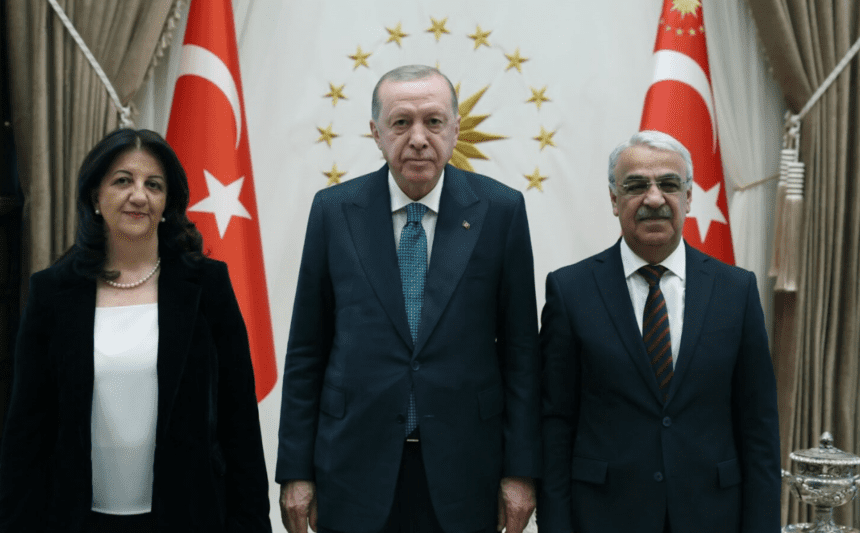
Members of Peoples’ Equality and Democracy Party (DEM Party) said they and Recep Tayyip Erdoğan reaffirmed a shared determination to keep a new peace initiative moving during talks in Ankara, and called on parliament, relevant ministries and public institutions to accelerate “concrete” and confidence-building steps tied to the process. The meeting was attended by İbrahim Kalın and Efkan Ala, according to official and party statements released afterward.
The delegation—Pervin Buldan and Mithat Sancar—is among the DEM figures authorized to visit Abdullah Öcalan, who has been held since 1999 at a prison on İmralı Island in the Sea of Marmara.
The current initiative has been framed by the government as a “terror-free Turkey” drive, while the DEM Party has described it as a “democratic society” process that should pair disarmament with legal and political reforms. It gained new momentum after Öcalan issued a public message on Feb. 27, 2025, calling on the Kurdistan Workers’ Party (PKK) to lay down its arms and disband—an appeal that DEM politicians delivered publicly after visiting him.
The meeting came as the Grand National Assembly of Turkey’s National Solidarity, Brotherhood and Democracy Commission moves toward finalizing a report expected to outline next steps. The draft of the commission’s final text has been circulated to political parties for review, with cross-party consultations expected before completion.
One of the most sensitive issues remains the “right to hope”—a shorthand used in European human-rights debates about whether aggravated life sentences must include a realistic possibility of review and release after a long period. In recent European Court case law, the European Court of Human Rights has emphasized that life sentences must be “reducible” in practice through a genuine review mechanism.
According to reporting on the commission’s work, the forthcoming parliamentary text is expected to avoid explicitly naming the “right to hope,” instead referencing broader principles and relevant European case law—an approach that could preserve political room to maneuver while leaving the core legal dispute unresolved.
The DEM Party has long argued that incorporating such a framework into Turkish law is essential to any durable settlement, including for Öcalan’s status, while critics and rights groups have questioned whether Ankara will match any disarmament steps with expanded rights protections, legal safeguards, and a wider political space for Kurdish politics.
Turkey and many Western states list the PKK as a terrorist organization, and the conflict—rooted in a decades-long insurgency—has cost tens of thousands of lives.