
ANKARA — Turkey’s parliament is set to vote on a draft report that lays out an ambitious package of legal and governance reforms tied to the disarmament and dissolution of the Kurdistan Workers’ Party (PKK), including a narrower approach to terrorism-related prosecutions, a restructuring of the state’s power to replace elected mayors, and a pathway for former militants to re-enter civilian life under judicial oversight.
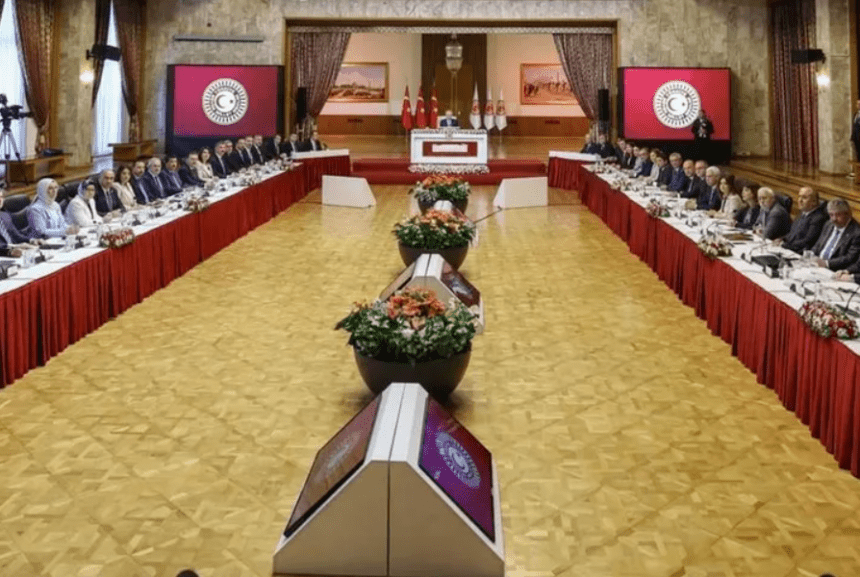
The document was prepared by a five-member drafting team representing all parties on the National Solidarity, Brotherhood and Democracy Commission and, according to accounts of the process, is scheduled for a vote in the commission this week. Numan Kurtulmuş, who chairs the body, met the drafting team over the weekend to finalize revisions before briefing representatives of smaller parties.
In structure and tone, the report reads as both a political narrative and a legislative “menu.” It is organized into seven sections that cover the commission’s work and stated objectives, a historical framing of Turkish–Kurdish coexistence, summaries of hearings, the PKK’s decision to disband, and a set of proposed legislative changes paired with broader democratization measures.
At its core, the draft seeks to link reform to sequencing: it argues that the next phase of the process should be anchored in law once state security institutions verify that the PKK has fully relinquished arms. Only then, it says, should a standalone, comprehensive statute be introduced—one designed not merely to manage immediate security risks, but to address the downstream legal and political consequences of the process and strengthen the ground for democratic politics.
A proposed reset on terrorism law and speech cases
One of the most consequential recommendations concerns the legal boundaries of “terrorism.” The draft calls for changes that would prevent the prosecution of non-violent acts as terrorist offenses and ensure that expression protected under freedom of speech is not treated as terrorism. It proposes revisions to the Turkish Penal Code and the Counterterrorism Law, emphasizing the principle of legal clarity.
In a similar vein, the text recommends reviewing media-related provisions so that opinion and criticism—so long as they do not cross into incitement—do not produce criminal liability. The underlying message is that a sustainable post-conflict framework requires legal predictability: rules that draw sharper lines between violence and non-violence, and between advocacy or criticism and direct calls to harm.
Ending trustee appointments and shifting power back to elected bodies
The draft also targets one of the most contested instruments in Turkey’s governance of Kurdish-majority municipalities: the practice of removing elected mayors and appointing government trustees in their place. The report recommends ending this approach and replacing it with an internal democratic mechanism: if a mayor is removed for any reason, the replacement should be selected by the city council through an election rather than appointed by the central government.
Supporters of the change argue it would protect electoral mandates and reduce the sense of collective punishment in provinces where municipal takeovers have become politically defining. Critics of the trustee system have long contended that the practice hollowed out local democracy; defenders have framed it as a security necessity. The draft’s proposal would not prevent investigations or removals, but it would shift the power of succession away from Ankara and back to locally elected bodies.
Prison, detention, and a push to align with court rulings
On criminal justice, the draft recommends revisiting sentence-enforcement legislation in light of rulings by the European Court of Human Rights and Turkey’s Constitutional Court. It calls for conditional release conditions to be made “fairer, more equitable and more comprehensive,” and urges a stricter approach to pretrial detention, framing detention as a measure of last resort rather than a default tool.
The report also recommends considering suspended sentences for sick and elderly prisoners, arguing that the right to life should take precedence over other rights. While couched in general terms, the set of proposals signals an attempt to reduce the scope of punitive pretrial practices and broaden humanitarian and proportionality considerations in sentencing and enforcement.
Reintegration without “impunity” or blanket amnesty
The draft’s approach to former PKK members is framed as reintegration with guardrails. It says individuals who laid down arms should be reintegrated into society and that those who did not commit crimes should be helped into civilian life. At the same time, it underlines that former members must still pass through a formal judicial process, and it warns that legal arrangements should not create a public perception of impunity or an across-the-board amnesty.
That balancing act—offering a viable civilian future while insisting on legal process—reflects a recurring tension in demobilization efforts: how to create incentives for disarmament without collapsing accountability, and how to distinguish between non-violent affiliation and direct involvement in violent acts. The draft does not spell out a detailed mechanism for categorization or review, but it signals that transparency and procedural fairness are intended to be central to implementation.
Öcalan: unspoken, but not absent
The report does not directly address the release of Abdullah Öcalan, who has been held on İmralı Island in the Marmara Sea since 1999 under an aggravated life sentence. Under current rules, that category of sentence for certain state-related crimes does not allow conditional release, making any “release pathway” politically and legally fraught.
Still, the document’s language on sentence enforcement—its broad emphasis on compliance with ECtHR and Constitutional Court jurisprudence—has been interpreted by political actors as indirectly encompassing debates around the so-called “right to hope,” the idea that even life sentences must include a realistic possibility of release after a sufficiently long period. Nationalist Movement Party (MHP) Deputy Chairman Feti Yıldız has previously suggested that the commission’s text would incorporate the concept through general references to European case law, even if not spelled out by name.
From the pro-Kurdish camp, Peoples’ Equality and Democracy Party (DEM Party) Co-chair Tuncer Bakırhan has argued that the peace initiative cannot be separated from Öcalan’s situation, contending that a settlement framework that leaves his status untouched would be politically untenable for a significant portion of society. The draft’s decision to keep the issue implicit rather than explicit appears aimed at preserving cross-party consensus in a commission that includes nationalist, conservative, and opposition representation.
The political context and competing criticisms
The commission was established after the PKK’s decision to disband, a development the draft places within a longer political arc that intensified in late 2024. That period included a widely remarked gesture by Devlet Bahçeli, whose outreach to DEM lawmakers was read as a signal that the ruling alliance was prepared to test a new track after the collapse of the earlier peace process in 2015.
The current effort also unfolds under the shadow of President Recep Tayyip Erdoğan’s domestic political calculus, with critics arguing that major reforms remain contingent on executive priorities and parliamentary arithmetic. The report itself acknowledges the need for a dedicated law after disarmament verification—an implicit admission that the commission’s work is advisory and that implementation would require sustained political will.
Opposition dynamics complicate the picture. The Republican People’s Party (CHP) has participated in commission sessions but has objected to what it describes as insufficient transparency around some elements of the broader process, including high-profile visits and contacts.
Another criticism raised by some lawmakers is about who is not covered. The draft contains no special provision for the tens of thousands of people prosecuted over alleged ties to the Gülen movement, the group inspired by late cleric Fethullah Gülen. The government’s post-2016 crackdown remains one of the largest and most enduring legal campaigns in modern Turkish politics, and some critics argue that selective reform—focused on one conflict file while leaving other mass-prosecution files untouched—could deepen perceptions of unequal justice.
Reflecting that concern, DEVA Party lawmaker İdris Şahin has warned that peace and stability cannot be built while “new victims” are left behind, urging that any recalibration of law and enforcement standards should be applied consistently.
What the draft signals—before any law is written
Even if approved by the commission, the report does not itself change statutes. Its significance lies in how far it goes in putting traditionally sensitive issues—terror definitions, speech prosecutions, municipal governance, and the post-disarmament legal horizon—into an official cross-party text. It frames disarmament not as an endpoint but as a trigger for a broader legal and political normalization package, while trying to preserve consensus by keeping the most polarizing question—Öcalan’s fate—largely in the realm of implication rather than explicit prescription.
Whether the recommendations translate into legislation, and how quickly, will depend on the sequencing the draft itself emphasizes: verification of disarmament, political bargaining over the scope of reforms, and the willingness of parliament to convert a blueprint into binding law.