
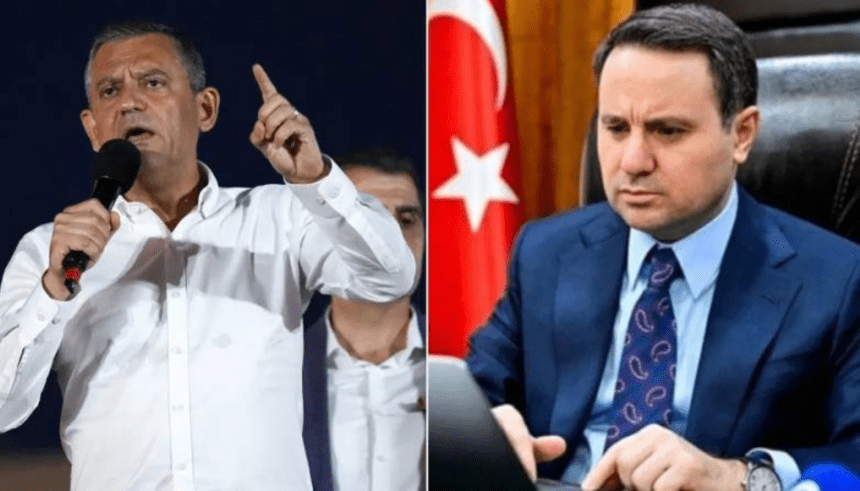
Akın Gürlek’s elevation from Istanbul’s chief public prosecutor to justice minister in mid-February 2026 intensified an already charged political climate, with opposition figures arguing the appointment deepened concerns about the relationship between politics and the judiciary.
Within days, CHP leader Özgür Özel chose to turn that tension into a public test of accountability. He said he had information about Gürlek’s assets and challenged the minister to disclose his wealth, pairing the accusation with a one-week deadline and a promise that, if Gürlek stayed silent, he would publish detailed property information himself. In Turkish politics, that kind of language is designed to do two things at once: force a response from the target, and signal to the public that the opposition is holding something concrete.
The deadline quickly became the story. By 23 February, attention had shifted to the next CHP parliamentary group meeting—held on Tuesdays—with expectations that Özel would use the platform to disclose Gürlek’s assets if the minister still offered no public statement. The anticipation was heightened by the stakes Özel had set for himself: he cited specific figures, claiming the list had fallen from “16 properties to 12,” and promised a detailed, registry-level reveal—“island by island, parcel by parcel.”
But when the group meeting arrived on 24 February, the anticipated reveal did not happen in the hall. Özel did not raise the assets issue during the session and, afterwards, told journalists that the deadline would expire “this evening” (Tuesday evening). On paper, that sounded like a minor adjustment—timing rather than substance—but politically it carried weight. A public ultimatum functions like a contract with the audience: once a leader starts a countdown, the moment it reaches zero is when people expect evidence, or at least a clear account of what will happen next. After that “this evening” remark, some also assumed Özel might instead unveil what he had at the Bakırköy rally on Thursday, 25 February. Yet Akın Gürlek was not mentioned there either.
The effect was predictable. Supporters who had been primed for documents were left waiting, while critics treated the pause as evidence that Özel’s rhetoric had outrun his delivery. Coverage sympathetic to the government moved quickly to frame the episode as a collapse of credibility, mocking Özel for failing to produce evidence after making a show of certainty. Özel’s earlier rhetoric was portrayed as “hype” and amplifying social-media nicknames meant to frame the episode as a political “fizzle-out.”
This is where the episode becomes more than a one-day communications stumble. The Gürlek deadline controversy landed on top of earlier arguments—inside and outside the opposition—about how Özel handles sensitive material and how he manages expectations.
In late December 2025, a separatedispute broke out after a dossier of documents alleging unexplained wealth and misconduct by Gürlek circulated among journalists. The leak triggered accusations that Özel had sat on explosive material and only moved once the story became unavoidable, while CHP figures responded that they pursued formal channels, including submitting a complaint and applications to oversight bodies. The central question was not only what the dossier contained, but whether the opposition leadership had been strategically cautious—or politically hesitant—until a leak forced its hand.
That earlier debate matters because it shaped how the February 2026 deadline was interpreted. When a leader is already being criticized for handling a file quietly, then announces a dramatic ultimatum and does not immediately follow through, observers tend to connect the dots. The story stops being “what is in the file?” and becomes “why does the handling of the file keep changing?”
A similar pattern surfaced in August 2025, when Özel fueled anticipation for what was billed as a major political “bombshell,” using language that suggested a decisive, watershed moment. When the disclosure arrived, however, it centered on an alleged extortion attempt tied to a single case—serious if substantiated, but narrower than the climate of expectation created by weeks of insinuation and high-stakes metaphors. Even among readers who viewed the allegation as significant, the gap between the scale of the buildup and the scope of the claim reinforced a recurring critique: that Özel at times markets the prospect of a systemic earthquake, only to deliver something closer to a contained episode.
Özel has faced a similar credibility question before. In July 2025, speaking about the Manavgat investigation, he claimed CHP had “32 hours of footage” and argued the “baklava box” episode had been planned “minute by minute,” presenting it as evidence of a staged setup. Yet there was no public release of that full footage accompanying the claim, and in mid-September 2025 he was still framing publication as something to be done later, saying he would broadcast the Manavgat images together with the indictment—arguing that releasing them earlier would allow prosecutors to shape the indictment around the visuals.
Özel later sharpened the Manavgat controversy into a direct challenge to President Erdoğan—“You air Gezi, I’ll air Manavgat”—but this challenge also revived an older, unresolved debate from the Gezi era itself. During the 2013 protests, Erdoğan repeatedly cited the Kabataş allegation that a headscarf-wearing woman had been attacked by a large group, described in contemporaneous accounts as bare-chested men with gloves and bandanas, and said the relevant footage was in hand and would be made public. Yet the promised “next Friday/soon” video release never materialized in the way those statements suggested, and when surveillance footage was later broadcast, it did not show the kind of assault being alleged. In other words, Özel’s “you publish, I publish” posture lands in a political culture where delayed or conditional video promises—especially around Gezi—have a long memory, and where audiences have learned to judge such claims by what is ultimately placed in the public record rather than what is previewed from the podium.
Seen together, the sequence highlights a strategic dilemma for any opposition leader operating under intense polarization and legal risk. There are credible reasons to be careful: documents may require verification, sources may need protection, and premature disclosure can invite counter-cases or be dismissed as misinformation. At the same time, caution has a political cost when it is paired with maximal certainty. When an opposition leader says, in effect, “I have the list,” sets a deadline, and promises a detailed reveal, the public naturally expects at least a minimum release of verifiable material at the chosen moment.
That is why “deadline politics” can backfire. A countdown is a powerful attention device, but it creates a single high-pressure point. If a leader does not deliver at that point, the focus shifts away from the allegation and toward the leader’s reliability. In the Gürlek case, the timeline quickly became the headline: first “one week,” then “tomorrow,” then “this evening,” then days of political argument about what was—or wasn’t—said.
The structural context makes this even more consequential. A government can often ride out inconsistency through agenda control and institutional power. An opposition leader has fewer levers; credibility becomes a core form of capital. That does not mean every claim must be fully published instantly. But it does mean the opposition must align tone, proof, and timing more tightly than a governing party typically needs to.
If Özel intends to keep pressing the Gürlek issue, the communication challenge is straightforward. He will either need to convert high-voltage rhetoric into a trackable public case—releasing a verifiable core, laying out a clear chronology, and regularly updating what has been submitted to which institutions—or he will need to moderate the “countdown” style that turns every promise into a credibility referendum. Otherwise, the cycle repeats: a strong signal produces peak anticipation, a delayed or partial landing produces disappointment, and the political conversation drifts from the underlying claim to the opposition leader’s follow-through.
In the end, the Gürlek file debate is not only about one minister’s assets or one party leader’s ultimatum. It is also a case study in how Turkish politics increasingly runs on expectation management. When the public is invited to watch a clock, the public expects something to happen when it hits zero.
By: News About Turkey (NAT)