

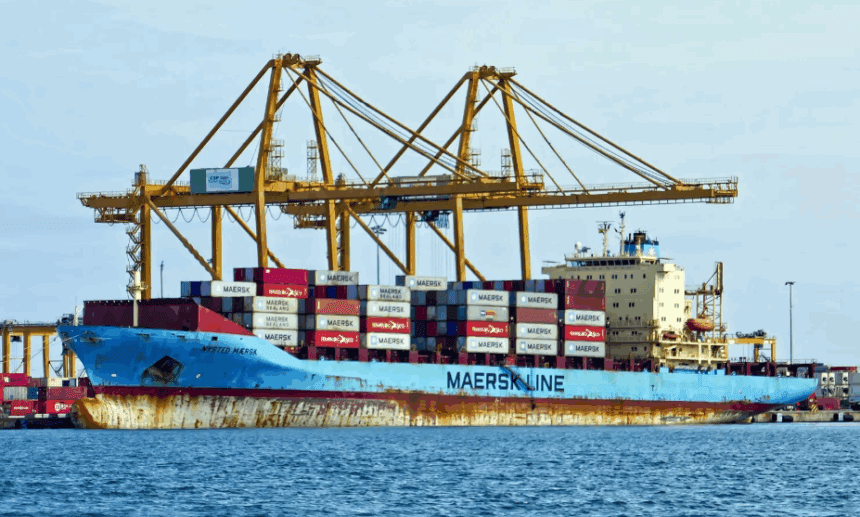
Ankara’s Aug. 29 announcement was pitched as a rupture—Foreign Minister Hakan Fidan told parliament that Turkish ports are closed to Israeli vessels, Turkish-flagged ships are barred from Israeli ports, and parts of the airspace are restricted. But the statement notably did not declare a blanket prohibition on all third-country traffic between Turkey and Israel, and officials supplied few concrete implementation details.
On the water, the gap is obvious. AIS logs show the Liberian-flagged ro-ro TRANS CARRIER departing İskenderun on Sept. 7 and arriving in Haifa on Sept. 8. Likewise, the Hong Kong-flagged Nysted Maersk left Mersin on Sept. 7 with published schedules indicating a Haifa ETA around Sept. 10. These are straightforward Turkey→Israel moves carried by non-Israeli, non-Turkish flags, contradicting the narrative of a shut lane.
Much of the “enforcement” has been informal and paper-based. In the days around the announcement, Turkish harbourmasters began asking agents for letters affirming that vessels have no Israeli affiliation and are not carrying military or hazardous cargo bound for Israel—requirements conveyed verbally, without an official nationwide circular at first, according to shipping sources and port notices. Protection-and-indemnity clubs subsequently circulated detailed restrictions, including bans on Israel-affiliated ownership/management regardless of flag and delivery-order paperwork checks such as BIMCO SHIPMAN documentation. This is policy via workaround, not a published, universally binding prohibition.
Carriers confirm the scope. Israel’s ZIM said it rerouted vessels after Turkey barred Israeli-affiliated ships from Turkish ports—i.e., the target is affiliation and flag, not the entire trade lane. That leaves a visible pathway for third-country tonnage to keep shuttling cargo between Mersin/İskenderun and Haifa.
Ankara frames the Aug. 29 step as part of a broader squeeze following the May 2024 suspension of direct Turkey–Israel trade—about $7 billion annually—pending a ceasefire and humanitarian access in Gaza. But the data points above show rerouting rather than a halt: Turkish exporters and foreign operators continue to exploit the regulatory seam the government left open. Even independent Turkish reporting has documented workarounds and continued sailings under non-Turkish, non-Israeli flags.
If Ankara intended an actual stop, it would publish a general, written ban on loading in Turkish ports for any Israeli discharge regardless of flag or ownership; hard-code HS-code controls and customs holds; and issue binding port circulars that foreclose “declaration” games and affiliations gymnastics. Instead, it has chosen a headline-heavy posture with discretionary enforcement that preserves plausible deniability—and Turkish exporters’ access to a lucrative lane—while claiming maximalist politics at home. The ships tell the real story.