
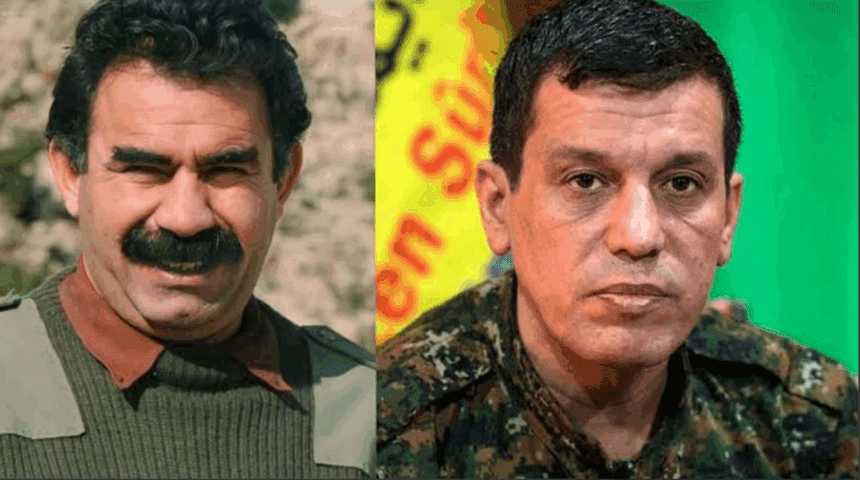
Abdullah Öcalan, the jailed founder of the Kurdistan Workers’ Party (PKK), has called for the implementation of a March 10 agreement aimed at integrating Syria’s Kurdish-led Syrian Democratic Forces (SDF) into Syria’s state institutions, describing the step as critical to preventing renewed fighting in Syria and supporting peace efforts in Turkey.
In a New Year’s message released via Turkey’s Peoples’ Equality and Democracy Party (DEM Party) on Tuesday, Öcalan said implementing the March 10 accord “will ease and accelerate the process” in Syria and urged Turkey to play a “facilitating, constructive, and dialogue-oriented” role.
The March 10 agreement was signed in Damascus by Syria’s interim President Ahmed al-Sharaa and SDF commander Mazloum Abdi, and outlined a roadmap to bring the SDF and the Kurdish-led civil administration in northeast Syria under the Syrian state by the end of 2025. The accord included provisions related to state authority over border crossings, airports, and energy sites, while also referencing Kurdish rights within Syria.
Pressure From Ankara And Damascus
Turkey and Syria’s interim authorities have publicly blamed delays on the SDF, arguing the group has been unwilling to advance integration and has attempted to revisit core terms.
Damascus on December 25 said talks had effectively stalled due to what it described as “unacceptable” SDF demands, signaling a hardening stance as the end-of-year deadline approached.
Turkey’s foreign minister, Hakan Fidan, has also escalated rhetoric in recent weeks. In a December 18 interview, he warned that patience among “relevant actors” was “running out,” while urging the SDF to honor the March 10 agreement “without any delay” and without “twisting” it—language that underscored Ankara’s insistence that the deal should not be reinterpreted or renegotiated.
Öcalan’s Message As A Signal To The SDF
Öcalan’s endorsement comes as Abdi has publicly signaled openness to direct contact with Öcalan and portrayed him as a potentially stabilizing interlocutor in easing tensions with Turkey.
In interviews published in late November, Abdi said the SDF had exchanged views with Öcalan through written messages and said he would like to visit Turkey to meet him, arguing that personal contact could help address issues tied to PKK-linked fighters in northern Syria.
Against that backdrop, Öcalan’s intervention is being read by observers as more than a general call for peace: it implicitly pressures the SDF leadership to stop stress-testing the agreement’s boundaries and move toward compliance at a moment when both Ankara and Damascus are tightening the political clock.
Nationalism, Sectarianism, And The “Democratic Society” Frame
In the same message, Öcalan portrayed nationalism and sectarianism as drivers of conflict in the Middle East and argued the region needs what he called a “Peace and Democratic Society” approach to avoid “irreparable consequences” from a new conflict. He said Kurdish rights could only be addressed through “social peace and democratic compromise,” not security-first policies.
He also linked peace to gender equality, arguing that “the liberation of society is impossible without the liberation of women,” and warned that male-dominated political culture reproduces violence—an extension of themes long present in PKK-adjacent ideological discourse.