
Many analysts are now arguing that President Recep Tayyip Erdoğan moved quickly through the administrative courts — especially in the diploma cancellation case — to prevent Ekrem İmamoğlu from running for president. İmamoğlu himself has made a similar argument.
After the Bölge İdare Mahkemesi (Regional Administrative Court / administrative appeals court) rejected his appeal yesterday, İmamoğlu reportedly pointed to the unusual speed of the process. In his courtroom statement, he said it was almost unheard of for an appeal court to decide such a politically sensitive case in only three weeks. He contrasted this with the “ahmak” case (“fool” case / criminal insult case), which he said had been kept waiting for nearly three years. According to İmamoğlu, such speed raised the question of whether some actors were preparing for an early election and rushing to make sure he could not become a candidate.
This argument is understandable. But it is also incomplete.
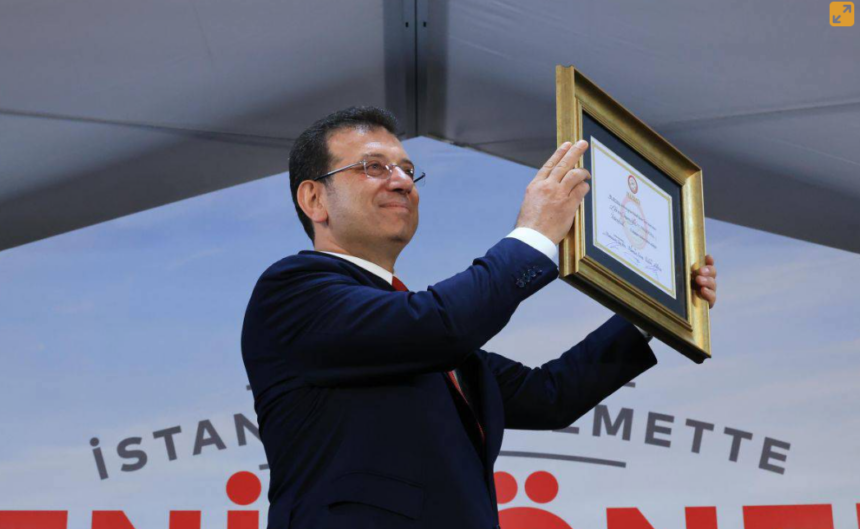
The diploma case matters because Turkey requires presidential candidates to have completed higher education. Istanbul University annulled İmamoğlu’s diploma in March 2025, and Reuters reported at the time that, if upheld, the cancellation would disqualify him from running for president because candidates must hold a university degree. More recently, the İstanbul Bölge İdare Mahkemesi 7. İdari Dava Dairesi (Istanbul Regional Administrative Court, 7th Administrative Case Chamber) rejected İmamoğlu’s appeal and stated that the file could still be taken to Danıştay (Council of State / Turkey’s highest administrative court) within 30 days of notification.
For that reason, many Turkish analysts, journalists, and opposition figures see the diploma case as Erdoğan’s quickest and most practical route to block İmamoğlu’s presidential candidacy. Their reasoning is straightforward: large criminal files involving corruption, terrorism, espionage, or organized crime can take years before producing a final and legally enforceable judgment. By contrast, an administrative dispute over a diploma can move more quickly and create a direct technical barrier to candidacy: without a valid university degree, İmamoğlu cannot run for president.
But that interpretation has one major weakness: the speed of the administrative decision does not necessarily prove that Erdoğan is preparing an early election.
Administrative cases generally move faster than major criminal proceedings. A diploma cancellation case, even when politically explosive, does not require the same long evidentiary process as corruption, terrorism, espionage, or organized crime trials. Therefore, the speed of the administrative process should not be treated as the only sign of a special acceleration campaign.
Erdoğan could move toward an early election even without waiting for the diploma case to be finalized by Danıştay. The reason is that another file is already much closer to producing a final political result: the “ahmak” case (“fool” case / criminal insult case), which is now before Yargıtay (Court of Cassation / Turkey’s top criminal appeals court).
In that case, İmamoğlu was sentenced in 2022 and given a political ban. In September 2025, the appeals court upheld the prison sentence and political ban. If Yargıtay also upholds the ruling, İmamoğlu could be sidelined from political life before the next presidential election.
This is the point many analyses miss.
The diploma cancellation case (administrative law case over İmamoğlu’s university degree) can say: you do not meet the educational requirement to run for president.
The “ahmak” case (“fool” case / criminal insult case) can say: you are politically banned.
That distinction is crucial. The first route targets İmamoğlu’s presidential eligibility. The second route is broader because it strikes at his political rights and his ability to hold elected office.
In other words, the diploma case can block the road to the presidency. The “ahmak” case can close the political road itself.
This is why İmamoğlu’s own interpretation should be taken seriously, but not treated as the whole story. He is right to question why the administrative appeal moved with such unusual speed. He is also right to ask why a politically explosive file was handled so quickly when other cases have waited for years. But the conclusion that this speed necessarily proves an imminent early election is less convincing.
A more accurate reading is that Erdoğan may already have several legal mechanisms available if he decides to move toward an early election.
The first mechanism is administrative: the İdare Mahkemesi (Administrative Court of First Instance), the Bölge İdare Mahkemesi (Regional Administrative Court), and finally Danıştay (Council of State) can create a technical eligibility barrier through the diploma case.
The second mechanism is criminal: the “ahmak” case is already before Yargıtay. If the political ban is confirmed there, Erdoğan’s camp would not need to wait for the larger criminal prosecutions to finish.
The third mechanism is long-term pressure: the broader corruption and terrorism-related proceedings keep İmamoğlu politically and legally trapped, even if they do not reach final judgment quickly.
This broader picture matters more than the narrow question of whether the administrative courts moved quickly because Erdoğan wants an early election.
Early election calculations may indeed be part of the political atmosphere. CHP leader Özgür Özel has argued that Erdoğan may seek an early election, possibly in 2027, because an early vote could help Erdoğan run again, while waiting until the scheduled 2028 election could create constitutional obstacles for his candidacy.
But even if Erdoğan has early election calculations, he does not necessarily need the administrative judiciary to finish the job first. Yargıtay can act at any time in the “ahmak” case. If it upholds the ruling, the political ban could become final, and that alone will be enough to remove İmamoğlu from the race.
Therefore, the real question is not simply: Did Erdoğan rush the diploma case because he wants early elections?
The deeper question is this: Is İmamoğlu being surrounded by multiple legal tracks, each moving at a different speed, but all pointing toward the same political result?
One track runs through administrative law: the diploma cancellation, the Bölge İdare Mahkemesi (Regional Administrative Court), and Danıştay (Council of State).
Another track runs through criminal law: conviction, appeal, and Yargıtay (Court of Cassation).
A third track runs through sprawling criminal prosecutions: corruption, terrorism, espionage, and organized crime allegations that may take years but keep İmamoğlu under constant legal pressure.
This is not merely a race between courts. It is a legal encirclement.
That is why opposition commentators and İmamoğlu himself should avoid framing the issue too narrowly. The diploma case is serious, and the speed of the administrative appeal decision is politically significant. But focusing only on the diploma file may unintentionally obscure the danger already waiting at Yargıtay.
Danıştay may decide the fate of İmamoğlu’s diploma.
But Yargıtay may decide the fate of his political rights.
And if Yargıtay moves before Danıştay, the whole debate over whether the diploma process was rushed for an early election may become secondary. The political ban in the “ahmak” case (“fool” case / criminal insult case) could do the job on its own.
So yes, Erdoğan may have an early election calculation. Yes, the diploma case may be part of that calculation. And yes, İmamoğlu is justified in questioning why the administrative judiciary acted with such unusual speed.
But the more dangerous reality is this: Erdoğan does not need to rely on one court, one case, or one legal theory.
If an early election becomes politically useful, the tools to block İmamoğlu are already on the table. The diploma case is only one of them. The “ahmak” case at Yargıtay may be the sharper one.
By: News About Turkey (NAT)