
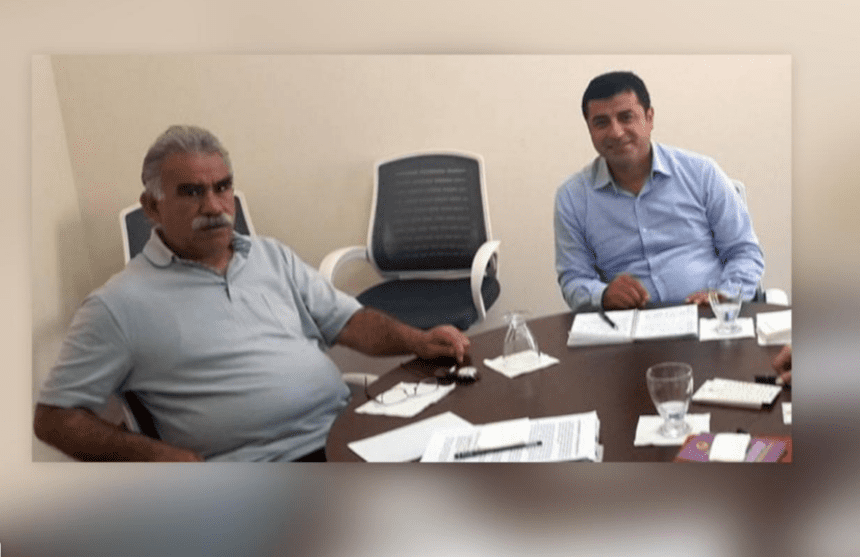
A disputed set of alleged prison-island meeting notes has opened a new debate over Abdullah Öcalan’s effort to reassert himself as the sole authority in Turkey’s renewed Kurdish process — this time by targeting Selahattin Demirtaş, one of the most influential civilian Kurdish political figures in the country.
The alleged notes, first published by journalist Mahmut Oral and later removed after objections from the pro-Kurdish People’s Equality and Democracy Party, include unusually harsh remarks attributed to Öcalan about Demirtaş, the imprisoned former co-chair of the Peoples’ Democratic Party. According to the text, Öcalan said Demirtaş must either contribute to the process or “shut his mouth,” adding that if Demirtaş does not do so, “I will shut it for him.” He was also quoted as asking whether Demirtaş does not know that “the chief negotiator is me.”
If accurate, the remarks are more than a personal insult. They point to a struggle over leadership inside Kurdish politics at a time when the Turkish state and its nationalist allies are seeking to manage the final phase of the PKK’s reported disarmament and dissolution.
Demirtaş has been in prison since 2016, but he still carries significant political weight. His appeal extends beyond the Kurdish electorate and reaches parts of Turkey’s wider opposition. For this reason, Öcalan’s alleged warning appears to draw a sharp line: civilian Kurdish politicians may participate in the process, but they should not challenge Öcalan’s authority as the main negotiator.
The timing of the alleged remarks is especially important because Devlet Bahçeli, leader of the Nationalist Movement Party, has openly argued that Öcalan’s influence over the PKK should be preserved and even increased in a new form. In an interview published on May 18, 2026, Bahçeli said a structure should be created so Öcalan could continue exercising influence over the dissolved PKK and help guide the organization’s final disarmament.
Bahçeli proposed that Öcalan could be given a limited role as a “Peace Process and Political Transition Coordinator,” while remaining in prison. He said this role would not mean recognizing Öcalan as the political representative of Kurds or as an advocate of ethnic rights, but rather as a temporary mechanism to ensure the PKK and its affiliated structures fully lay down arms.
This gives Öcalan’s alleged words to Demirtaş a much sharper meaning. Bahçeli is calling for Öcalan’s influence over the PKK to be institutionalized, while Öcalan is allegedly warning Demirtaş not to act as an alternative center of political authority. In practical terms, both messages point in the same direction: the process should be controlled through Öcalan, not through competing Kurdish political figures.
Bahçeli’s proposal aimed at placing Öcalan’s continued influence over the PKK at the center of the next phase of the process. Bahçeli framed the idea as a way to prevent fragmentation, delays, splinter groups, or foreign interference during the disarmament stage.
That context makes the alleged Demirtaş warning politically explosive. Öcalan appears to be saying that there is no room for a second Kurdish leadership line. Demirtaş may remain popular among voters, and the pro-Kurdish party may continue to operate in legal politics, but the alleged message from Öcalan is clear: the negotiations belong to him.
The disputed leak also created its own controversy. After publishing the alleged notes, Mahmut Oral removed the report and later announced that he had resigned from his position as editor-in-chief of the agency. He said he no longer had any organic connection with the outlet that had published the material.
The authenticity of the notes remains contested, and the pro-Kurdish party has objected to the publication. Still, the political message carried by the alleged text has already shaped the debate. At the very moment when Bahçeli is proposing to expand Öcalan’s role over the PKK, Öcalan is allegedly trying to discipline Demirtaş and prevent him from becoming an alternative voice in the process.
The result is a revealing picture of Turkey’s new Kurdish process. It is not only about disarmament, legal reforms, or the future of the PKK. It is also about who has the authority to speak, negotiate, and decide. In the alleged notes, Öcalan’s answer is blunt: Demirtaş must either support the process under his leadership — or remain silent.