

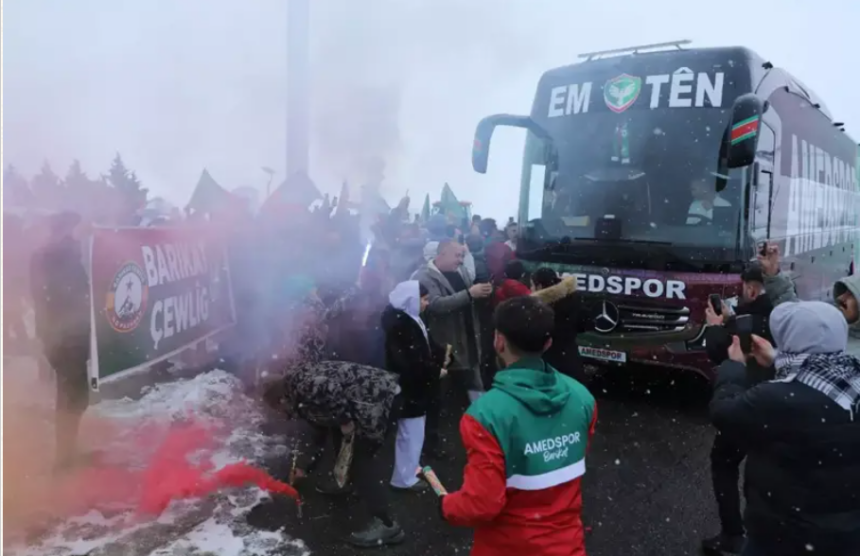
From the lower divisions to second place in Turkey’s Süper Lig, Amedspor has become a remarkable sporting success and a source of collective pride for millions of Kurds. Yet the troubled history of Diyarbakırspor offers a warning: whether Amedspor can develop into an enduring institution comparable to Barcelona may depend not only on football, but also on the fate of Turkey’s renewed Kurdish peace process.
November 7, 2026 | Opinion
When Amedspor faced Galatasaray in Istanbul on Saturday, it was not simply another encounter between a newly promoted club and one of Turkey’s football giants. It was a confrontation that would have seemed almost unimaginable only a year earlier: a team from Diyarbakır, long associated with the lower divisions, challenging the country’s most successful club as its closest rival at the top of the Süper Lig.
Galatasaray eventually won 4–3, but the scoreline concealed a remarkable contest.
Trailing 3–0 after 59 minutes, Amedspor responded with two goals in three minutes, threatening an extraordinary comeback. Galatasaray restored its two-goal advantage in the 80th minute, only for Amedspor to score again in stoppage time.
The Diyarbakır club left Istanbul without points, but hardly without pride.
After eleven rounds of the 2026–27 season, Amedspor remains second with 23 points, having recorded seven victories, two draws and two defeats. It sits above Trabzonspor, Beşiktaş and Fenerbahçe in the provisional standings, although those clubs have each played one fewer match.
Having already defeated Trabzonspor 2–1 and Beşiktaş 3–2, Amedspor has demonstrated that its remarkable opening season is more than a passing surprise.
For decades, Turkish football has largely revolved around four established powers: Galatasaray, Fenerbahçe, Beşiktaş and Trabzonspor. Amedspor’s presence near the summit challenges that familiar hierarchy.
Yet its greatest achievement may have little to do with league standings.
The club is increasingly becoming a unifying symbol for Kurdish communities across Turkey and Europe, raising a question that goes beyond football: Can Amedspor become for Turkey’s Kurds what FC Barcelona has long represented for Catalans?
From Diyarbakır to the Wider Kurdish World
Amedspor is rooted in Diyarbakır, but its growing popularity extends far beyond the city.
Across Kurdish-majority provinces such as Van, Batman, Mardin, Şırnak, Hakkâri, Muş and Ağrı, the club has attracted supporters who often remain passionately loyal to their own local teams.
Vanspor, Batman Petrolspor, Mardin 1969 Spor and other regional clubs maintain distinct histories, identities and traditions. Their supporters do not necessarily abandon those loyalties when they embrace Amedspor.
Instead, a new form of overlapping allegiance is emerging.
A supporter from Van may consider Vanspor his hometown team while celebrating Amedspor’s victories in the Süper Lig. The same applies to fans from Batman, Mardin and other cities.
Nor is this phenomenon confined to regional clubs.
For generations, millions of Kurds have supported Galatasaray, Fenerbahçe or Beşiktaş, often inheriting those allegiances through family traditions. Many continue to follow these clubs while developing a separate emotional attachment to Amedspor.
The distinction is significant. Supporting an Istanbul giant may reflect sporting tradition or family loyalty. Supporting Amedspor may also express a sense of Kurdish cultural belonging.
Research published in August 2026 by the Kurdish Studies Center and Rawest Research demonstrates the scale of this transformation.
Based on face-to-face interviews with 1,471 Kurdish respondents across 19 Turkish provinces, the study found that 9 percent identified Amedspor as their first team and another 23 percent as their second. The researchers estimated that these figures represented approximately four million Kurdish adults nationwide, four times the estimated number several years earlier.
The findings reveal something more profound than ordinary football popularity.
Some 38 percent of respondents regarded Amedspor primarily as a symbol of identity, while another 38 percent considered it both a football club and a representative of cultural identity. Only 24 percent viewed it solely as a football team.
Yet local loyalties remain important: when asked whom they would support if Amedspor faced their hometown club, 39 percent favoured their local team, compared with roughly one-quarter who preferred Amedspor.
This tension is not necessarily a weakness. It illustrates how Kurdish football supporters can maintain multiple allegiances rather than forming a single, uniform fan base.
Amedspor’s appeal also crosses political and geographical boundaries.
Kurds living in Istanbul, Ankara, İzmir, Mersin and other western Turkish cities follow the club, while communities in Germany, France, Belgium, the Netherlands, Sweden and elsewhere increasingly identify with its success.
For the diaspora, Amedspor provides an accessible connection to cultural heritage, particularly for younger generations raised outside Turkey.
The atmosphere inside Diyarbakır Stadium reflects this extraordinary enthusiasm. During the opening six weeks of the season, its reported occupancy rate reached approximately 97 percent, the highest in the Süper Lig at that stage.
The stadium has become more than a sporting venue. It offers a public space where Kurdish songs, language and collective celebration are prominently visible.
Amedspor has thereby achieved something important: it has created a shared source of joy and achievement in a community whose public history has so often been defined by conflict, political exclusion and unresolved grievances.
Why the Barcelona Comparison Matters
FC Barcelona’s significance to Catalan society has never been confined to sporting success.
Under Francisco Franco’s dictatorship, when Catalan language and cultural expression faced severe restrictions, Barcelona became an important institution through which collective identity could be expressed.
Its famous motto, Més que un club—more than a club—captures this historical relationship.
Barcelona represents a city, but its emotional reach extends throughout Catalonia and among Catalan communities abroad. Its sporting achievements have helped sustain a cultural identity that transcends geographical boundaries.
Amedspor is developing a comparable relationship with Kurdish supporters.
Its name, derived from the Kurdish name for Diyarbakır, carries particular significance. So do its Kurdish-language communications, the songs heard in its stands and the widespread identification of its victories with Kurdish pride.
Nevertheless, the comparison has limits.
Barcelona possesses more than a century of institutional development, a global commercial presence, major European trophies, a renowned youth academy and a distinctive membership-based governance tradition.
Amedspor is only beginning its journey in Turkey’s highest division.
The political circumstances of Catalonia and Turkey’s Kurdish population are also different. Barcelona’s history cannot simply be transplanted into the Kurdish question.
The analogy is most persuasive not as a comparison of sporting achievements or political objectives, but as an illustration of how football can become an enduring expression of cultural identity.
Whether Amedspor can achieve that institutional longevity is another matter.
And the history of Diyarbakırspor offers a particularly revealing warning.
Diyarbakırspor: Football’s Troubled Relationship With the Kurdish Question
Long before Amedspor captured national attention, Diyarbakırspor was the city’s principal football institution.
Founded in 1968, the club first reached Turkey’s highest division in 1977 after an extraordinary rise through the lower leagues. It experienced several subsequent promotions, but those of 2001 and 2009 are particularly relevant to the changing political climate surrounding the Kurdish question.
Diyarbakırspor’s 2001 promotion followed the relative reduction in armed conflict after the PKK’s 1999 ceasefire announcement.
It was a period of cautious political optimism, although no formal peace process comparable to later initiatives had yet emerged. The promotion was celebrated widely, and the club remained in the top division for five consecutive seasons before relegation in 2006.
Its return in 2009 coincided with the government’s Kurdish Opening, also known as the Democratic Opening, which sought to address aspects of the Kurdish question through political engagement and reform.
Once again, football appeared to offer an opportunity for greater Kurdish visibility within Turkish national life.
But the optimism proved fragile.
During the 2009–10 season, Diyarbakırspor encountered intense tensions around certain fixtures, particularly against Bursaspor. Nationalist hostility, crowd disorder and disciplinary controversies overshadowed its campaign.
The return match against Bursaspor in Diyarbakır was abandoned in March 2010, with the Turkish Football Federation subsequently awarding the visitors a 3–0 victory.
Diyarbakırspor was relegated at the end of the season. Financial difficulties, administrative weaknesses and accumulated debts subsequently accelerated its decline.
Its collapse cannot be attributed solely to politics. Poor management and sporting problems played significant roles, and its relegation preceded the more decisive deterioration of the Kurdish Opening in 2011.
Nevertheless, the episode demonstrated how a football club associated with a politically sensitive regional identity could become exposed to broader nationalist tensions.
The experience is particularly relevant because Amedspor and Diyarbakırspor are separate institutions, despite their shared association with Diyarbakır.
Amedspor emerged from a different organizational history. Its adoption of the name Amedspor in October 2014 occurred during the separate 2013–15 peace process.
The decision soon generated controversy. In January 2015, the Turkish Football Federation imposed a fine because the club had used a name and emblem different from those formally registered with the federation.
After the collapse of the peace process in 2015, Amedspor faced further controversies, disciplinary sanctions and hostility at some away matches, including documented attacks against players and supporters.
Yet the club survived these difficulties and continued its rise.
The contrast with Diyarbakırspor is important. Amedspor’s current success demonstrates greater sporting momentum and an expanding support base, but it does not automatically guarantee protection from the political pressures that affected its predecessor.
Amedspor’s Rise and Turkey’s Renewed Peace Process
The timing of Amedspor’s promotion is politically significant.
On May 2, 2026, the club secured promotion to the Süper Lig for the first time after drawing 3–3 with Iğdır FK and finishing second in the TFF First League.
Its achievement coincided with renewed efforts to resolve the decades-long conflict between the Turkish state and the PKK.
The new initiative gained momentum following Abdullah Öcalan’s February 2025 call for disarmament and the subsequent steps taken toward ending the armed conflict.
On August 10, 2026, Turkey’s parliament adopted a framework law addressing the legal arrangements necessary for disarmament and the possible reintegration of former PKK members.
Three days later, President Recep Tayyip Erdoğan received representatives of Amedspor, Erzurumspor and Çorum FK at the Presidential Complex in Ankara.
The reception was officially organized for all three newly promoted Süper Lig clubs, not specifically for Amedspor. Nevertheless, the public recognition of a club whose Kurdish identity had previously attracted controversy carried symbolic significance.
On the same day, Erdoğan separately received families of security personnel killed in the conflict and military veterans, emphasizing national unity, the sacrifices made during decades of violence and the government’s commitment to security.
These encounters illustrated the competing sensitivities surrounding the current peace initiative.
Ankara is attempting to advance a process of conflict resolution while reassuring nationalist constituencies, security institutions and families directly affected by the conflict.
Amedspor’s growing visibility forms part of this changing political atmosphere.
But a crucial distinction must be maintained: political normalization may create more favourable conditions for a club to operate, but it does not manufacture victories.
Amedspor’s promotion and impressive start in the Süper Lig reflect sporting achievement, professional preparation and the efforts of players, coaches and administrators.
What politics may influence is the environment in which those achievements can be sustained.
The Risks of Becoming a Political Symbol
Amedspor’s cultural significance brings opportunities, but also vulnerabilities.
Its association with Kurdish identity has attracted widespread support, yet it has also exposed the club to controversies that other football institutions may not encounter in the same way.
There are competing interpretations of its growing prominence.
One sees Amedspor as a possible bridge between Turkish and Kurdish communities, creating opportunities for social interaction and a more inclusive public culture.
Another warns that political actors could seek to instrumentalize its popularity, turning sporting success into a symbol serving agendas beyond the club’s control.
Both concerns underline the importance of institutional independence.
Amedspor’s identity should not be reduced to any single political party or movement. Nor should its cultural symbolism eclipse its sporting responsibilities.
Its long-term ambitions require sustainable finances, transparent governance, a professional management structure and investment in youth development.
A strong football academy could provide opportunities for talented young players from Diyarbakır and neighbouring provinces, while commercial partnerships and an expanding diaspora audience could support financial stability.
Equally important is preserving the club’s grassroots character. If Amedspor becomes inaccessible to ordinary supporters or dependent on political patrons, it risks weakening the very connection that makes it distinctive.
Its Kurdish identity need not prevent it from welcoming Turkish, Arab, Armenian, Syriac or other players and supporters.
Barcelona offers a relevant lesson here: a football institution can remain closely associated with a particular culture while becoming internationally recognized and inclusive.
But even the strongest management cannot entirely eliminate the effects of a deteriorating political environment.
The Peace Process and the Future of the Barcelona Dream
Turkey’s earlier attempts at resolving the Kurdish question provide reasons for both hope and caution.
The 2009 Kurdish Opening eventually faltered. The separate 2013–15 peace process collapsed amid renewed armed conflict and political polarization.
If the current initiative encounters a similar fate, Amedspor may face renewed pressures unrelated to its performances on the pitch.
The risks are not necessarily confined to formal government decisions. Nationalist hostility at away matches, disputes over Kurdish cultural expressions, inconsistent disciplinary treatment and the withdrawal of commercial support could all complicate the club’s development.
Conversely, a durable peace accompanied by broader cultural recognition and consistent institutional protections could create conditions in which Amedspor develops into a stable, internationally respected sporting institution.
This does not mean that Amedspor’s future should depend on peace negotiations.
On the contrary, the ability of a club openly associated with Kurdish identity to compete freely and receive equal treatment regardless of the political climate would itself be an important measure of democratic normalization.
Amedspor’s experience will therefore test something larger than the success of a football team.
It will test whether Turkey can accommodate a prominent expression of Kurdish cultural identity as a lasting part of its national sporting life, rather than treating it differently according to changing political circumstances.
More Than a Club—and a Test for Turkey
Amedspor’s 4–3 defeat against Galatasaray may eventually become a footnote in the Süper Lig’s history. Its current second-place standing may change, and its impressive debut season may prove difficult to sustain.
Yet its emergence already represents something more consequential.
A club from Diyarbakır has become a source of collective pride for millions of Kurds across Turkey and Europe, including supporters who remain devoted to their hometown teams or to the traditional Istanbul giants.
It has transformed football into an arena of cultural visibility, shared celebration and belonging.
That achievement provides the foundation for the Barcelona comparison.
But Barcelona did not become more than a club simply because of its victories. Its cultural significance was sustained through generations of institutional development and changing political circumstances.
Amedspor must now undertake a similar institutional journey, adapted to its own circumstances.
Its future will be determined by the quality of its football, the strength of its management, its relationship with supporters and its ability to remain independent of competing political agendas.
Yet one of the most consequential external factors may be the fate of Turkey’s renewed Kurdish peace process.
Diyarbakırspor’s troubled history illustrates how sporting institutions can suffer when internal weaknesses intersect with political tensions. Amedspor’s rise offers an opportunity to demonstrate that the relationship between Kurdish identity and Turkish football need not follow the same trajectory.
Ultimately, the question is not simply whether Amedspor can win the Süper Lig or qualify for European competition.
It is whether a club that openly expresses Kurdish cultural identity can build an enduring, respected institution within Turkish football, whatever direction the country’s politics takes.
Amedspor has already begun to become more than a club for millions of Kurds. Whether it can become their Barcelona may depend on two achievements: building an institution strong enough to endure sporting setbacks, and a political environment in which Kurdish cultural expression no longer depends on the temporary fortunes of a peace process.
The first challenge belongs to Amedspor. The second belongs to Turkey.
By: News About Turkey (NAT)

