
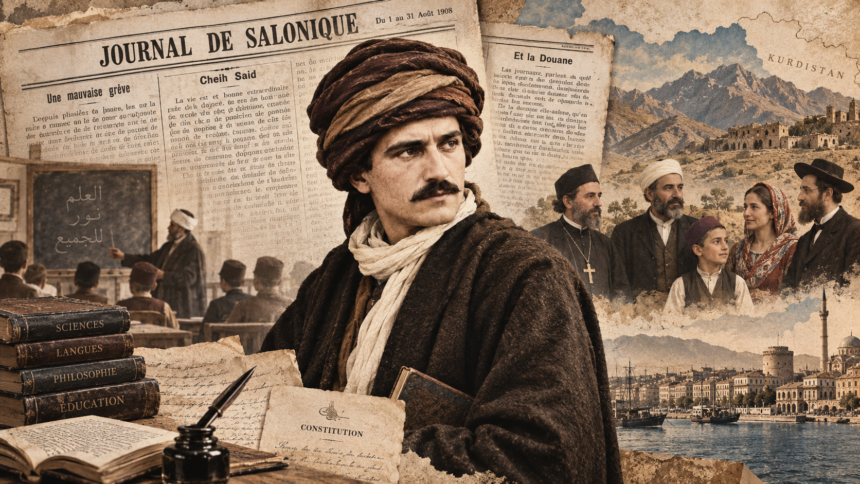
A French-language interview with Said Nursi published in 1908 sheds light on the Kurdish Islamic scholar’s early political thinking, showing him defending constitutional government, equality regardless of religion and the expansion of education throughout Kurdistan.
The interview appeared in Le Journal de Salonique, a French-language newspaper published in Ottoman Salonica, as part of a series by journalist Max Yvel shortly after the Young Turk Revolution restored the Ottoman Constitution in July 1908.
Nursi, then widely known as Said-i Kürdi, or Said the Kurd, is referred to in the newspaper as “Cheih Said.”
Published under the headline Opinions du Cheih Said, the interview records Nursi expressing unequivocal support for the restored constitutional order.
Asked what he thought of the Constitution, Nursi replied:
“It is a very good thing, sir. I am for the Constitution in its entirety.”
When the interviewer suggested there might be a contradiction between constitutionalism and Nursi’s religious teachings, he rejected the premise.
“What does the Quran say?” Nursi asked, before arguing that religions should be respected and that the Constitution established equality regardless of religious affiliation.
“There is therefore nothing in this that contradicts religion,” he said.
The exchange offers a direct contemporary record of an important feature of Nursi’s political thinking during the Second Constitutional Era: his attempt to reconcile Islamic principles with constitutional government rather than treating the two as opposing systems.
Religious equality and constitutionalism
Nursi went further than simply accepting the Constitution as a political necessity. He presented constitutional equality as compatible with religion itself.
Asked directly whether he accepted constitutional government, he answered:
“It is recommended to us by our religion; therefore it is good.”
This emphasis on religious equality is particularly notable in the multi-religious setting of the late Ottoman Empire, where questions concerning the political status of Muslims, Christians and Jews were central to debates surrounding constitutional citizenship.
A striking comment on the caliphate
One of the most remarkable passages concerns the office of the caliph.
After Nursi spoke positively about Sultan Abdülhamid II, the interviewer asked whether his attitude resulted from the Sultan’s position as caliph.
Nursi said the opposite.
He described the caliphate as the one aspect that could be criticized, saying:
“To be Caliph is, so to speak, to intercept the communication and also the communion between God and the people.”
He continued that there should be no barrier before the divine and concluded:
“This title of Caliph seems superfluous to me.”
The wording is striking given Nursi’s later prominence as one of the most influential Muslim thinkers in modern Turkey and deserves particular attention in assessments of his early political thought.
The statement should nevertheless be understood in its 1908 context and according to the precise wording of the French source rather than interpreted automatically through later debates about the Ottoman caliphate.
“National democratization”
The interviewer then asked whether Nursi was advocating what the newspaper called a form of “national democratization” — démocratisation nationale.
Nursi answered:
“Absolutely.”
He followed this with the formula:
“All for one, one for all.”
He described what could make society strong as material unity, a “communion of ideas” and “unity of thought.”
Although the brief exchange does not provide a detailed definition of what either Nursi or the interviewer understood by démocratisation nationale, it is significant that the phrase appears explicitly in the contemporary interview and that Nursi responds affirmatively.
Praise for the constitutional movement
Nursi also spoke approvingly of the Ottoman Committee responsible for the constitutional movement, describing its accomplishment as “magnificent.”
But his praise was accompanied by advice.
He argued that the organization should continue working in the background and avoid becoming a vehicle for personal ambitions.
Remaining less visible, he suggested, would allow its members to concentrate on their work while preserving the Committee’s prestige in the eyes of the public.
“My aim is to spread education throughout Kurdistan”
The most explicit discussion of Kurdish affairs comes when Yvel asks Nursi directly about Kurdistan.
Nursi described it as:
“A land of progress, sir; a terrain very favorable to intellectual cultivation.”
He then stated his objective in unusually clear terms:
“My aim is always to work for the spread of education throughout Kurdistan.”
Nursi rejected portrayals of the region as inherently uncivilized, describing its landscape and arguing that its inhabitants possessed considerable potential for intellectual development.
The essential task, he said, was to establish a class of educators.
Through education, Nursi predicted, Kurdistan could cease being associated with ignorance and instead become known for its learning, its contribution to civilization and its service to what he called the “common fatherland” — la patrie commune.
That formulation provides an important window into the young Nursi’s position on Kurdish identity.
His comments display an unmistakable concern with Kurdistan as a distinct social and educational space. At the same time, the political objective presented in the interview is not Kurdish separation from the Ottoman state.
Instead, he envisages the intellectual advancement of Kurdistan contributing to a shared political homeland.
The combination complicates attempts to fit the young Said Nursi neatly into either a later Turkish nationalist framework or a modern Kurdish separatist one.
The Nursi represented in the 1908 interview could speak explicitly of Kurdistan and Kurdish intellectual advancement while simultaneously advocating constitutional government, religious equality and participation in a common Ottoman homeland.
The journalist Max Yvel ended the interview with an unusually admiring observation:
“Thus spoke Sheikh Said, and he spoke words of gold.”
Full English Translation of “Opinions du Cheih Said”
The following is an English translation of the French-language interview published in Le Journal de Salonique. The translation follows the original wording as closely as possible while using readable modern English. “Cheih Said” refers here to Said Nursi, then commonly known as Said-i Kürdi.
OPINIONS OF SHEIKH SAID
— What do you think of the Constitution? we ask Sheikh Said.
— It is a very good thing, sir. I am for the Constitution in its entirety. I was happy to be able to speak in this sense before those crowds that were willing to receive my teachings.
— But your teaching was purely religious.
— Well?
— Is there not a contradiction between the constitutional principle and the religious concept?
— Not at all. What does the Quran say? To respect all religions, each of which has a divine principle.
The Constitution establishes the equality of all, no matter what religion they belong to. There is therefore nothing in this that contradicts religion.
Since we respect people’s convictions, we must accept the constitutional principle, which thus has a religious origin.
Otherwise, we would be bad Muslims, and everyone knows that we are good believers.
— So you accept the Constitution?
— It is recommended to us by our religion; therefore it is good.
— What do you think of the Sultan?
— I think that he may be the best of sovereigns.
— Is it his status as Caliph that makes you speak this way?
— No, not at all. On the contrary, that is the one thing that can be criticized.
To be Caliph is, so to speak, to intercept the communication, and also the communion, between God and the people.
Now, there must not be — one must not place — a barrier before the divinity.
This title of Caliph seems superfluous to me.
— So you advocate a kind of national democratization?
— Absolutely.
All for one, one for all.
That is what can unite us closely and make us strong: material union, communion of ideas, unity of thought.
— Have you approached the sovereign?
— No.
His reputation as an exceptionally gifted man had reached as far as Kurdistan.
That was precisely what struck us.
How, we asked ourselves, could such a superior man be so badly disposed toward his own subjects?
We have seen, thanks to the Constitution, that the evil lay in his entourage.
Once those harmful men have disappeared, the sovereign and the people will know one another better and will love one another.
By granting the Constitution, the Sultan certainly understood that he himself would be the first to benefit from it in every respect.
We shall love him more.
— And the Ottoman Committee?
— Its work is magnificent.
One must possess many qualities to accomplish useful work.
Therefore, the members who compose the Committee and who accomplished such a great feat are superior to others.
This Committee has accomplished, I say, a magnificent work.
But this is only a beginning.
Much remains to be done.
The best way to pursue something is to devote oneself to it completely.
The Committee worked in the shadows to obtain the Constitution; it must continue to work in the shadows to obtain everything else.
There are two advantages to remaining in the background.
One accomplishes more work, and this leaves no room for personal ideas or ambitions, however legitimate they might be.
Furthermore, the prestige of the Committee increases.
Such a powerful organization remains intangible and becomes still greater in the eyes of the ordinary public, who see the progress being made but, not seeing those responsible for it, imagine them greater and more powerful than they could actually be.
Invisibility is an additional attraction.
— Would you tell us about Kurdistan?
— It is a land of progress, sir; a terrain very favorable to intellectual cultivation.
My aim is always to work for the spread of education throughout Kurdistan.
The region is not savage.
On the contrary, it is cheerful with greenery, abundant in water, with restful valleys, wooded summits and gorges where the chirping of birds mingles with the murmur of the water.
I believe in the influence of the environment.
In such a pastoral environment, systematically backward ideas cannot flourish.
My compatriots possess very good capacities for intellectual development.
The whole task is to succeed in creating a teaching class.
Through students charged with spreading knowledge, Kurdistan, which has been known for its ignorance, will become known for its learning, its contribution to civilization and its services to the common fatherland.
Thus spoke Sheikh Said,
and he spoke words of gold.
Max Yvel