
On May 20, News About Turkey (NAT) argued that the new Kurdish process unfolding in Turkey was about considerably more than ending the armed campaign of the Kurdistan Workers’ Party (PKK). The more consequential possibility, we suggested, was that Abdullah Öcalan’s restoration as the indispensable interlocutor for disarmament would also restore his authority over the broader Kurdish political field, including its legal and civilian components. The question was therefore not simply whether Ankara needed Öcalan to close the PKK chapter, but whether the authority accumulated through that role would enable him to shape the political order that followed it. Less than four months later, developments inside DEM Party are giving that forecast a much firmer factual foundation. What was hypothetical in May is not yet fully realized, but the sequence is now visible: Öcalan is involved not only in discussions about ending armed struggle but increasingly in discussions about the political structures, cadres and program that are supposed to emerge afterward.
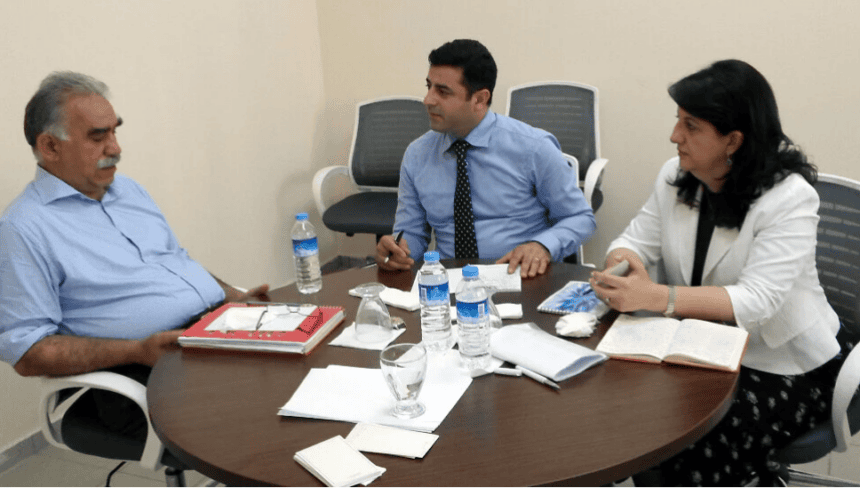
The evidence has accumulated in stages. In an August 2 message relayed by the DEM Party’s İmralı delegation, Öcalan described the process as the beginning of a democratization project and called for serious work toward a “democratic republic.” The phrase itself is not new to DEM politics; the party had used the concept before the current process, which means it would be simplistic to portray the Democratic Republic project as something suddenly imposed from İmralı. What is new is the organizational connection now being drawn between Öcalan and the next stage of the party. In August, Pervin Buldan said explicitly that the September 6 congress was not the “real congress” but largely one necessitated by legal requirements, with the more consequential congress expected before Newroz. She then added that Öcalan was discussing “a new party” involving changes to its statutes, program and cadres and said that work on the new structure would begin after September 6. In the same briefing, Buldan said Öcalan would participate in a planned “Disarmament and Politicization” subcommittee because he would have a role in organizing the transition. That moves his involvement beyond ideological influence and into the institutional architecture of the process.
By the end of August, DEM’s own leadership was publicly defining the destination. Tuncer Bakırhan said the party was preparing for a later “Democratic Republic Movement Congress” and described September 6 as the starting point of a much larger political transformation rather than an endpoint. On September 6 he became more explicit: the leadership elected at the congress would prepare what he called the larger congress, while DEM would reshape its program, political language, organizational practice and cadre structure to fit the new period. He then announced that the “Democratic Republic Movement” was beginning that day. Buldan reinforced the point after the congress, saying another congress would be held within a few months to build the new movement and that September 6 represented its first step. The final legal form is still not entirely settled in public: the Democratic Republic Movement could become an umbrella around a transformed DEM, the party itself could be renamed and reconstructed, or another legal vehicle could eventually emerge. But the political objective is no longer vague. A post-PKK political formation is being deliberately constructed, and Öcalan is already connected to its ideological direction, its proposed program and statutes, its cadres and the institutions managing the transition.
That makes it increasingly reasonable to describe Öcalan as the emerging de facto political leader of the new order, even though he holds no formal party office. De facto leadership is ultimately a question of where decisive political authority resides, not what title appears in a party registry. If senior figures travel to İmralı for strategic guidance, if Öcalan is consulted over the program and personnel of the new formation, if the movement adopts a political framework he has placed at the heart of the transition, and if he participates institutionally in managing the passage from armed organization to political activity, then the absence of a formal chairmanship does not eliminate effective leadership. A future de jure role is a different matter. Öcalan remains imprisoned, and the existing legal framework does not itself create a path to conventional party leadership. Any formalization of his authority would therefore require major legal and political changes that have not occurred. But if his status is transformed in later stages of the process, the gap between his informal authority and formal position could itself become a political issue. That is a future scenario; the stronger claim today is narrower but increasingly defensible: the man overseeing the liquidation of the armed structure is also becoming a central architect of the political structure intended to follow it.
That development raises a more fundamental question than the name of the future party. What exactly does the transition from armed struggle to democratic politics mean? Normally, demilitarization should redistribute authority toward elected politicians, voters, parliament, municipalities and civil society. An armed organization disappears because political representation is moving into institutions in which leadership can be contested and legitimacy must periodically be renewed at the ballot box. But another outcome is possible: the weapons can disappear while the vertical hierarchy constructed during the armed struggle survives. Political authority can migrate rather than decentralize. In that scenario, the Kurdish movement would undergo demilitarization without a corresponding decentralization of political power. The emerging movement could be broader in social composition—DEM explicitly wants to address Turks, Kurds, Alevis, workers, women, young people and other constituencies—while still becoming more centralized around one ultimate source of political authority. A movement can therefore become socially more inclusive while becoming internally less pluralistic. This is the tension that matters most in the next stage, and it is also where Selahattin Demirtaş becomes much more than a secondary personality in the story.
Demirtaş embodies an alternative source of legitimacy that Öcalan does not possess: direct electoral legitimacy developed through competitive national politics. The distinction is not simply between two Kurdish leaders. Öcalan’s authority is historical, organizational and ideological, rooted in his founding role in the PKK and his unique capacity to influence the armed movement. Demirtaş built political capital through elections, campaigning and an ability to reach constituencies outside the traditional Kurdish base. His 2014 presidential campaign received 9.8 percent of the vote and helped establish him as a national political figure. The following year, under his co-leadership, HDP pursued Türkiyelileşme—the attempt to become a party of Turkey rather than remain primarily a Kurdish electoral vehicle—and won 13.12 percent and 80 seats in the June 7, 2015 election, sharing the third-highest number of parliamentary seats with MHP. Academic studies of that election specifically identify the “Demirtaş factor,” his conciliatory political style and HDP’s ability to attract both Kurdish voters who had previously supported AKP and liberal-left voters outside its traditional constituency as important elements of the breakthrough. Contemporary analyses likewise emphasized his ability to broaden HDP’s appeal to secular and non-Kurdish voters.
There is also evidence that the distinction between Öcalan’s historical authority and Demirtaş’s civilian legitimacy has not disappeared during Demirtaş’s long imprisonment. A May 2026 Ank-Ar survey, which should be treated as one poll rather than definitive evidence, asked who better represented Kurdish demands and reported Demirtaş ahead of Öcalan by 63.9 percent to 22.6 percent nationally; among DEM voters, the reported split was 80 percent for Demirtaş against 17.9 percent for Öcalan. The figures are particularly interesting because AKP and MHP respondents in the same survey were more favorable to Öcalan than most opposition voters were, an unusual pattern that at least raises questions about the different political functions the two figures may serve in the emerging order. More importantly, it undercuts any assumption that Öcalan’s restored institutional role automatically translates into uncontested popular authority over DEM’s electorate. Demirtaş’s political future remains conditional on his release and his own willingness to return to frontline politics, but his potential significance lies precisely in this independent electoral legitimacy.
If Kurdish politics eventually fractures around those different sources of authority, Demirtaş would not necessarily have to settle for leading the non-Öcalan half of another Kurdish movement. The more ambitious possibility would be to revive the core insight behind Türkiyelileşme and build a wider democratic political project addressed to Turkey as a whole. Such a project would not need to deny its Kurdish roots, but neither would Kurdish identity have to define the outer limits of its electorate. It could place Kurdish rights within a broader platform of rule of law, institutional democracy, social justice, decentralization, individual freedoms and political pluralism. Demirtaş has already demonstrated that such a coalition can exist electorally, even if the particular circumstances of 2015 cannot simply be reproduced eleven years later. The strongest version of this scenario is therefore not “Öcalan versus Demirtaş” within a closed Kurdish political arena. It is a more consequential divergence: an Öcalan-centered post-PKK movement on one side and a potential civilian project using Kurdish democratic demands as one component of a broader challenge to Turkey’s polarized party system on the other.
The creation of Özgür Özel’s Yeni Parti does not necessarily eliminate that space. Yeni Parti instantly became the second-largest parliamentary group when Özel and 91 MPs left the CHP in July, and it has introduced important organizational changes while presenting itself as a broad opposition force. But its published program remains explicitly grounded in the Six Arrows and social democratic values, and its founding personnel overwhelmingly emerged from the CHP. That makes it a major new institutional actor, but not necessarily the answer to every voter located between Erdoğan’s bloc, Turkish nationalism, the traditional social-democratic electorate and Kurdish identity politics. Even discussion surrounding Yeni Parti’s formation has revolved around whether it should remain effectively a continuation of the CHP or evolve into a more encompassing and politically central formation. A future Demirtaş project could therefore compete for a different kind of center—not necessarily a conventional ideological centrism, but a cross-cutting democratic constituency of Kurds, liberal and social-democratic Turks, younger voters, rights-oriented conservatives and others who may not feel fully represented by either the governing alliance or a CHP-derived opposition. This remains a political possibility rather than a forecast of inevitable success, but 2015 provides an electoral precedent that makes it more than fantasy.
The consequences would extend directly into Erdoğan’s political calculations because DEM’s parliamentary weight is potentially decisive. Following the formation of Yeni Parti, the late-July parliamentary distribution put AKP at 277 seats, MHP at 46 and DEM at 56. AKP and MHP therefore had 323 seats together—well short of the 360 votes, three-fifths of the 600-member parliament, required both for parliament itself to renew presidential and parliamentary elections and for a constitutional amendment to clear the initial constitutional threshold. DEM’s votes could bridge that gap. The constitutional significance is particularly important: an amendment adopted with between 360 and 399 votes normally proceeds to a referendum, while 400 represents the two-thirds threshold associated with adoption without a mandatory referendum. Article 116 also provides that if parliament renews elections during a president’s second term, that president may stand once more. This means cooperation with an Öcalan-centered parliamentary bloc could become relevant not merely in ordinary lawmaking but in the architecture of Erdoğan’s political future. None of this establishes a secret bargain, and it would be irresponsible to present future DEM votes as already committed. But it explains why the structure and leadership of post-PKK Kurdish politics matter to Erdoğan far beyond the peace process itself.
This is also why fragmentation could benefit the government even without a formal Erdoğan-Öcalan alliance. A Kurdish political field divided between an İmralı-centered movement and a civilian-electoral alternative would make opposition coalition-building more complicated, particularly in a presidential system where second-round alignments can determine the outcome. An Öcalan-centered formation could pursue an autonomous “third way,” field its own candidate in the first round and negotiate its position later; a Demirtaş-led or Demirtaş-influenced current might instead seek a wider democratic coalition. Those are scenarios, not established plans, but the institutional incentives are clear. Ankara has reason to value an interlocutor capable of imposing discipline on the former armed movement, while Erdoğan has reason to prefer an opposition landscape divided into several competing poles rather than a unified anti-government electorate. The unresolved question is whether the current process is deliberately designed to produce that fragmentation or whether fragmentation will emerge as an unintended consequence of restoring Öcalan’s authority. The available evidence is not sufficient to answer that question, and the distinction matters.
The May 20 analysis therefore requires updating, but not reversing. Its first proposition—that Öcalan’s restored authority would move beyond PKK disarmament into legal Kurdish politics—is becoming substantially better supported. The second—that this could eventually fracture the Kurdish political movement—remains unresolved. No Demirtaş-led alternative has been created, no major component has formally broken with DEM, and the next movement’s final legal structure has not yet been announced. What has changed is that the potential fault line can now be identified much more precisely. One model would carry Öcalan’s historical authority from the armed era into the political institutions of the post-PKK period. The other would insist that the end of armed struggle should also mark a transfer of legitimacy toward voters and elected civilian leaders.
That is ultimately the significance of the coming congress. The issue is no longer whether Öcalan will influence the end of the PKK; that role is already established. The issue is whether he will also define the political order that succeeds it.
And if that produces a second political pole around Demirtaş, the result may be more consequential than a simple division of Kurdish politics. Öcalan could emerge as the de facto leader of the post-PKK movement while simultaneously creating the conditions for Demirtaş to attempt, once again, something larger: turning a political current born from the Kurdish question into a democratic movement competing for Turkey itself.
By: News About Turkey (NAT)