
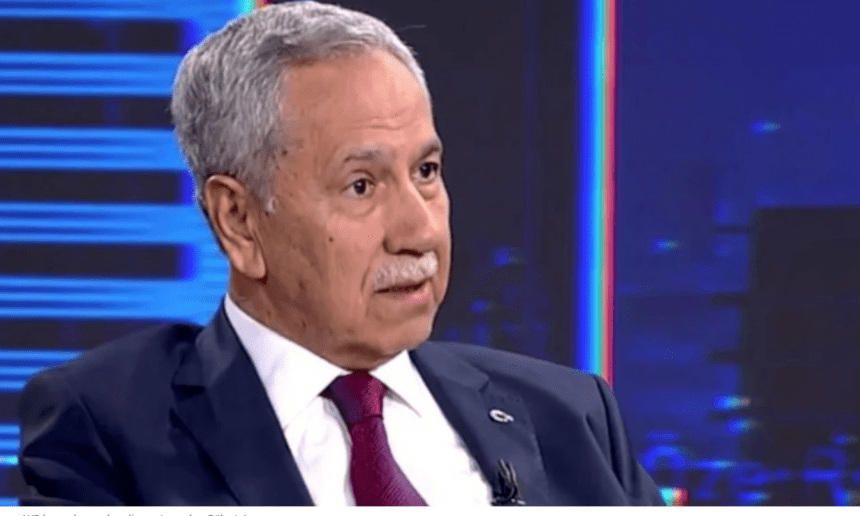
A blunt intervention by Bülent Arınç — one of the founders of the Justice and Development Party (AKP) and a former speaker of Turkish Parliament — has reignited debate over religion, credibility and political ethics in Turkey, after video clips from a weekend conference spread widely online.
Speaking at an event in Ankara billed as a discussion on democracy, law and politics, Arınç said the political current that came to power promising cleaner governance and “virtue” had failed to provide moral leadership. “We came as the movement of the virtuous, but now neither virtue nor ethics remains,” he said, using language strongly associated with the reformist tradition that helped launch the AKP in the early 2000s.
Arınç then linked the political drift he described to what he framed as a social and religious backlash. “People are abandoning Islam. They are taking off the headscarf. They are quitting prayers,” he said, casting the shift as a crisis of credibility rather than a simple change in personal belief. In another widely circulated excerpt, he urged people not even to greet those who, he said, still believe the judiciary should serve politicians — a line that echoed long-running concerns about political influence over courts.
Arınç also argued that religious language in public life has lost trust because of the people who now claim to speak for it. “Many charlatans started speaking, with caps and without,” he said, referring to religious attire and the proliferation of self-styled religious authorities. In his telling, scandals, hypocrisy and the normalization of self-interest — inside politics and beyond — have made religiosity something people increasingly avoid rather than embrace.
The speech came at a conference featuring independent Mustafa Yeneroğlu, a former AKP lawmaker who has become an outspoken critic of rights abuses and legal practices in Turkey and now sits as an independent from İstanbul. Their appearance together underscored a theme that has grown more sensitive over the past decade: criticism of the government’s legal and moral record is no longer limited to secular or opposition circles, but increasingly voiced by figures rooted in Turkey’s conservative political tradition.
What surveys say about religious practice and perceptions
Arınç’s rhetoric is sweeping — and difficult to prove or disprove in the way a concrete policy claim might be — but multiple recent surveys suggest the underlying trend he described is at least plausible in parts of society, especially in perceptions of decline and in some measures of practice.
A 2023 nationwide study by Ankara Enstitüsü found that 72.7% of respondents said religiosity in Turkey is declining, while smaller shares said it is rising or unchanged. The same study reported that about 40% said they perform the five daily prayers regularly, 25% said they pray sometimes, and 18% said they do not pray. On fasting, 67% said they fast regularly during Ramadan, while 12% said they used to but no longer can, and 11% said they do not fast.
At the same time, the study also illustrates why the story is not simply “belief collapsing.” It found that 92.3% still identify as Muslim, with smaller shares describing themselves as deist (3.2%) or atheist (2.7%). In other words, shifts may be more visible in practice, interpretation, and public trust than in formal religious identity.
International survey work points in a similar direction on daily observance. A 2025 Pew Research Center report on Muslim religious practices found that among Muslims in Turkey, 31% said they pray all five salah every day — one of the lower shares among the countries surveyed in that study.
Longer-term trend data often cited in Turkish debates also indicate change across a decade. A 2019 report summarizing findings from a KONDA “Social Change” comparison (2008–2018) said the share describing themselves as atheist rose from 1% to 3%, while those saying they are “pious” fell from 55% to 51%. The same summary reported that in the “worship and veiling” section, fasting fell from 77% to 65%, and the share categorized as wearing “türban” fell from 13% to 9% over that period.
More recently, KONDA’s “Lifestyle Research” comparison between 2008 and a nationwide 2024 wave (6,137 respondents) reported a drop in those identifying as “devout” (from 55% to 46%) and an increase in those identifying as atheist or nonbeliever (from 2% to 8%).
Taken together, these surveys don’t prove Arınç’s specific claims about headscarves being removed or prayers being abandoned in a uniform way across the country. But they do provide measurable support for two parts of his broader argument: (1) many Turks perceive a decline in religiosity, and (2) some indicators of strict observance and self-described devoutness have weakened over time, even as Muslim identity remains dominant.
Why Arınç’s critique matters inside the AKP story
Arınç framed the issue as the unraveling of the AKP’s founding narrative: a movement that promised to replace the corruption-tainted coalition era of the 1990s with cleaner governance, stronger ethics and a more authentic public conservatism. His message, however, is also a warning about unintended consequences: that when religion becomes closely tied to power, patronage and impunity, public religious language can lose credibility — and the backlash can show up in private behavior.
That dynamic is visible in another finding from the Ankara Enstitüsü study: respondents were divided on whether head covering should be considered a religious obligation for every Muslim woman, with 46.8% agreeing and 44.2% disagreeing. The polarization on such a basic question points to a society where religious norms remain central, but are contested — and where shifts in visibility (like dress and daily practice) can carry political meaning.