
The political storm now surrounding the Republican People’s Party, or CHP, should not be understood merely as a series of disconnected legal developments. It is not only about municipal investigations, corruption allegations, statements reportedly given under effective remorse provisions, mayoral defections from the CHP to the AKP, or renewed speculation about a possible party closure case. Taken together, these developments suggest a broader political strategy: not necessarily to destroy the CHP, but to weaken, discredit, and contain it.
That distinction is crucial.
At first glance, the pressure on the CHP appears to be moving toward a dramatic legal endgame. Investigations targeting CHP municipalities have been followed by allegations involving former and current mayors, claims about party congress delegates, accusations about money transfers, and renewed debates over both a possible CHP closure case and the so-called “absolute nullity” case concerning the CHP congress process. Pro-government media have amplified these claims, presenting them as evidence that corruption may extend from municipalities to the party’s central structure.
Some of these corruption allegations may be serious. They should not be dismissed automatically as propaganda. If public resources were misused, if municipal power was abused, if illegal financing took place, or if party officials were involved in unlawful activity, these matters must be investigated. No political party, including the CHP, should be immune from legal scrutiny.
However, there is a clear difference between legitimate investigation and political exploitation.
The real purpose of this campaign may not be to close the CHP, annul the party congress, or remove Özgür Özel from his position. Indeed, Özgür Özel has already proven useful to Erdoğan’s political calculations. Under Özel’s leadership, the CHP remains visible, loud, reactive, and permanently under pressure. It occupies the main opposition space, but it is constantly forced to defend itself against allegations, investigations, defections, and internal legitimacy debates.
From Erdoğan’s perspective, this may be an ideal arrangement: a CHP that is alive enough to absorb opposition energy, but damaged enough to struggle as a credible alternative.
In other words, Erdoğan may not need to remove Özel. He may need him to stay.
A CHP under constant pressure can be more useful than a CHP pushed into martyrdom. If the party were closed, if its congress were annulled, or if Özel were removed through a dramatic legal intervention, the opposition could rally around a new victimhood narrative. Such a move could energize anti-AKP voters, create sympathy among undecided citizens, and force fragmented opposition groups to reorganize under a new political roof.
Most importantly, it could open the way for a fresh centrist or center-right political movement — one that would not carry the historical baggage of the CHP and would therefore be much harder for Erdoğan to demonize.
That is exactly what Erdoğan does not want.
For more than two decades, Erdoğan’s political machine has benefited from having the CHP as its main opponent. The CHP is familiar. It is historically loaded. It can be portrayed to conservative voters as elitist, secularist, disconnected from ordinary people, hostile to religious values, and unable to represent ordinary Anatolian society. Whether this image is fair or not is not the point. The point is that this anti-CHP narrative has worked for Erdoğan for years.
But this weapon only works if the CHP remains alive.
A closed CHP would no longer serve as the same useful enemy. It could be replaced by a new movement with a different language, a different identity, and a broader electoral appeal. A new centrist or center-right opposition could attract voters who are tired of the AKP but still reluctant to vote for the CHP. Such a movement could speak to conservatives, nationalists, liberals, urban voters, Kurds, young people, and economically frustrated former AKP supporters at the same time.
That would be much more dangerous for Erdoğan than the existing CHP.
This is why the current strategy seems to be: discredit, don’t destroy.
Erdoğan does not need a closed CHP. He needs a wounded CHP. He needs a CHP that remains on the political stage but is permanently associated with scandal, legal vulnerability, internal conflict, and public doubt. In other words, he needs a damaged CHP — not necessarily a party destroyed by law, but one weakened in the public imagination.
This is the function of the current campaign.
The investigations and allegations do not need to result in a final court judgment to be politically useful. The government does not need to prove every claim beyond doubt in order to benefit politically from them. It only needs to create enough smoke, confusion, suspicion, and scandal to make voters hesitate. In politics, especially in a heavily controlled media environment, perception often matters as much as legal truth.
A party that is constantly accused, constantly defending itself, and constantly appearing in scandal headlines loses the ability to speak about the country’s real problems.
Turkey is facing inflation, poverty, institutional decay, judicial politicization, foreign policy uncertainty, housing problems, unemployment, and a growing loss of hope among young people. Yet the political agenda is increasingly filled with the CHP: CHP municipalities, CHP mayors, CHP delegates, CHP congresses, CHP women politicians, CHP defections, CHP closure, and CHP nullity.
This is not accidental. It is agenda control.
A government that cannot easily defend its record prefers to put the opposition on trial. Instead of answering for the economy, justice, corruption, nepotism, migration, education, or foreign policy failures, it forces the opposition to explain itself. A strong opposition speaks about the future of the country. A weakened opposition speaks about its own survival.
That is exactly where Erdoğan wants the CHP to be.
The use of statements reportedly given under effective remorse provisions is central to this strategy. Such statements can be politically explosive because they carry the appearance of confession, even when their content remains contested or only partly verified. Claims attributed to figures such as Usak Mayor Özkan Yalım are not being treated merely as legal material. They are being transformed into headlines, talking points, and psychological ammunition.
Allegations about money, delegates, signatures, bags, suitcases, and party officials are circulated not only to inform the public, but to construct an atmosphere of guilt.
The target is not only the courtroom. The target is the voter’s mind.
This is also why the “absolute nullity” debate is politically useful even if it does not ultimately remove Özgür Özel from his seat. The point may not be to actually overturn the CHP congress. The point is to keep the CHP leadership under permanent suspicion. If the party’s congress can be portrayed as illegitimate, its chairman as legally vulnerable, and its internal processes as corrupt, then the party’s authority is weakened.
The legal process becomes a political fog machine.
The same logic applies to the party closure debate.
A closure case may or may not be filed. Even if it is filed, it may or may not succeed. But the constant discussion of closure has its own political value. It presents the CHP as a party standing at the edge of illegality. It tells the public: “This party is not merely an opposition party; it is a legal problem.”
That perception is damaging even without a final legal outcome.
This is why the CHP is being kept under pressure, but not necessarily pushed over the cliff.
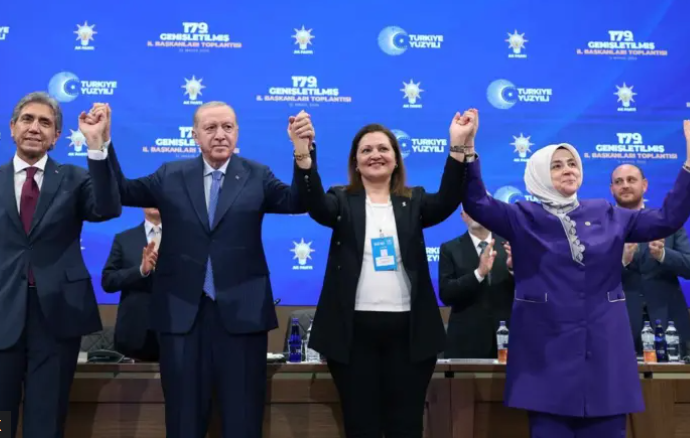
The mayoral defections from the CHP to the AKP also fit this pattern. Each defection is presented as more than a personal or local political decision. It becomes a symbol. It tells voters that even CHP mayors no longer trust their own party. It suggests that the CHP is collapsing from within. It creates demoralization among opposition supporters and gives AKP media a powerful visual message: former CHP figures standing beside Erdoğan, receiving AKP badges, and publicly crossing the line.
The cases of Ayyonkarahisor Mayor Burcu Köksal and Dinar Mayor Veysel Topçu are especially important in this regard. Their defections are not being discussed only as political transfers, but as part of a broader atmosphere of pressure, allegations, family-related vulnerabilities, and legal threats. The significance lies not simply in whether each claim is true, but in how such cases are used to create the impression that CHP politicians are vulnerable, compromised, or ready to defect under pressure.
This is how a party’s image is poisoned.
At the same time, one must be especially careful about the private life and sexual relationship allegations involving leading CHP figures. Unlike corruption claims, which may involve public money, official authority, and concrete legal responsibility, these private-life allegations are often much harder to verify and may have little relevance to any legal investigation.
Some of these claims may be based on rumor, insinuation, or selective use of photos from ordinary party events.
This is where the campaign becomes more troubling.
If corruption allegations exist, they should be investigated through proper legal channels. But sexual or private-life allegations should not be casually mixed into corruption files or political debates unless they are directly relevant to a specific legal matter. Otherwise, they become tools of humiliation rather than instruments of justice.
In a patriarchal and conservative political culture, allegations about private life can be especially damaging to politicians in countries like Turkey. Even when denied, unsupported, or irrelevant, such claims can still create public pressure.
That is why this part of the campaign should be treated with particular caution.
The purpose of these allegations may not be to prove a crime. It may be to shame, stain, and intimidate. It may be to force CHP figures to spend their energy denying rumors instead of speaking about the country’s real problems.
This is not accountability. It is character assassination.
Financial corruption allegations and private-life insinuations therefore serve different legal functions, but they can serve the same political function: both can damage the CHP’s public image. One attacks the party’s honesty; the other attacks its dignity. Together, they create the image of a party that is not only legally vulnerable, but morally weakened.
This is politically useful for Erdoğan.
The voter is not necessarily expected to believe every claim. The voter is expected to become tired, confused, and cynical.
This cynicism is valuable for an incumbent government. If voters believe that “everyone is corrupt,” “everyone is dirty,” “all parties are the same,” and “the opposition is no better,” then many will either stay home or return to the familiar power they already know. For a government facing economic fatigue and political erosion, voter cynicism can be as useful as voter enthusiasm.
That is why the CHP does not need to be legally destroyed.
It only needs to be politically and morally exhausted.
This strategy also helps Erdoğan prevent the emergence of a more dangerous opposition alternative. If the CHP remains the main opposition but is constantly wounded, it absorbs the energy of anti-AKP voters while failing to fully mobilize them. It remains large enough to block the rise of a new force, but damaged enough to struggle against Erdoğan. In this sense, the CHP becomes a container for opposition anger — but not necessarily a vehicle for power.
That is the ideal opposition from Erdoğan’s perspective: visible, loud, wounded, defensive, and controllable.
This also connects to Erdoğan’s long-term succession agenda. As his rule enters a new phase, the question of what comes after Erdoğan becomes increasingly important. Whether the future involves his son Bilal Erdoğan, another family-linked figure, or a loyal political heir from within the AKP ecosystem, Erdoğan needs a weak and fragmented opposition landscape to manage that transition.
A strong, united, credible opposition could block such a succession project. A discredited CHP makes it easier.
This is why the idea of a damaged CHP is so central.
A clean, confident, broad-based opposition could challenge not only Erdoğan’s current rule, but also his attempt to shape Turkey’s future after himself. A damaged CHP, by contrast, allows Erdoğan to say: “Look at them. They are corrupt. They are chaotic. Whatever your complaints about us, they are not a real alternative.”
That is the political message behind the storm.
None of this means that corruption allegations involving CHP municipalities should be ignored. No party should be above scrutiny. If public money was misused, if municipal resources were abused, if illegal financing took place, or if officials engaged in corruption, these matters must be investigated seriously.
But there is a difference between genuine accountability and perception warfare.
Justice seeks evidence. Perception warfare seeks atmosphere.
Justice asks whether a crime occurred. Perception warfare asks how much political damage can be produced.
Justice separates relevant evidence from rumor and private-life gossip. Perception warfare mixes everything together — corruption allegations, personal relationships, sexual insinuations, family pressures, mayoral defections, and party closure talk — until the public can no longer distinguish law from propaganda.
That is what appears to be happening now.
The CHP is being pushed into a defensive corner. Its municipalities are under investigation. Its internal congress process is being questioned. Its mayors are defecting. Its leaders are being targeted. Its politicians are being dragged into private-life allegations. Its legal existence is being discussed. Its public image is being damaged.
But the aim is not necessarily to finish the CHP.
The aim is to keep it bleeding.
A closed CHP could become a martyr. A destroyed CHP could give birth to a stronger successor. A banned CHP could open the door to a new center-right opposition that Erdoğan cannot easily control. But a wounded CHP — alive, defensive, scandalized, and politically damaged — is useful.
That is the strategy behind the CHP storm.
Discredit, don’t destroy.
Pressure, don’t close.
Keep the CHP alive, but make voters doubt it.
Keep Özgür Özel in place, but surround him with suspicion.
Keep the party as the main opposition, but prevent it from becoming a convincing alternative.
For Erdoğan, the most useful CHP is not a dead CHP. It is a CHP that survives under a permanent cloud of suspicion — strong enough to occupy the opposition space, but weak enough to lose the battle for public trust.
By: News About Turkey (NAT)