
Chinese electric vehicle maker BYD has put its planned $1 billion factory investment in Turkey on hold, delaying one of the most prominent foreign investment projects announced for the country’s automotive sector in recent years.
BYD Executive Vice President Stella Li said construction of the planned factory in the western province of Manisa has not started and that the company has not set a timetable for moving ahead with the project. Her comments marked the clearest indication so far that the investment, announced with high-level political backing in 2024, has been pushed down the company’s list of priorities.
“Right now our first priority is Hungary,” Li said, adding that BYD’s second priority is to identify a suitable location for another production facility in Europe.
The statement leaves the future of the Manisa project uncertain. The planned Turkish factory had been expected to produce electric and plug-in hybrid vehicles, create thousands of jobs and begin production by the end of 2026. That target now appears increasingly unlikely, given that construction has yet to begin.
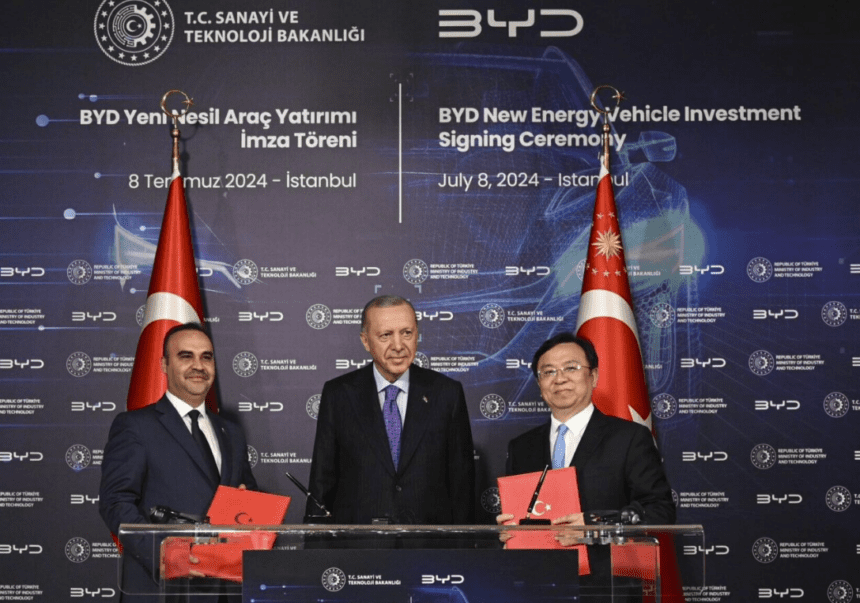
BYD announced the Turkey investment in July 2024 under an agreement signed with Turkey’s Industry and Technology Ministry. The project was presented as a major step in strengthening Turkey’s position in the global electric vehicle supply chain. The planned facility was expected to have annual production capacity of 150,000 electric and plug-in hybrid vehicles and include a research and development center focused on sustainable mobility technologies.
The project was also expected to create up to 5,000 direct jobs. President Recep Tayyip Erdoğan attended the signing ceremony in İstanbul, underlining the political importance Ankara attached to the deal.
At the time, Turkish officials described the investment as evidence of the country’s appeal as a manufacturing hub, pointing to Turkey’s supplier base, industrial capacity, workforce and location between Europe, Asia and the Middle East.
BYD’s decision to pause the Manisa project comes as the company focuses on its Hungarian plant in Szeged. Vehicle assembly at the Hungary facility is now expected to begin in the fourth quarter of 2026, about a year later than earlier plans. The plant will be BYD’s first passenger-car production site in Europe and is expected to play a central role in the company’s regional expansion strategy.
The shift also reflects the impact of European trade policy. The European Union has imposed additional duties on Chinese-made electric vehicles after concluding that Chinese producers benefit from state subsidies. BYD faces a 17 percent additional EU countervailing duty on battery electric vehicles imported from China. Producing vehicles inside the European Union would help the company reduce exposure to those duties and strengthen its competitive position in the European market.
Turkey had also increased pressure on Chinese vehicle imports. In 2024, Ankara imposed an additional 40 percent customs duty on vehicles imported from China, with a minimum duty of $7,000 per vehicle. The measure was introduced to protect domestic production, support local investment and limit pressure on Turkey’s current account balance.
The BYD investment agreement offered the company a way around some of those costs. Under the deal, BYD was exempted from Turkey’s additional customs duty and other import-related levies in return for its commitment to local production. That arrangement has now become a central point of criticism as the company continues to sell vehicles in Turkey while delaying factory construction.
BYD has expanded rapidly in the Turkish market. Its local distributor reported that the company sold 45,537 vehicles in Turkey in 2025, making it one of the fastest-growing automotive brands in the country. BYD also became a leading player in Turkey’s new-energy vehicle and plug-in hybrid segments. The company had expanded its dealership network and introduced new electric and hybrid models as demand for electrified vehicles increased.
However, the gap between sales growth and production delays has triggered political criticism. Opposition lawmaker Turhan Çömez of the İYİ Party accused the government of granting tax exemptions and incentives to attract BYD without securing concrete progress on the promised factory. He argued that the company had benefited from the Turkish market while prioritizing production in Hungary.
The criticism is politically sensitive because the Manisa project was promoted as a symbol of Turkey’s ability to attract high-value foreign direct investment. For Ankara, the planned factory was not only an automotive project but also part of a broader strategy to position Turkey as a regional hub for electric vehicles, batteries and next-generation mobility technologies.
The delay also comes after earlier reassurances from Turkish officials. Government-linked statements in 2024 and 2026 had said the investment process was continuing without problems. The latest comments from BYD’s senior management suggest that the project remains alive but no longer has a clear implementation schedule.
Turkey has faced similar setbacks before. German automaker Volkswagen selected Manisa for a planned factory in 2019 and established a local subsidiary, but the project was later suspended and then abandoned. The company cited the collapse in global vehicle demand during the COVID-19 pandemic, while the plan had also faced political pressure after Turkey’s military operation in Syria. That earlier case has made the BYD delay more politically significant, particularly because both projects involved Manisa and were presented as major automotive investments.
For BYD, the decision appears to be driven by strategic sequencing rather than a complete withdrawal. The company is expanding quickly outside China and has been increasing its sales in Europe. Its European sales rose sharply last year, and the company has continued to strengthen its dealership and production plans across the region. But building factories in Europe has proved slower than expected, with BYD and other Chinese automakers facing delays as they adapt to local regulations, supply chains, labor markets and permitting processes.
For Turkey, the pause raises questions about the country’s investment incentive strategy. Ankara has used tariffs, exemptions and industrial policy tools to encourage Chinese automakers to produce locally rather than simply export vehicles into the Turkish market. If BYD’s Manisa factory remains delayed, critics are likely to argue that the government gave away market access too early without securing binding construction milestones.
The outcome will matter beyond BYD. Turkey is trying to attract more electric vehicle and battery investments at a time when global automakers are rethinking supply chains because of tariffs, geopolitical tensions and changing demand. A successful BYD factory would strengthen Turkey’s argument that it can serve as a bridge between Chinese manufacturers and European markets. A prolonged delay, however, could weaken confidence in Ankara’s ability to convert major announcements into actual production.
For now, the project is not formally canceled. But with no construction under way, no production timeline and Hungary clearly placed ahead of Turkey, the Manisa investment has moved from a flagship success story to a test of whether Turkey can turn promised foreign investment into operating industrial capacity.