
Özgür Özel may have had compelling reasons to leave the CHP after losing its leadership through a court ruling. But establishing another party in Turkey’s already crowded political field—and calling it simply the “New Party”—raises a separate question: was this really the best choice?
Özgür Özel and 90 other lawmakers formally left the Republican People’s Party on Friday and established Yeni Parti, which translates simply as the “New Party.”
The move immediately transformed the balance of parliament. With 91 lawmakers, Yeni Parti became its second-largest group, behind President Recep Tayyip Erdoğan’s Justice and Development Party. The CHP, which had held 135 seats before the split, was left with 44.
That gives Özel something few founders of new parties possess: parliamentary strength, national recognition and an existing political organization ready to move with him.
But it does not settle the more difficult question.
Was creating a separate party—and choosing such a generic name—the right course for the politicians who left the CHP?
Why Özel believed he had to leave
Özel’s decision did not follow an ordinary leadership contest or ideological dispute. A court annulled the CHP congress that had elected him chairman in 2023 and restored former leader Kemal Kılıçdaroğlu. Özel’s supporters described the decision as political interference, while the government maintained that the judiciary was acting independently.
Özel had repeatedly demanded a new congress but Kılıçdaroğlu refused. Remaining inside the CHP would therefore have meant accepting the authority of a leadership that Özel and most of the party’s lawmakers no longer considered legitimate.
In those circumstances, leaving was understandable.
Özel could argue that he was not abandoning the political project he had led. He was trying to preserve it after losing control of the CHP’s legal identity, headquarters and formal machinery.
His supporters could also point to the CHP’s strong performance in the 2024 local elections under his leadership. They see themselves not as a defeated faction searching for a new home, but as the team that rebuilt the opposition and was then removed through the courts.
Forming a separate party allowed them to remain together, retain the main opposition group in parliament and continue backing jailed Istanbul Mayor Ekrem İmamoğlu as their ‘preferred’ presidential candidate.
A name that says almost nothing
In Turkish, yeni (“new”), yeniden (“again” or “anew”) and yenilik (“innovation”) carry slightly different meanings. In political language, however, all three are used to promise renewal, change or a break with the past.
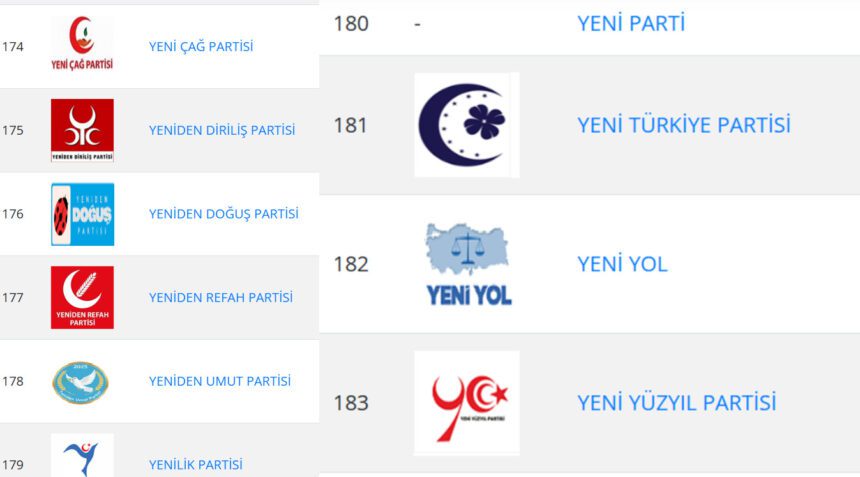
The Yargıtay (Court of Cassation) Chief Public Prosecutor’s Office already lists Yeni Çağ Partisi, Yeni Türkiye Partisi, Yeni Yol and Yeni Yüzyıl Partisi. The wider family of renewal-themed names also includes Yeniden Diriliş Partisi, Yeniden Doğuş Partisi, Yeniden Refah Partisi, Yeniden Umut Partisi and Yenilik Partisi. With the addition of Yeni Parti, at least ten registered parties now employ “new,” “renewal,” “innovation,” “rebirth” or a closely related concept in their names.
The Court of Cassation’s chief prosecutor recorded 189 active political parties on July 1, 2026. Yeni Parti’s registration on July 24 has raised that number to 190.
That does not mean Turkish voters will face 190 parties on the ballot
Registration is only the first and easiest step. A party’s appearance in the official registry does not mean it is legally capable of contesting an election.
Under Turkey’s Political Parties Law, a party must establish organizations in at least half of the country’s provinces—meaning at least 41 of 81 provinces. Within those provinces, it must also organize in at least one-third of the relevant districts and complete its district, provincial and national congresses. These conditions must ordinarily have been met at least six months before election day.
A 2022 amendment also removed the alternative route under which having a parliamentary group could be sufficient for electoral participation. The law now emphasizes organizational presence rather than representation obtained through transfers of sitting members of parliament.
This distinction dramatically reduces the number of “new” parties that can actually appear on a ballot.
In its March 25, 2026 decision concerning the local by-elections scheduled for June 7, the Supreme Election Council identified 41 parties that had fulfilled the legal requirements by the relevant cutoff date. Among the ten parties carrying “Yeni,” “Yeniden” or “Yenilik” in their names, only three appeared on that list:
The Ballot-Access Risk—but Not a Dead End
Yeni Parti’s 91 lawmakers give it immediate authority inside parliament. But they do not automatically give the party the right to participate in the next election under its own name.
This creates a race against time, but not necessarily a political dead end.
If an early election is called before Yeni Parti completes those requirements, Özel and his colleagues could seek places on the candidate lists of another party that is already eligible to contest the election. Depending on the legal and political arrangements, they might have to resign from Yeni Parti or obtain the required party approvals. They could also run as independent candidates.
Turkish electoral law allows citizens who meet the eligibility conditions to become parliamentary candidates whether or not they belong to a political party. It also permits candidates to be placed on another party’s list under specified conditions.
But this would be a fallback, not an ideal solution.
Yeni Parti itself would not appear on the ballot. Its candidates would run beneath another party’s name and emblem, and their success would depend on negotiations over which constituencies they would contest and where they would be placed on the lists.
Nor could Yeni Parti solve the problem simply by joining an electoral alliance under its own name. Under the current law, only parties that already possess election-participation eligibility may formally join such an alliance, and each participating party submits its own candidate lists.
Is the Party Really New?
Yeni Parti is new mainly in a legal and organizational sense. Its leader previously headed the Cumhuriyet Halk Partisi (Republican People’s Party, CHP), its deputies were elected on CHP lists, and much of its expected electorate already belongs to the CHP opposition base. Ekrem İmamoğlu, its strongest potential presidential figure, also built his national position through the CHP.
The party has not yet brought major independent figures from civil society, conservative democratic movements, Kurdish political circles, academia or trade unions into its founding leadership. Its establishment therefore resembles a large parliamentary breakaway more than the creation of a genuinely new social coalition.
More importantly, Yeni Parti still appears detached from the practical realities of Turkish society. The old CHP mentality remains visible: leaders seem to assume that voters will immediately understand the split, recognize the new party and transfer their support without difficulty. Therefore, there is a serious risk of ballot confusion. Because the word Yeni appears in the names of several political parties and movements, some voters—especially elderly citizens, people with limited literacy or those who do not closely follow political developments—may accidentally vote for a different party containing the same word.
This is not a minor communication problem. By abandoning a historic and familiar party identity without first building a strong organization and clear public recognition, Yeni Parti risks confusing precisely the voters it needs most. A movement claiming to represent the whole country must understand how ordinary citizens actually receive political information and cast their ballots, rather than assuming that everyone follows internal party developments closely.
The risk of confusion may not end with the parties already eligible to appear on the ballot. Erdoğan and the governing bloc would have every incentive to turn the word Yeni into a small political industry. They would not even need to establish every party from scratch: already registered but currently ineligible parties with similar names could be helped to complete the organizational and congress requirements necessary to enter an election.
By election day, voters might therefore find themselves choosing among Yeni Parti, Daha Yeni Parti (Newer Party), En Yeni Parti (Newest Party) and perhaps even Gerçek Yeni Parti (Real New Party). The joke almost writes itself, but the danger is real.
To deserve its name, Yeni Parti must therefore do more than establish a new legal entity. It must introduce credible figures from outside the former CHP structure, build a genuinely democratic political culture and create a nationwide organization capable of explaining clearly who it represents. Otherwise, it may appear less like a new movement than the Özel–İmamoğlu wing of the CHP continuing under another name—while leaving many traditional opposition voters uncertain about which party they are actually supporting.
By: News About Turkey (NAT)