

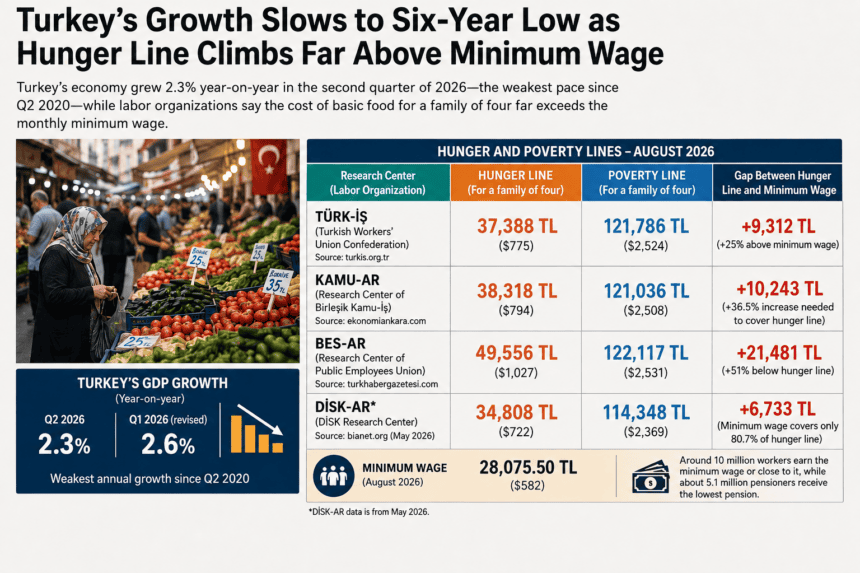
Turkey’s economic growth slowed to its weakest annual pace in six years in the second quarter of 2026, while newly released cost-of-living figures showed that millions of households are facing basic food expenses substantially above the country’s minimum wage.
Gross domestic product expanded 2.3 percent year-on-year in the April-June period, slowing from a revised 2.6 percent in the first quarter, according to data released Monday by the Turkish Statistical Institute (TurkStat).
The second-quarter result came below market expectations of around 2.9 percent and marked the fourth consecutive quarter in which annual economic growth lost momentum. It was the weakest growth rate since the second quarter of 2020, when the economy contracted sharply during the COVID-19 pandemic.
The economic slowdown coincided with new figures showing the continuing erosion of household purchasing power.
TÜRK-İŞ, Turkey’s largest labor confederation, said Monday that the monthly amount required for a family of four in Ankara simply to maintain an adequate and balanced diet — known as the hunger line — increased to 37,388 lira ($775) in August.
The figure is more than 9,300 lira above Turkey’s monthly net minimum wage of 28,075.50 lira.
The union calculated the broader poverty line, which includes food as well as housing, utilities, transportation, healthcare, education, clothing and other essential expenditures, at 121,786 lira ($2,524) per month for a four-person household.
The monthly cost of living for a single employee reached 48,305 lira ($1,001) — around 72 percent more than the minimum wage.
The figures illustrate an increasingly pronounced divide between continued growth in overall economic output and the financial conditions experienced by many wage earners.
Although Turkey remains outside recession and GDP is still increasing, high inflation and restrictive monetary policy have weakened domestic demand while the prices of basic necessities continue to rise rapidly.
On a seasonally and calendar-adjusted basis, GDP grew 1.1 percent from the previous quarter, accelerating from growth of around 0.3 percent in the first three months of the year.
The quarterly increase means Turkey’s economy continues to expand despite the weaker annual headline rate. However, domestic demand contracted around 1.3 percent quarter-on-quarter, indicating that households and businesses are becoming increasingly cautious as borrowing costs remain high.
Household consumption was still one of the principal sources of annual growth, increasing 3.5 percent from a year earlier.
Government consumption, however, declined 1.8 percent, while gross fixed capital formation — a broad measure of investment — grew by only 0.6 percent.
Foreign trade also reflected the weaker economic environment. Exports of goods and services fell 3.4 percent, while imports declined by a sharper 6.4 percent.
The stronger decline in imports helped improve the contribution of net foreign trade to economic growth, but it also points to declining demand for imported consumer products, machinery, intermediate goods and other products used by Turkish households and businesses.
Sectoral figures showed an uneven economy.
Agriculture, forestry and fishing recorded the strongest performance, expanding 13.3 percent year-on-year, while information and communications grew 8.6 percent.
Public administration, education, health and social work activities increased 4 percent. Other services grew 3.2 percent, while industry expanded 2.4 percent.
Financial and insurance activities and real estate each grew 2.1 percent, while professional, administrative and support services increased 2 percent.
Trade, transportation, accommodation and food services — sectors closely linked to consumer activity — expanded by only 0.5 percent.
Construction was the only major sector to contract, falling 1.9 percent from a year earlier.
At current prices, Turkey’s GDP reached approximately 19.87 trillion lira, or $438.35 billion, during the second quarter, an increase of around 36 percent in nominal terms compared with the same period a year earlier.
The large difference between nominal GDP growth and real economic growth reflects the continuing effect of high inflation on prices throughout the economy.
Food costs continue rising
The GDP figures were released on the same day as TÜRK-İŞ’s August hunger and poverty survey, providing another measure of how inflation continues to affect household finances.
The union’s hunger line increased from around 36,940 lira in July to 37,388 lira in August, while the poverty line climbed from approximately 120,325 lira to 121,786 lira.
The minimum food expenditure required for a family of four increased 1.21 percent in August alone.
TÜRK-İŞ calculated that food prices had risen 37.90 percent over the previous 12 months, while the average annual increase was 40.33 percent. Food costs increased 24.03 percent during the first eight months of 2026.
The official net minimum wage for 2026 stands at 28,075.50 lira per month, after being increased by approximately 27 percent at the beginning of the year. It is scheduled to remain at that level through December unless an additional adjustment is introduced.
That means the minimum wage is already around 25 percent below TÜRK-İŞ’s estimated minimum food requirement for a four-person family, without accounting for rent, transportation, electricity, heating, clothing, healthcare or education.
A worker earning the minimum wage would also receive only around 23 percent of the amount TÜRK-İŞ calculates that a four-person family requires to remain above the poverty threshold.
Alternative calculations by other labor organizations show an even wider gap.
KAMU-AR, the research center affiliated with the Birleşik Kamu-İş labor confederation, calculated the August hunger line at 38,318 lira ($794) and the poverty line at 121,036 lira ($2,508).
Under that calculation, the hunger line stands 10,243 lira above the monthly minimum wage.
Even four people in the same household each earning the minimum wage would collectively receive about 112,302 lira per month, still roughly 8,700 lira below KAMU-AR’s estimated poverty line.
KAMU-AR’s figures imply that a single minimum wage covers only about three-quarters of the food expenditure required by a four-person household.
Another labor research organization, BES-AR, produced an even higher estimate, calculating the August hunger line at 49,556 lira ($1,027) and the poverty threshold at 122,117 lira ($2,531). Under that measure, the minimum wage is more than 40 percent below the amount required merely for food expenditure by the household used in its calculation.
Differences among the organizations reflect variations in the goods, household profiles and methodologies included in their calculations, but all of the surveys point in the same direction: basic living expenses remain substantially above the earnings of a minimum-wage worker.
Earlier research from the DİSK Research Center similarly showed how rapidly the gap had widened.
Using May figures, the organization calculated a hunger line of 34,808 lira and a poverty line of 114,348 lira. At that point, the minimum wage covered only 80.7 percent of the hunger line and 24.6 percent of the poverty line.
The August figures indicate that the gap has widened further as prices continued increasing while the minimum wage remained unchanged.
Inflation remains above 30 percent
The cost-of-living pressure persists despite a substantial decline in Turkey’s headline inflation rate from the extreme levels recorded in previous years.
Official annual consumer inflation stood at 31.75 percent in July, compared with 32.11 percent in June. Consumer prices still increased 1.78 percent during July alone.
Food inflation measured by TÜRK-İŞ was considerably higher on a 12-month basis at 37.90 percent in August, demonstrating why households can experience a heavier inflation burden than the headline consumer price index suggests.
Food represents a particularly large share of expenditure among lower-income households, meaning increases in groceries can have a disproportionate effect on workers and pensioners even when overall inflation gradually declines.
Around 10 million workers are estimated to earn the minimum wage or wages close to it, while millions of pensioners also receive incomes below labor organizations’ calculated hunger thresholds.
The result is that the slowdown in inflation does not necessarily translate immediately into improving living standards. Lower inflation means prices are rising more slowly; it does not mean that the substantial price increases accumulated over previous years are being reversed.
High rates squeeze demand
Turkey’s central bank has kept monetary conditions restrictive in an effort to bring inflation under control.
The benchmark one-week repo rate remained at 37 percent following the bank’s July meeting, while the overnight lending and borrowing rates were maintained at 40 percent and 35.5 percent respectively.
The central bank has said recent indicators confirm an ongoing weakening in domestic demand and has maintained that restrictive monetary conditions are necessary to support the disinflation process.
The second-quarter GDP figures provide further evidence that this tightening is increasingly affecting the real economy.
Investment barely increased, construction contracted, imports declined sharply and sectors closely connected with consumption recorded limited growth.
The policy dilemma is that easing monetary conditions too rapidly could stimulate consumption and credit before inflation has been brought under control, potentially creating renewed pressure on prices and the lira.
Keeping interest rates high for too long, however, risks further weakening investment, household demand, business activity and employment.
The combination of 2.3 percent GDP growth and inflation above 30 percent illustrates the difficult balance policymakers face.
Government growth target increasingly difficult
The weaker second-quarter performance also raises questions about Turkey’s official growth projections.
The government’s existing medium-term economic program projects 3.8 percent GDP growth for 2026, while recent market expectations have been closer to approximately 3 percent.
Following growth of 2.6 percent in the first quarter and 2.3 percent in the second, achieving the government’s current annual target would require a substantial acceleration during the second half of the year. (Reuters)
A revised Medium-Term Programme is scheduled to be announced on September 7, when updated forecasts for growth, inflation and other major economic indicators are expected.
TurkStat also revised Turkey’s growth rate for 2025 upward to 3.7 percent from 3.6 percent, while first-quarter 2026 growth was revised to 2.6 percent from an earlier estimate of 2.5 percent.
Turkey therefore remains a growing economy in statistical terms, but Monday’s two sets of data highlight different dimensions of the country’s economic situation.
GDP continues to expand and the economy has avoided recession. Yet annual growth has fallen to its weakest pace since the pandemic shock of 2020, domestic demand is weakening and investment growth is minimal.
At the household level, meanwhile, the country’s 28,075.50-lira minimum wage no longer covers even the monthly food expenditure that major labor organizations calculate is required for a four-person family.
TÜRK-İŞ puts that food requirement at 37,388 lira and the broader poverty threshold at nearly 122,000 lira.
Together, the figures show that Turkey’s immediate economic challenge is no longer simply maintaining positive GDP growth. It is whether inflation can be reduced without producing a deeper economic slowdown — and whether eventual disinflation can translate into a meaningful recovery in the purchasing power and living standards of workers and households.
I deliberately connected the two stories throughout rather than simply placing the hunger-line report after the GDP report; that makes the GDP-versus-living-standards contrast the central news angle and avoids repetitive conclusions.