

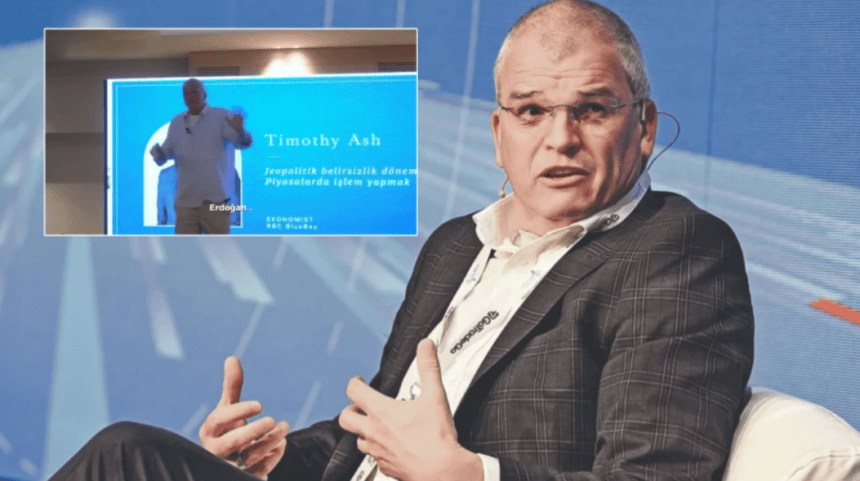
The British economist immediately withdrew Erdoğan’s name after invoking an era of “sociopathic leaders.” His subsequent explanation was that it was simply a slip of the tongue. But Ash’s long record on Turkey — deeply attached to the country, often admiring of its achievements and close to figures in its business and defence establishment while simultaneously critical of Erdoğan’s concentration of power — makes the episode more complicated.
British economist Timothy Ash seemed to know almost immediately that he had said something in Turkey that could have consequences.
Speaking at a financial gathering in Bodrum, Ash was discussing the growing tendency for the personal interests of powerful political leaders to shape the behaviour of states.
He referred to Donald Trump and Vladimir Putin and then suggested that the world might be living through an era of “sociopathic leaders.” As he continued the thought, he mentioned Israeli Prime Minister Benjamin Netanyahu — and then Turkish President Recep Tayyip Erdoğan.
Almost immediately, Ash pulled back.
He said he had not said it, asked for the recording to stop and joked that the remark would probably appear in Sabah the following day.
The prediction was almost prophetic.
The footage circulated in Turkish media, Sabah portrayed the remarks as an attack on Erdoğan, and on August 27 the Bakırköy Chief Public Prosecutor’s Office announced that it had opened an ex officio investigation into Ash for alleged “insulting the president.”
The prosecutor’s office confirmed that the investigation had been triggered after video of Ash’s comments at the Muğla meeting appeared in the media.
Ash had predicted the backlash before it happened.
But another question soon emerged: was the Erdoğan reference really nothing more than the accidental verbal mistake Ash later claimed it was?
A Slip — or an Unfiltered Thought?
Ash moved rapidly to contain the damage.
He described what happened as a genuine slip of the tongue, stressed that he had immediately withdrawn the remark and said absolutely no offence had been intended. He also rejected any comparison between Erdoğan and Netanyahu, praising Erdoğan’s position on Gaza and the Palestinians. T24 reported his clarification on the evening of August 27.
That may be exactly what happened.
There is no way to know with certainty what Ash intended in the few seconds before his retraction, and a fragment of unscripted speech cannot establish what someone privately believes.
Yet the structure of the original argument makes the episode difficult to dismiss as meaningless.
Ash was not discussing an unrelated subject when Erdoğan’s name suddenly appeared. He was talking specifically about leaders, personal power and the extent to which individual interests can supersede those of the states they govern. He invoked Trump and Putin, referred to an age of “sociopathic leaders,” then moved to Netanyahu and Erdoğan.
Only after Erdoğan’s name came out did he abruptly retreat.
That sequence permits another interpretation: perhaps the mistake was not that Ash thought of Erdoğan in that context, but that he allowed the thought to become public.
His reaction is revealing in another respect. Ash immediately predicted the political-media consequences. He understood that the remark could provoke precisely the kind of reaction that followed.
The question, therefore, is not simply whether Ash intended formally to label Erdoğan a sociopath. The recording does not establish such a direct declaration.
The more interesting question is whether Erdoğan’s name surfaced because Ash holds a considerably harsher underlying view of the Turkish president than the carefully calibrated language he normally uses in public.
His own writings show why that possibility cannot simply be dismissed.
Ash Loves Turkey — In His Own Words
Ash is not an outsider with a passing interest in Turkish politics.
He has covered Turkey for more than 25 years as an economist and emerging-markets analyst. He is currently BlueBay Emerging Market Senior Sovereign Strategist at RBC Global Asset Management.
More importantly, his attachment to Turkey is something Ash himself openly acknowledges.
In a lengthy June 2026 essay examining his perspective and biases, Ash recalled how he began covering the country professionally around 2000.
“As it was I ended up loving it,” he wrote.
He went on to explain that he loves covering Turkey because of its politics, geopolitics, economics, culture, history, food and, “above all,” its people. He praised Turks as exceptionally hospitable and noted that, as a foreign analyst, he has been able to secure meetings at the highest levels.
This matters when trying to understand Ash’s treatment of Erdoğan.
His relationship with Turkey is not simply analytical. After more than two decades, there is an unmistakable affection for the country and a substantial network of political, business, diplomatic and financial contacts.
And Ash’s assessment of Erdoğan himself has never been one-dimensional.
He Criticizes Erdoğan — But He Also Clearly Admires Aspects of Him
Ash has been highly critical of Erdoğan in important areas.
He has blamed the concentration of power around the presidency and the erosion of institutional checks and balances for major policy errors. He has been particularly critical of the unorthodox interest-rate experiment that produced high inflation and currency depreciation.
In his June assessment, Ash described Turkey’s weak rule of law, political manipulation of the legal system and excessive concentration of executive power as serious weaknesses.
Yet the same Ash who writes those criticisms has also expressed considerable admiration for Erdoğan as a political leader.
Asked directly in June 2026 for his assessment of the president, Ash called the picture “mixed” but described Erdoğan’s political survival skills in extraordinary terms.
He wrote that many observers would have to conclude that Erdoğan was a “political genius” and argued that he was arguably the most consequential Turkish leader since Mustafa Kemal Atatürk.
That is far removed from the language normally associated with a reflexively anti-Erdoğan commentator.
Ash has also credited Erdoğan with genuine achievements.
He regards the first decade of AKP government as a period of important reform and economic progress, even though he believes the system deteriorated significantly after the Gezi protests and became increasingly concentrated around Erdoğan personally.
More recently, Ash has repeatedly portrayed developments in Turkey’s international position as major victories for Erdoğan.
In July 2026, he titled one analysis “NATO summit is a huge win for Erdogan.” He highlighted Erdoğan’s relationship with Trump, Turkey’s military-industrial strength and Ankara’s growing importance to Western defence calculations.
His February trip notes were similarly positive about Turkey’s improving strategic position and about the economic stabilisation programme implemented after Mehmet Şimşek’s return to government.
Ash therefore does not fit comfortably into either of Turkey’s familiar political camps.
He can be deeply critical of Erdoğan’s governance while admiring his political instincts. He can condemn Erdoğan’s economic mistakes while celebrating Turkey’s geopolitical victories. He can worry about the rule of law while arguing that Erdoğan remains an extraordinarily capable political operator.
That tension is essential to understanding what happened in Bodrum.
Then There Is the Bayraktar Connection
Another part of Ash’s record makes the story still more interesting: his exceptionally positive assessment of the Bayraktar family and Turkey’s defence-technology establishment.
Selçuk Bayraktar, Erdoğan’s son-in-law, has repeatedly been singled out by Ash as one of the most impressive figures in contemporary Turkey.
Following Erdoğan’s 2023 election victory, Ash argued that what he called the “Bayraktar line” was gaining influence within the governing establishment.
His description was strikingly complimentary.
Ash characterised the Bayraktar-associated tendency as “rational, logical, meritocratic” and credited Turkey’s technological achievements — particularly its drones and defence platforms — with contributing to Erdoğan’s political success.
He also identified Selçuk Bayraktar as a potentially powerful eventual successor to Erdoğan.
Elsewhere, Ash called Selçuk Bayraktar “Turkey’s Elon Musk” and predicted that he would be an exceptionally strong presidential candidate if he ever entered electoral politics.
That admiration has continued.
In February 2026, Ash wrote that Erdoğan’s son-in-law continued to produce “technology and defence wins” for Turkey, praised Baykar’s extraordinary export performance and again identified Bayraktar as a credible technocratic presidential successor.
And Ash’s connection to the Bayraktar ecosystem is not limited to commentary from a distance.
In October 2023, Ash co-authored an article on Ukraine’s defence sector with Haluk Bayraktar, Selçuk Bayraktar’s brother and the chief executive of Baykar. The joint article argued for the development of Ukraine’s domestic defence capabilities and appeared under both men’s bylines.
Ash later wrote about attending a 2024 defence-industry gathering in London at which Haluk Bayraktar was also present, describing Baykar’s role in Ukraine in highly favourable terms.
These are meaningful professional connections.
They do not prove a private friendship of any particular depth, and there is no public evidence that either Selçuk or Haluk Bayraktar intervened in the investigation against Ash.
But they do establish something more substantial than an analyst simply praising a company from afar: Ash has interacted professionally with senior figures from the Bayraktar-Baykar circle and has publicly promoted an extremely favourable assessment of their technological and political significance.
That background could help explain why direct criticism of Erdoğan presents Ash with a complicated dilemma.
The Restraint Makes Sense
Ash’s affection for Turkey is genuine.
His criticism of Erdoğan is also genuine.
So is his admiration for the country’s defence transformation and his enthusiasm for the Bayraktar model.
Those positions can coexist, but they create an obvious tension.
For someone who has spent more than 25 years cultivating access across Turkey’s establishment, direct personal condemnation of Erdoğan could carry costs that ordinary outside commentators do not face.
People with long-established relationships, professional access and genuine affection for a country frequently choose their words differently from commentators with no relationships to preserve.
Ash himself emphasises how valuable his high-level access in Turkey has been.
Viewed in that context, the Bodrum moment takes on a different character.
Perhaps Erdoğan’s name simply entered the sentence accidentally.
But perhaps Ash briefly expressed an association that already existed in his mind and then, almost instantaneously, remembered everything that saying it publicly might jeopardise.
His “Sabah tomorrow” reaction suggests that he certainly understood the environment.
The Retraction Came Fast. So Did the Apparent End of the Investigation
Then came another remarkable development.
Only hours after the investigation became public, Ash announced that he had been informed that Turkish authorities had closed it.
According to Ash, the authorities had examined the issue and determined that the allegations had no merit and that there was no case. His August 27 statement was reproduced by other international news outlets.
There is an important distinction, however.
The opening of the investigation was publicly confirmed by the Bakırköy Chief Public Prosecutor’s Office and reported by Turkey’s state news agency and DHA.
The claim that it was subsequently closed came from Ash.
As of August 28, no equally prominent public announcement from the prosecutor’s office explaining the closure had emerged.
That does not mean Ash’s account is incorrect. It simply means the two developments have different levels of official public confirmation.
The extraordinary speed nevertheless raises an obvious question.
Did Ash’s stature, relationships or connections help?
There is currently no evidence demonstrating that they did.
There is no evidence that the Bayraktar family intervened, that Erdoğan ordered the case closed or that anyone inside the government contacted prosecutors on Ash’s behalf.
But the question will inevitably arise precisely because Ash is not an ordinary foreign critic.
He is a prominent international investor and analyst who has spent decades building relationships in Turkey; who openly says he loves the country; who has access to senior figures; who has repeatedly praised Erdoğan’s geopolitical accomplishments; who regards Selçuk Bayraktar as one of Turkey’s most impressive political and technological figures; and who has even published jointly with Baykar CEO Haluk Bayraktar.
Against that background, a criminal investigation that appears to have opened and disappeared within hours is bound to attract scrutiny.
Article 299 and the Bigger Problem
The episode is also another reminder of the extraordinary sensitivity surrounding criticism of Erdoğan.
Turkey’s Article 299 criminalises insulting the president and has been used extensively during Erdoğan’s presidency.
The European Court of Human Rights dealt directly with the law in its 2021 Vedat Şorli v. Turkey ruling.
The Strasbourg court unanimously found a violation of freedom of expression and said that giving a head of state enhanced protection through a special criminal insult provision was incompatible with the spirit of the European Convention on Human Rights. It also warned of the chilling effect created by criminal investigations and punishment for political expression.
Ash’s reaction in Bodrum provides an almost textbook illustration of that chilling effect.
He said Erdoğan’s name.
He immediately tried to withdraw it.
He asked for the recording to stop.
He predicted the hostile press coverage.
Then the investigation came.
Whether or not the remarks ultimately met any reasonable definition of criminal insult, Ash behaved as someone who already understood the potential price of speaking too freely about Turkey’s president.
Maybe the Remark Was the Retraction — Not the Thought
That leaves the central question.
Ash says Erdoğan’s name was a slip of the tongue.
It may have been.
But there is another way of understanding what happened.
The underlying thought may not have been accidental at all. The real “slip” may simply have been allowing an unfiltered version of that thought to escape into a recorded conversation.
Ash’s own published record shows that he understands the darker dimensions of Erdoğan’s rule perfectly well. He has written about the overconcentration of power, institutional deterioration, questionable economic decisions and political manipulation of the judicial system.
At the same time, Ash loves Turkey. He admires much of what the country has achieved. He considers Erdoğan an extraordinary political talent. He views Turkey’s growing strategic importance positively. And his relationship with the defence-industrial ecosystem surrounding the Bayraktar family is unusually warm and professionally substantive.
That combination may naturally produce restraint.
Ash can dislike important aspects of Erdoğan while still wanting Turkey to succeed. He can admire Selçuk Bayraktar without endorsing every feature of Erdoğan’s political system. He can praise Erdoğan on Gaza or geopolitics while privately holding a far more severe judgment of the president’s style of leadership.
Those positions are not contradictory.
They may, in fact, explain the Bodrum moment.
For a few seconds, Timothy Ash spoke without the careful qualifications that normally characterize his writing about Erdoğan.
Then he realised what he had said.
And, remarkably, he predicted what would happen next.
The newspaper backlash followed. The prosecutors followed.
And then, according to Ash, the case disappeared almost as quickly as it had appeared.
The episode therefore leaves behind a more interesting question than whether a British economist technically insulted the Turkish president:
Did Timothy Ash accidentally say something he did not believe — or did he accidentally say aloud something he usually knows better than to say so directly?