
Footage of heavily armed officers surrounding an elderly, partially paralyzed man has intensified criticism that Turkey’s latest mass operation relied on intimidation and spectacle against people who appeared to pose no immediate physical threat.
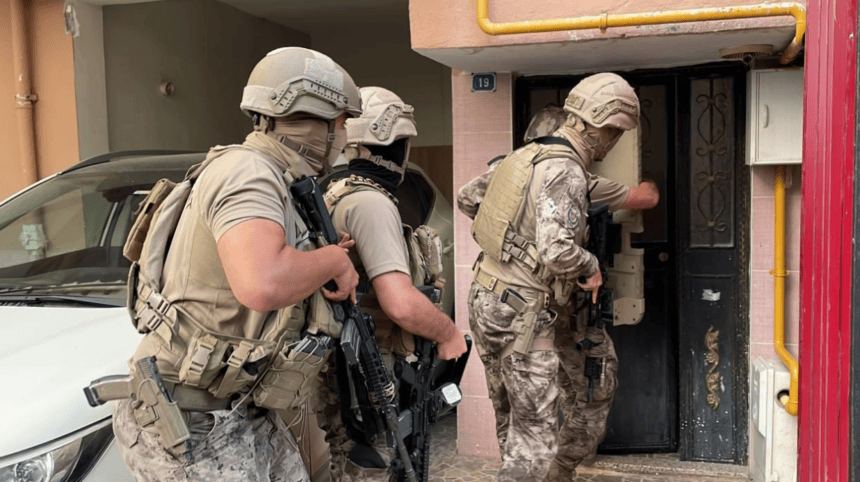
Masked police officers carrying assault rifles raided homes across Turkey on Monday in a nationwide operation targeting hundreds of people accused of links to the faith-based Gülen movement.
The operation was launched on July 13, two days before the 10th anniversary of the failed coup of July 15, 2016. Justice Minister Akın Gürlek and Interior Minister Mustafa Çiftçi initially announced that 968 suspects were being targeted in coordinated raids across all 81 provinces. Turkish newspaper Oksijen reported that the largest numbers of suspects were in Ankara, İzmir and Istanbul.
Updated figures released after the raids said proceedings had been initiated against 973 people, of whom 704 had been taken into custody. Authorities said efforts were continuing to apprehend another 269 people. The reason the initial total of 968 increased to 973 was not publicly explained.
According to figures published by Turkish media, the 704 detainees included 170 active public employees, six retired public employees, 44 people previously dismissed from government service and 484 private-sector employees or other civilians.
The active public employees reportedly included police officers, a gendarmerie officer, prison guards, a court clerk, teachers, doctors, nurses, a dietitian, university lecturers and research assistants. Five lawyers were also among those taken into custody.
Yet it was not merely the scale of the operation that provoked criticism. Images emerging from the raids showed the disturbing methods used against some of the suspects.
Footage carried by pro-government media and subsequently circulated on social media showed approximately a dozen masked and heavily armed officers at the home of an elderly man. The officers were equipped with long-barrelled weapons and tactical equipment.
The man appeared to have serious mobility problems. One of his arms seemed unusable, and he struggled to walk as officers held and escorted him from the property. A Turkish report described him as elderly and partially paralyzed.
There was no publicly available indication that the man was armed, violent or attempting to resist the officers. His physical condition, as visible in the footage, suggested that he was unlikely to present an immediate danger to a large tactical police unit.
His identity, precise medical condition and the specific allegations against him were not disclosed.
Independent Turkish reporting said sick, elderly, paralyzed and disabled people were among those detained during the nationwide operation. Students were also reportedly targeted.
The images raised an obvious question: Why were masked tactical officers carrying assault rifles needed to remove a visibly disabled elderly man from his home?
Police may take reasonable precautions when executing a detention order. But those precautions should be based on an individual assessment of the person involved, including whether the suspect has a history of violence, possesses weapons, is likely to resist or presents a genuine risk to officers or the public.
The visible deployment of overwhelming force against an elderly man who could barely walk appeared profoundly disproportionate.
The authorities did not explain whether an individual security assessment had been conducted before the raid or why ordinary officers could not have carried out the detention without assault rifles, masks and tactical equipment.
A spectacle of power
The operation appeared designed not only to detain suspects but also to produce dramatic images demonstrating the government’s determination ahead of the coup anniversary.
Masked officers, long-barrelled weapons, coordinated dawn raids and politically charged announcements helped create the appearance of an urgent battle against a dangerous armed network.
But the people taken into custody included teachers, healthcare workers, academics, lawyers, retired public employees, private-sector workers and people with serious medical problems.
The government has not publicly alleged that every person targeted in the operation participated in violence, possessed weapons or was preparing an attack.
The use of tactical units against vulnerable civilians therefore risks turning law enforcement into political theatre. It publicly portrays suspects as dangerous terrorists before prosecutors have presented individualized evidence and before a court has determined their guilt.
A detention order is not a conviction. Every person taken into custody remains legally entitled to the presumption of innocence.
That principle becomes meaningless when government officials, police operations and media coverage collectively present suspects as enemies of the state before they have appeared before a judge.
Government describes operation as an ‘purification campaign’
The language used by senior officials reinforced concerns that the operation was not being presented as an ordinary criminal investigation.
Gürlek described the raids as part of a major “purification campaign’. He thanked President Recep Tayyip Erdoğan for strengthening the government’s determination through his leadership and said the struggle would continue against what the government calls the FETÖ/PDY network.
Such language effectively places the suspects outside the ordinary protections of criminal justice. Rather than emphasizing individual evidence, specific criminal conduct and the presumption of innocence, it portrays an entire category of people as contamination from which the state must be “purified.”
Ten years of mass investigations
The Gülen movement is a worldwide faith-based civic initiative inspired by the late Muslim cleric Fethullah Gülen.
Erdoğan’s government began its campaign against the movement after corruption investigations became public in December 2013. The investigations implicated government ministers as well as members of Erdoğan’s family and political circle.
Erdoğan dismissed the investigations as a conspiracy to overthrow his government and subsequently designated the movement a terrorist organization.
Following the coup attempt of July 15, 2016, Erdoğan immediately accused Gülen and his followers of responsibility. The movement has consistently denied involvement in the coup attempt and rejects Ankara’s characterization of it as a terrorist organization.
The coup attempt was followed by a two-year state of emergency and an unprecedented purge of Turkey’s military, judiciary, police, education system, diplomatic service, media and other public institutions.
Figures attributed to Turkey’s Justice Ministry illustrate the extraordinary reach of the investigations.
As of June 30, 2026, authorities had taken judicial action against 720,580 people in Gülen-related cases. When people named in complaints but not formally investigated are included, the total number drawn into the process reached approximately 2.28 million.
Prosecutors reportedly issued decisions not to pursue charges against 373,642 people, while courts acquitted 124,861. A total of 127,102 people received convictions, although considerably fewer of those judgments had become final. Another 83,836 people remained under investigation or prosecution.
The exceptionally high number of non-prosecution decisions and acquittals raises questions about how many people were subjected to investigation, detention, loss of employment and public stigmatization without sufficient evidence to establish criminal responsibility.
These numbers also demonstrate why the latest operation cannot be regarded as an isolated police action. It is part of a campaign that has continued for a decade and has affected a significant part of Turkish society.
July 15 as a permanent justification
The timing of the operation was clearly connected to the anniversary of the coup attempt.
Government statements repeatedly invoked July 15 and described the raids as a continuation of the struggle that followed the events of 2016. The raids were launched amid official commemorations portraying July 15 as a defining and unquestionable moment in Turkey’s political history.
For Erdoğan, the coup attempt became a critical turning point. Its aftermath enabled his government to remove perceived opponents from state institutions, close media outlets and civil society organizations, reshape the judiciary and expand presidential control.
A decade later, July 15 continues to be used to justify mass operations against people who were never accused of taking part in the coup itself.