

Recep Tayyip Erdoğan rose to power promising to liberate Turkey’s religious conservatives from state tutelage. More than two decades later, the destruction of the Gülen movement, the operations against the Süleymancılar and Furkan, the imprisonment of Erdoğan’s strongest secular opponent and the judicial takeover of the CHP suggest a darker conclusion: Erdoğan did not abolish tutelage. He personalized it.
There is a profound historical irony at the center of Recep Tayyip Erdoğan’s Turkey. Erdoğan emerged from the political tradition that regarded itself, with considerable justification, as one of the principal victims of the February 28 process. His generation experienced a republic in which generals, judges, prosecutors, university administrators and an aggressively secular establishment claimed the authority to determine how visible Islam could be in public life, which religious schools could operate, which Islamic communities were legitimate and even whether a young woman wearing a headscarf could study at university. February 28 was therefore never simply a National Security Council meeting or the removal of Necmettin Erbakan from government. It represented a philosophy of state tutelage in which autonomous religious society was regarded as inherently dangerous whenever it became strong enough to compete with the state for loyalty, education, wealth or political influence.
Erdoğan converted that history of humiliation into one of the foundations of his political legitimacy. He promised conservative Turks that never again would unelected institutions classify Muslims as acceptable or unacceptable, determine which religious communities could operate freely or use the machinery of the state to discipline citizens because of their beliefs. Yet nearly three decades after February 28, Turkey is again witnessing autonomous Islamic communities confronted by mass detention, criminal-organization accusations, financial investigations, trusteeships, company takeovers and a media atmosphere in which allegations against religious networks can rapidly become presumed facts before courts establish individual guilt. The extraordinary difference is that the political authority presiding over this process is no longer a secular military establishment. It is an Islamist president.
The events of August 2026 have made this contradiction impossible to dismiss. On August 13, authorities carried out a sweeping operation against the Süleymancılar across 17 provinces, detaining community leader Alihan Kuriş and numerous others. Kuriş and 31 other suspects were subsequently jailed pending trial. Prosecutors accuse individuals in the investigation of operating a criminal organization for financial gain and of offenses involving money laundering, fraud and taxation. These are serious accusations, and no religious affiliation can provide immunity from criminal law. If an individual has committed fraud, laundered money or forged documents, prosecutors should prove that offense before an independent court and that individual should be punished accordingly. The democratic problem begins when allegations against individuals are transformed into a criminal identity imposed upon an entire religious community.
Only six days later, on Wednesday, August 19, counterterrorism police launched another coordinated operation, this time against Alparslan Kuytul and the Furkan movement. Kuytul was detained at his home in Adana together with his wife, Semra Kuytul, while other Furkan members and associates were taken into custody in raids across six provinces. Police searched 49 locations, and proceedings were announced against 32 suspects. Furkan said one of Kuytul’s lawyers was also among those detained. Five companies were placed under trusteeship, while restrictions were imposed on 349 social-media accounts. The allegations range from establishing or managing a criminal organization to money laundering, fraud, forgery and tax offenses.
Again, the argument is not that religious people cannot commit crimes or that every allegation is necessarily fabricated. The issue is whether Turkey is investigating identifiable crimes committed by identifiable individuals or progressively treating politically independent religious communities themselves as suspect social organisms whose leadership, businesses, institutions and communications infrastructure can be attacked before a final judgment establishes guilt.
The political sequence surrounding Kuytul’s detention makes this question particularly disturbing. Kuytul had publicly criticized the Süleymancılar operation and argued that the community was being punished because it had ceased reliably supporting Erdoğan’s Justice and Development Party. He said some of its members had even supported the secular opposition CHP and declared that, had the community continued voting for the AKP, he was certain the operation would not have occurred. That remains Kuytul’s interpretation rather than an established judicial fact. But what happened immediately afterward transformed his accusation into a much larger political controversy.
Oktay Saral, a chief adviser to Erdoğan, publicly told Kuytul that “your turn will come.” Saral also used a Turkish expression warning that the water had already heated up for him.
The following morning the police came.
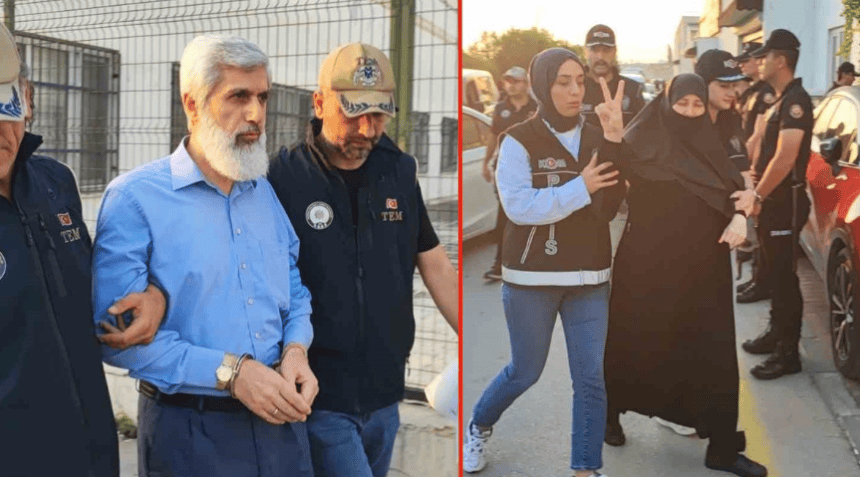
Kuytul was detained together with his wife and other members of his movement.
When one of the president’s advisers publicly predicts that a critic will be next and counterterrorism officers arrive at that critic’s home the following morning, the government cannot reasonably demand that citizens regard the political threat and the judicial action as completely unrelated events.
The broader question is therefore not whether Erdoğan remains an Islamist. He does. The question is whether an Islamist president has adopted one of February 28’s central authoritarian principles: organized religious power may exist only as long as it remains subordinate to the political state.
The lead image above almost speaks for itself. It shows Alparslan Kuytul being escorted by police and his wife, Semra Kuytul, being taken into custody by a female police officer who herself wears a headscarf. The symbolism is striking. During the February 28 era and the late 1990s, Turkey repeatedly saw images of secular-looking female police officers, university officials and other female representatives of the state confronting, harassing, detaining or physically removing headscarved conservative women in the name of the secular order. Today, the image is almost the reverse: a headscarved female police officer is now the representative of state power taking another headscarved conservative woman into custody. The headscarf has changed sides of the police line, but the machinery of coercion has not disappeared. That reversal captures the transformation at the heart of Erdoğan’s Turkey: February 28 has not returned in its old secular appearance; some of its methods of controlling independent religious society have instead been absorbed and redeployed from within the very conservative social world that once suffered under them.
The Gülenists Were the First Test Case
The present moment cannot be understood without confronting what happened to the Gülen movement. Erdoğan accused the movement of orchestrating the July 15, 2016 coup attempt, an accusation that the movement has consistently denied. Anyone who participated in a military coup, ordered violence or committed another demonstrable criminal act should have been investigated individually and given a fair trial. But what followed July 15 went vastly beyond determining who participated in an attempted military uprising. The state progressively transformed a huge religious, educational, professional and social community into a category of collective suspicion.
Teachers became terrorism suspects because of the schools in which they worked. Businesspeople lost companies because of social connections. Journalists were imprisoned. Academics and civil servants were dismissed. Accounts at Bank Asya, children’s attendance at particular schools, employment at institutions that had previously operated legally, union membership, newspaper subscriptions, donations, associations and the use of the ByLock messaging application became elements in terrorism cases. Women could find themselves detained because of allegations against their husbands. Families were divided between prison, unemployment and exile.
According to government figures released in 2026, more than 720,000 people have been investigated and more than 127,000 convicted over alleged Gülen links since the coup attempt. Hundreds of companies were taken under state trusteeship. Schools, universities, media organizations, charities, foundations and businesses disappeared from Turkey’s social landscape. Whatever legitimate criminal investigations existed within that enormous process, the state’s response became something far larger than identifying individuals responsible for July 15.
It became the destruction of an entire social milieu.
One of Turkey’s greatest democratic failures was that so much of society accepted this because the victims were Gülenists. Many secularists had despised the movement for years and felt little obligation to defend its members. Nationalists treated Gülenists as collective enemies of the republic. Erdoğan loyalists portrayed almost every demand for due process as sympathy for terrorism. Other Islamic communities often remained silent, perhaps believing that an exceptional state apparatus constructed against an exceptional enemy would never be turned toward them.
That was a catastrophic mistake.
One never needed to admire Fethullah Gülen to defend a Gülenist’s civil rights. One did not need to accept the movement’s theology, defend its political alliances or deny wrongdoing by particular members. The principle should have been much simpler: a Gülenist has the same right to individual guilt, individual evidence and the presumption of innocence as every other citizen.
Instead Turkey accepted a different principle: once the state identifies a community as dangerous, ordinary membership, sympathy, employment or association can itself become suspicious.
Once that principle was normalized, Erdoğan acquired an extraordinarily powerful instrument of government. Police learned how to conduct network-based mass investigations. Prosecutors learned how to construct enormous organization cases. The bureaucracy learned how quickly companies and institutions could be seized or closed. Government trustees became instruments capable of destroying economic independence before years of litigation reached a final conclusion. Media narratives learned to convert accusations into social identities.
Many Islamic communities may have believed that machinery belonged exclusively to the Gülen case.
It did not.
Furkan subsequently faced years of raids, prosecutions and administrative pressure. Now the Süleymancılar are confronting one of the largest operations in their recent history. And when Kuytul criticized that operation and argued that political loyalty was the real issue, he was warned publicly by a presidential adviser and detained the next morning together with his wife and other members of his movement.
The Gülen movement, the Süleymancılar and Furkan are not identical. They differ profoundly in theology, organizational culture, historical development and political strategy. What increasingly appears to place them in the same category from Erdoğan’s perspective is not doctrine.
It is autonomy.
The Gülen movement possessed independent schools, businesses, media institutions, professional networks and an enormous international presence. The Süleymancılar possess a religious and educational tradition considerably older than the AKP and do not derive their legitimacy from Erdoğan. Furkan has developed an independent following around Kuytul, who criticizes Erdoğan from inside an Islamist worldview rather than from Turkey’s secular political tradition.
All can tell conservative Muslims something increasingly dangerous to a personalized political system:
Islam is not Erdoğan, and opposing Erdoğan does not mean opposing Islam.
The Secular Opposition’s Extraordinary Contradiction
The inconsistency of sections of Turkey’s secular opposition becomes especially striking when one compares their reaction to the operations against religious communities with what the state is simultaneously doing to the CHP. If one wants evidence that Turkey’s judiciary has become capable of restructuring political life rather than merely adjudicating crimes, it is difficult to imagine a more dramatic sequence than the events of 2025 and 2026.
Ekrem İmamoğlu, the politician who twice defeated Erdoğan’s political machine in Istanbul and emerged as perhaps the president’s strongest potential national challenger, was detained in March 2025 and placed in pretrial detention. The day before his detention, Istanbul University revoked the degree required for him to qualify constitutionally as a presidential candidate.
İmamoğlu was not an isolated case. Numerous CHP mayors, municipal officials and party figures have been detained, suspended or prosecuted. Opposition-controlled municipalities have faced a succession of operations that gradually transformed legal proceedings into a major restructuring of political competition.
Then the judiciary crossed an even more extraordinary threshold.
On May 21, 2026, an Ankara appeals court annulled the CHP’s November 2023 congress, removed Özgür Özel and the party’s entire elected leadership and restored Kemal Kılıçdaroğlu and his previous administration.
This is not merely unequal campaigning.
It is not simply biased television.
It is not just a government enjoying the advantages of incumbency.
A court effectively told the country’s largest opposition party that the leadership chosen by its own delegates would no longer lead it and restored the leadership those delegates had voted to remove.
That event should have transformed the way Turkey is analytically described.
For years, political scientists commonly described Erdoğan’s Turkey through concepts such as competitive authoritarianism. The concept was useful because it captured a political system in which elections were deeply unfair, institutions favored the incumbent and opposition forces were harassed, but opposition parties still possessed meaningful organizational autonomy and the governing party still faced a genuine possibility of losing electoral contests.
That description is increasingly inadequate.
Competition cannot meaningfully be called autonomous when the state can imprison the opposition’s strongest presidential candidate, eliminate his legal eligibility to run, arrest elected mayors and then use a court to invalidate the main opposition party’s internal leadership election and remove its chairman.
Elections may still take place.
Opposition parties may still receive millions of votes.
Citizens may still enter polling stations.
But the state is increasingly deciding who is permitted to compete, which opposition leadership may organize that competition and whether a victory or internal party result will be allowed to stand.
That is not merely competitive authoritarianism.
It is increasingly a personalist electoral autocracy in which elections survive but organized competition exists only within boundaries that the ruling system reserves the power to rewrite.
The same political circles that correctly recognize extraordinary judicial interference when İmamoğlu is imprisoned or the CHP congress is annulled can suddenly become far less skeptical when prosecutors target the Süleymancılar, Furkan or previously the Gülen movement. When the accused is a CHP mayor, they emphasize political motive, presumption of innocence, judicial independence and the possibility that criminal law is being weaponized. When the accused belongs to a religious community they distrust, some reproduce the state’s language of “criminal organization,” “secret network,” “financial empire” or “new FETÖ” with strikingly little hesitation.
The motivations differ. Pro-government voices may attack a religious community because it is politically unreliable for Erdoğan. Secularist voices may distrust tarikats and cemaats because of ideological hostility toward organized religion. Nationalist-statist voices may regard autonomous religious communities as rival centers of authority.
Different roads arrive at the same police operation.
That is why the contradiction matters. If prosecutors can be politically weaponized when they investigate İmamoğlu, why should they automatically be presumed independent when they investigate Alihan Kuriş? If an indictment does not establish that a CHP mayor is corrupt, an indictment cannot by itself establish that an entire Islamic community is a criminal organization. If judicial intervention in the CHP’s internal congress is an assault on political autonomy, the institutional destruction of a religious community before final judgment should also provoke scrutiny.
The Turkish judiciary cannot be Erdoğan’s political weapon when it comes for secular politicians and an unquestionable guardian of truth when it comes for Muslims the secular opposition dislikes.
Either the rule of law is universal, or it is something else.
İmamoğlu deserves the presumption of innocence.
So does Alparslan Kuytul.
So does Alihan Kuriş.
So did hundreds of thousands of Gülenists.
The principle cannot depend upon the identity of the defendant.
Turkey Has Moved Beyond “Competitive Authoritarianism”
The annulment of the CHP congress should therefore be understood as a qualitative political turning point. Earlier versions of Erdoğanism distorted political competition while generally leaving opposition organizations formally intact. The playing field was unequal, the media environment heavily tilted, state resources favored the incumbent and opposition leaders faced legal harassment, but elections could still produce major defeats for the ruling party. The CHP could win Istanbul, Ankara and eventually the 2024 local elections nationally. This was the strongest basis for continuing to call Turkey a competitive authoritarian regime.
That description becomes much harder to defend once Erdoğan’s most serious rival is physically removed from electoral competition and the judiciary can determine who leads the principal opposition party. At that point the regime is no longer simply manipulating competition; it is arrogating to itself the power to constitute the opposition itself.
This distinction is fundamental. A competitive authoritarian government cheats while facing an opponent it does not entirely control. A hegemonic electoral autocracy increasingly determines the conditions under which an opponent may exist. One controls television. The other controls the identity of the challenger. One uses state money in campaigns. The other can imprison the likely presidential candidate. One pressures an opposition party. The other can nullify that party’s congress and remove its chosen leadership.
Turkey has crossed increasingly far into the second category.
The CHP’s 2024 electoral victory makes the transformation particularly revealing. When voters demonstrated that Erdoğan could be defeated at the local level and gave the CHP the strongest national result of its recent history, the response was not simply an effort to govern better, repair the economy and win those voters back. Instead the period that followed brought escalating investigations against opposition municipalities, the detention of İmamoğlu, the annulment of his diploma and eventually judicial intervention in the CHP’s own leadership.
That sequence suggests an increasingly explicit lesson:
If the opposition becomes electorally dangerous, the state will not merely compete with it. The state may reorganize it.
A political system cannot plausibly preserve the adjective competitive indefinitely under those conditions.
Erdoğan Has Learned That Elections Can Be Stolen in More Than One Way
Erdoğan’s evolving relationship with religious constituencies cannot be separated from his experience with elections. The conventional democratic assumption is that a ruler facing dissatisfied conservative voters must negotiate with religious communities because every bloc of votes matters. Erdoğan increasingly behaves as though this is no longer true. One reason may be that Turkey’s recent electoral history has taught him that elections can be controlled, distorted or effectively stolen in several different ways.
The word stolen should not be reduced to only one image—officials secretly adding millions of fabricated ballots after polling stations close.
An election can be stolen administratively.
It can be stolen institutionally.
It can be stolen through coercion.
It can be stolen by excluding the most dangerous candidate before voting begins.
It can be stolen by annulling a result after voters choose the wrong winner.
And there are moments in Turkey’s recent history when there is serious reason to ask whether manipulation reached the ballot count itself.
The 2017 constitutional referendum is the strongest case. Erdoğan won the referendum establishing the presidential system by only 51.4 percent to 48.6 percent—a margin of roughly 1.38 million votes. During the vote, election authorities controversially changed their approach to unstamped ballots, weakening a safeguard at the most politically consequential moment possible.
More importantly, later peer-reviewed election-forensic research went considerably further. Researchers examining official polling-station data found systematic and statistically significant patterns consistent with both ballot stuffing and voter rigging in the 2017 referendum. Their analysis detected ballot-stuffing characteristics in roughly 11 percent of polling stations and concluded that the magnitude of the anomalies may have been large enough to change the referendum from a “No” victory into the official “Yes” result. The authors were careful: election forensics cannot by itself provide incontrovertible proof of actual fraud, and false positives cannot be completely excluded. But their findings make it equally irresponsible to insist that direct vote manipulation can simply be dismissed as fantasy.
The same research found similar statistically significant patterns in the 2018 presidential and parliamentary elections, including evidence compatible with ballot stuffing and voter rigging. The authors specifically concluded that the 2017 anomalies should not be regarded as a one-time lapse and identified structural biases requiring further investigation.
This matters enormously for understanding Erdoğan’s psychology of power. The Turkish opposition often discusses election manipulation exclusively in terms of biased television or state resources. Those factors are certainly important, but Turkey’s own electoral history provides reason to take more direct forms of manipulation seriously as well.
Then came Istanbul in 2019, which demonstrated another form of electoral theft in broad daylight. Ekrem İmamoğlu defeated the AKP candidate. Instead of accepting the result, the governing political machine challenged it until the Supreme Election Council annulled the mayoral contest and ordered Istanbul to vote again. Other ballots cast during the same election were allowed to stand. Voters had elected a mayor, and an institution of the state effectively told them that their choice would not be accepted.
That attempt failed only because Istanbul’s voters refused to submit. In the rerun, İmamoğlu won by a dramatically larger margin.
But the lesson Erdoğan could take from the episode was still important: an unfavorable electoral result could be challenged through the institutions of the state. The first vote did not have to be politically final.
The 2023 presidential election added another layer to this history. In the final days before voting, a striking number of major surveys showed Kemal Kılıçdaroğlu ahead. KONDA put Kılıçdaroğlu at 49.3 percent and Erdoğan at 43.7 percent. Yöneylem, MetroPOLL, Türkiye Raporu, ORC, MAK and several other final surveys also showed the opposition candidate leading.
The official first-round result was almost the reverse: Erdoğan received approximately 49.5 percent and Kılıçdaroğlu roughly 44.9 percent.
Therefore, it would be careless to examine 2023 as if nothing had happened before it. Turkey entered that election with a history that already included the 2017 referendum controversy, statistically significant evidence compatible with ballot stuffing and voter rigging in 2017 and 2018, the annulment of the opposition’s Istanbul victory in 2019 and a deeply unequal media and institutional environment.
The burden should therefore not be on skeptics to pretend that manipulation is unimaginable.
Turkey has demonstrated several mechanisms through which electoral will can be distorted.
And today Erdoğan possesses even more power than he did during some of those earlier elections.
Erdoğan may believe he needs enough public support to maintain legitimacy, but he may no longer believe that losing a particular religious constituency threatens his survival. If necessary, political competition can be distorted. Candidates can be prosecuted. Party organizations can be weakened. Internal opposition elections can be annulled. Media narratives can be dominated. And Turkey’s past provides serious reasons to worry that even the integrity of ballot-level outcomes cannot simply be assumed beyond question.
Erdoğan may therefore calculate that he can lose voters without necessarily losing power.
That calculation changes everything.
Why Economic Anger No Longer Necessarily Frightens Erdoğan
This helps explain an apparent contradiction in Erdoğan’s treatment of the conservative electorate. Turkey has experienced years of severe inflation, declining purchasing power, extraordinary housing costs and growing frustration among workers, pensioners, young families and small-business owners. These problems affect conservative voters as much as secular voters. Erdoğan cannot satisfy all of their economic demands. He cannot return the purchasing power destroyed over several years, dramatically lower rents, increase every pension and wage to match expectations and simultaneously stabilize the economy.
Under genuinely uncertain democratic competition, this should make Erdoğan extremely cautious about alienating any additional conservative constituency.
Yet he increasingly appears willing to do precisely that.
Erdoğan no longer believes ordinary electoral dissatisfaction threatens his power in the same way it once did. A leader who thinks an election can genuinely remove him must persuade dissatisfied people. A leader who believes political institutions can prevent dissatisfaction from being transformed into a successful transfer of power can discipline them instead.
The distinction becomes particularly important with independent religious communities. A poor conservative voter complaining about the economy is one dissatisfied citizen. A religious community with thousands of followers, dormitories, businesses, educational institutions, local leaders and trusted religious authorities represents an organized mechanism capable of converting dissatisfaction into collective political behavior.
That is far more dangerous.
An independent cemaat can tell conservative voters that Erdoğan has failed them economically.
It can tell them that criticizing Erdoğan is not criticizing Islam.
It can tell them that voting for another party is religiously permissible.
It can move hundreds or thousands of votes through social trust rather than television advertising.
For a government increasingly organized around one man, that autonomy becomes politically threatening.
This is why Kuytul’s argument concerning the Süleymancılar deserves attention. His claim is not merely that Erdoğan dislikes them. It is that they became vulnerable once Erdoğan concluded he could no longer rely on their votes.
The crucial point is that Erdoğan may no longer believe he needs those votes badly enough to tolerate their independence.
From Religious Pluralism to a Managed Religious Order
Erdoğan’s objective therefore need not be the destruction of religion. That would fundamentally misunderstand his political project. Erdoğan does not want to secularize Turkish society in the manner of the February 28 generals.
He wants to manage the religious sphere.
This is why organizations closely connected to the Erdoğan political ecosystem are important. TÜGVA provides a useful example. Bilal Erdoğan is not formally its president; he sits on the foundation’s High Advisory Board. But his prominence in the organization is public, and TÜGVA openly conducts major projects in cooperation with state ministries. Its own material documents projects involving the Ministry of Youth and Sports and Ministry of National Education and events bringing Bilal Erdoğan together with ministers, governors and other senior public officials.
There is nothing inherently illegitimate about a religiously conservative youth organization working with young people. Nor is there anything illegitimate about Bilal Erdoğan participating in a civil-society foundation.
The political significance lies in the contrast.
One type of religious-conservative organization enjoys extraordinary access to ministries, governors, public institutions and the presidential political ecosystem.
Another type can wake up to counterterrorism raids.
One works openly beside the state.
Another can have companies placed under trusteeship.
One represents religious organization compatible with Erdoğan’s political order.
Another possesses independent leadership capable of telling believers not to vote for Erdoğan.
This suggests that Erdoğan’s emerging project is not the abolition of religious communities but the political homogenization of conservative society. He does not need one literal religious order encompassing every Sunni Muslim. He needs a religious ecosystem in which the organizations with institutional power, youth access, state cooperation and economic opportunity either support the presidential order or at least refrain from challenging it.
Under this model, Diyanet can expand.
Government-compatible foundations can prosper.
Religious rhetoric can dominate presidential ceremonies.
Mosques can remain central symbols of national identity.
Islam can become more visible rather than less.
What becomes dangerous is independent Islam.
The Gülen movement represented an extraordinarily powerful version of independent Islamic civil society.
It was destroyed.
The Süleymancılar represent a much older religious network whose legitimacy does not depend on Erdoğan.
They are now under enormous pressure.
Furkan represents an Islamist movement whose leader openly tells religious conservatives that Erdoğan is not entitled to unconditional political obedience.
Its leader, his wife and other members were detained the morning after a presidential adviser warned that his turn was coming.
The pattern does not prove that every criminal allegation is fabricated. It does suggest a political environment in which religious independence itself has become increasingly costly.
February 28 Has Changed Its Clothes
This brings us back to Doğu Perinçek’s statement after his release from Silivri Prison in March 2014: “Cemaatlerin, tarikatların kökünü kazıyacağız”—“We will uproot the religious communities and religious orders.”
The significance of the statement is ideological. It reflected an old statist conception of Turkey in which autonomous religious communities were regarded as dangerous because they created social structures, economic resources and loyalties outside centralized political authority.
For years Erdoğan appeared to represent the opposite tradition.
Now the two political traditions increasingly appear to have arrived at the same conclusion from different directions.
The old secular establishment distrusted independent Islamic organization because it threatened Kemalism.
Erdoğan can distrust independent Islamic organization because it threatens Erdoğanism.
One wanted to subordinate religion to a secular state.
The other can subordinate religion to a personalized Islamist state.
This is why the media reaction to Furkan and the Süleymancılar matters. Sections of the secular opposition press that correctly recognize the politicization of the judiciary when CHP politicians are arrested can nevertheless reproduce the language of criminalization when religious communities are targeted. Pro-government outlets can attack those communities because they are politically disobedient; secular outlets can attack them because they distrust religious communities; statist-nationalist voices can attack them because they oppose autonomous social authority.
The ideological motivations are different.
The outcome is similar.
And the historical resemblance to February 28 lies precisely there. February 28 did not operate through generals alone. It required a political atmosphere in which large sections of society could be convinced that religious communities represented dangers so extraordinary that normal democratic protections no longer applied.
Erdoğanism has repeatedly benefited from the same psychology.
Gülenists could be persecuted because they were Gülenists.
Kurds could be persecuted because they were accused of separatism.
Secular journalists could be prosecuted while conservatives looked away.
CHP mayors could be imprisoned while government supporters presumed guilt.
Süleymancılar could be described as a criminal network before trial because secularists distrust cemaats.
Furkan could be targeted because Kuytul refuses political obedience.
Each group believes the state is justified when it comes for somebody else.
Erdoğan keeps the machinery.
This is how authoritarianism becomes durable.
The CHP should understand this better than anyone today. Its strongest presidential figure is in prison. His university degree has been revoked. Its mayors have been detained. Its internal congress was annulled. Its elected chairman and leadership were removed by a court.
At this point there is no intellectually coherent way for the secular opposition to say that Erdoğan’s judiciary is politically compromised when it attacks the CHP but inherently trustworthy when it attacks a religious community.
If İmamoğlu deserves skepticism toward prosecutorial allegations, Kuytul deserves it.
If an elected CHP leadership deserves organizational autonomy, a religious community deserves institutional autonomy.
If criminal accusations must be proven against opposition mayors, they must also be proven individually against Gülenists, Süleymancılar and Furkan members.
Democracy has no ideological exception clause.
Erdoğan Did Not End Tutelage—He Perfected It
The central mistake may therefore be continuing to describe Erdoğan as the leader who defeated Turkey’s system of tutelage.
He defeated one form of tutelage.
He then built another.
The military no longer dominates politics.
The presidency does.
The old secular establishment could close political parties.
The new order can judicially restructure them.
The generals could remove an Islamist government indirectly.
Today the judiciary can remove the elected leadership of the principal opposition party.
The February 28 establishment could pressure religious communities.
Today prosecutors, financial investigations and trusteeships can dismantle their institutional infrastructure.
The old media establishment helped define which Muslims were reactionary.
Today different sections of pro-government, nationalist and secular media can converge in criminalizing independent religious communities.
And the most important difference is that Erdoğan may possess a level of control the February 28 generals never achieved.
The competitive-authoritarian label increasingly understates this transformation. Competition presupposes that opponents remain independent enough to organize, select leaders, nominate candidates and survive victories. When the strongest challenger is jailed, his eligibility is removed, mayors are arrested and the main opposition party’s congress can be annulled by a court, competition becomes conditional upon the tolerance of the system it is supposedly competing against.
Turkey still has elections.
That does not make it competitive in the meaningful political sense.
Authoritarian systems can hold elections.
Electoral autocracies can count ballots.
What matters is whether power can actually be removed against the wishes of the ruler.
Erdoğan’s conduct increasingly suggests that he intends to ensure that question is never tested under neutral conditions.
And this is precisely why he may now believe he can afford to alienate conservative voters suffering under the economic crisis and attack religious communities that no longer reliably support him. He does not necessarily believe he needs every vote if he controls enough of the political system surrounding those votes.
Turkey’s past gives him reasons for that confidence.
A constitutional referendum marred by serious irregularities transformed the political system in his favor.
A peer-reviewed forensic analysis found evidence consistent with ballot stuffing and voter rigging capable of affecting that referendum’s outcome.
Similar statistical patterns appeared again in 2018.
When his party lost Istanbul in 2019, the election was annulled.
When polls predicted serious danger in 2023, he survived within an extraordinarily unequal political environment.
When the CHP defeated the AKP nationally in the 2024 local elections, its strongest presidential figure was subsequently imprisoned and its own congress eventually annulled.
Viewed separately, each event can be given a legal or procedural explanation.
Viewed together, they describe a political system.
And that system is no longer adequately captured by saying elections are merely “unfair but competitive.”
The competition itself is being dismantled.
The New February 28
So is February 28 returning under an Islamist president?
Not literally.
There are no tanks moving through Sincan.
The generals no longer summon the government.
Headscarved students are not being expelled from universities by secular rectors.
The ideological language is different.
But the authoritarian principle behind February 28 may have survived remarkably well: the state reserves the right to decide which autonomous social forces may become politically powerful.
The February 28 generals believed religious communities should not become strong enough to challenge the secular republic.
Erdoğan increasingly appears to believe religious communities should not become strong enough to challenge Erdoğan.
The old regime tried to control Muslims because they were too religious.
The new regime can control Muslims because they are too independent.
This is why the destruction of the Gülen movement matters.
This is why the Süleymancılar operation matters.
This is why Kuytul’s detention, together with his wife and other members of Furkan the morning after a presidential adviser warned him, matters.
This is why the CHP congress decision matters.
This is why İmamoğlu’s imprisonment matters.
And this is why Turkey’s history of electoral manipulation matters.
They are not unrelated stories.
They describe the concentration of political authority around one presidency and the progressive destruction of every institution capable of turning social dissatisfaction into independent organized power.
The politician who once promised conservative Muslims freedom from the state may therefore be constructing a system in which they are free to worship, build organizations and participate in public life only as long as those institutions never become politically independent enough to threaten him.
The February 28 generals told Muslims:
Do not become too powerful because your Islam threatens the state.
Erdoğan’s emerging order sends a different warning:
Believe, worship, organize and prosper—but do not become powerful enough to tell Erdoğan no.
That is not the end of February 28.
It is its authoritarian principle reborn in a more sophisticated form.
And because it is administered by an Islamist president who can claim to speak in the name of the very religious society being disciplined, it may ultimately prove more difficult to resist than the original.
By: News About Turkey (NAT)