

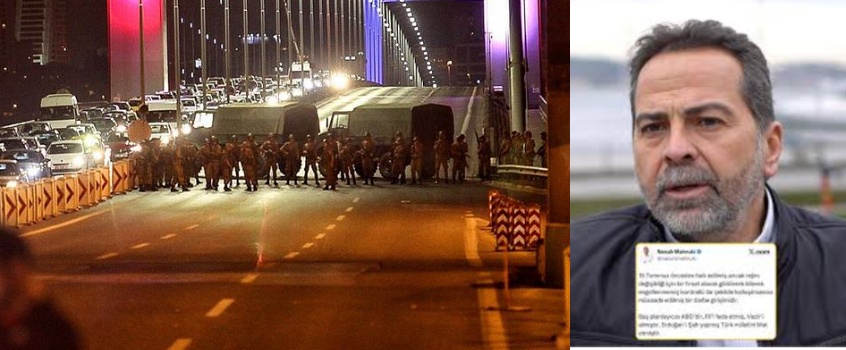
Turkish authorities have detained AKUT co-founder Nasuh Mahruki over a social-media post questioning the official account of the July 15, 2016 coup attempt.
The Bakırköy Chief Public Prosecutor’s Office accused Mahruki of “inciting the public to hatred and hostility or degrading the public” after he alleged that the coup attempt had been detected in advance but was deliberately not prevented because it created an opportunity to change Turkey’s political system.
Mahruki described July 15 as a “controlled” operation that ultimately strengthened President Recep Tayyip Erdoğan.
He did not publicly provide evidence sufficient to establish that claim as fact. It remains an allegation that should be subjected to scrutiny.
But detaining him does not answer the questions he raised.
A government confident in its version of events could release intelligence reports, military communications, telephone records and surveillance footage. It could permit an independent investigation into what political, military and intelligence officials knew before the first troops and aircraft were deployed.
Instead, prosecutors have treated the questioning itself as a potential crime.
A line the opposition refused to cross
Mahruki’s detention highlights the failure of Turkey’s main opposition parties to confront the official July 15 narrative.
For a decade, opposition leaders have criticized the emergency rule, mass dismissals, prosecutions and presidential system that followed the coup attempt. Yet most have continued to accept Erdoğan’s central account of the event and repeat the government’s “FETÖ” terminology.
Their argument has generally been that Erdoğan exploited July 15—not that the complete story of July 15 remains unresolved.
Mahruki went further. He directly connected the authorities’ alleged advance knowledge, their failure to prevent the operation and the regime change that followed.
For saying publicly what opposition leaders largely avoided saying for ten years, he was detained.
Özel’s response shows the danger of the label
The internal conflict within the CHP also demonstrates how powerful the government’s terminology remains.
After Kemal Kılıçdaroğlu suggested that overseas commentators associated with “FETÖ” supported Özgür Özel, Özel issued an extensive defence of his record. He referred to the Ergenekon and Balyoz cases, books written by his team and hundreds of military officers who had previously supported him.
“This mud will not stick to us,” he said.
His response resembled more than an ordinary political rebuttal. It suggested fear that an unsupported allegation could eventually be turned into a criminal investigation.
Yet Özel did not reject guilt by association itself. He argued only that the accusation could not apply to him.
The opposition continues to use the same weapon it fears.
Unanswered questions remain
The case of former Air Force commander Akın Öztürk is among the disputed issues surrounding July 15.
Öztürk was convicted of helping lead the coup attempt, but he denied the accusation. His defence maintained that he learned of the events while at his daughter’s home and later went to Akıncı Air Base under instructions from senior commanders to persuade the participants to abandon the operation.
Turkish courts rejected that account.
However, questions about his movements, telephone records, instructions and communications with senior commanders remain legitimate subjects of public inquiry. Asking those questions does not establish his innocence, but neither should it be treated as support for a coup.
An official narrative protected by prosecution
Mahruki’s allegation may ultimately prove inaccurate. The proper response would be evidence demonstrating why it is inaccurate.
Detention sends a different message.
It warns journalists, politicians, academics and civil-society figures that July 15 may be commemorated but not seriously investigated.
Turkey marks the anniversary as “Democracy and National Unity Day.” Yet a political system that detains people for questioning an official historical narrative is not defending democratic unity.
It is enforcing silence.
For ten years, Turkey’s opposition largely remained within the boundaries Erdoğan established around July 15.
Mahruki stepped outside them.
That is why he was detained.
By: News About Turkey (NAT)