
Ten years after July 15, Turkey’s opposition still appears incapable of confronting the political mythology upon which President Recep Tayyip Erdoğan built his present authoritarian order.
The anniversary messages issued by prominent opposition figures differed in wording and intensity. Özgür Özel repeated the government’s “FETÖ” designation. Ekrem İmamoğlu avoided that acronym but spoke of a “vile organization” and a “grand conspiracy.” Mansur Yavaş offered the most restrained message, commemorating the dead and wounded without naming the Gülen movement or using inflammatory descriptions.
Leaders of smaller opposition parties also varied in tone. Some criticized Erdoğan’s exploitation of July 15 and the regime change that followed. Others directly repeated the government’s attribution of the events to “FETÖ.” Almost none challenged the official account itself.
This conformity is particularly striking because the political and judicial system constructed after July 15 is now being directed against the opposition.
İmamoğlu remains imprisoned and faces a sprawling prosecution that he and the CHP describe as politically motivated. Opposition municipalities have faced successive investigations, arrests and removals. A court annulled the CHP congress that elected Özel and returned Kemal Kılıçdaroğlu to the party leadership. Özel is now preparing for the possible establishment of a new party should legal challenges to the judicial takeover fail.
Despite all this, opposition leaders continue to participate—directly or rhetorically—in the annual commemoration of the event Erdoğan used to justify the restructuring of the judiciary, bureaucracy, military, media and political system.
Özel proudly says his position has not changed
Özel’s anniversary interview went considerably further than his brief social-media statement.
Asked whether his understanding of July 15 had changed during the past decade, he replied that, thankfully, it had not. He declared that the CHP had stood on the “right side of history,” behind Parliament, elected officials and democracy.
For Özel, this consistency is evidence of democratic integrity. But it also exposes the opposition’s intellectual paralysis.
Ten years of emergency decrees, mass purges, torture allegations, politically charged prosecutions and judicial interference have not led him to reconsider the official account that Erdoğan used to legitimize those practices.
Özel criticizes the authoritarian consequences of July 15 while proudly preserving his original interpretation of the event itself.
He described July 15 categorically as a bloody coup attempt carried out by the “Fethullahist Terrorist Organization.” He then described İmamoğlu’s arrest on March 19, 2025, and the May 21, 2026 judicial intervention in the CHP leadership as further coups against democracy.
The contradiction is difficult to ignore.
Özel condemns the judiciary for attacking elected politicians while continuing to endorse the narrative that allowed Erdoğan to reconstruct that judiciary.
He wants the public to distinguish between the supposedly democratic use of extraordinary state power after July 15 and the illegitimate use of the same machinery against the CHP today. But authoritarian institutions do not remain confined to the original enemies against whom they were established.
Once collective suspicion, political labelling and guilt by association become normalized, their targets inevitably expand.
Kılıçdaroğlu turns Erdoğan’s “FETÖ” weapon against Özel
The internal CHP conflict demonstrates what happens when the opposition accepts Erdoğan’s political language.
Kılıçdaroğlu alleged that fugitive “FETÖ” members, foreign-based websites and YouTube commentators were supporting Özel and his allies. He apparently offered no evidence of coordination or an organizational relationship. The opinions of online commentators were themselves presented as grounds for political suspicion.
This is Erdoğan’s system of guilt by association reproduced inside the opposition.
For years, people in Turkey have been placed under suspicion because of the actions or statements of others: a relative, employer, journalist, bank customer, social-media contact or someone who merely expressed support for them.
Kılıçdaroğlu was himself repeatedly targeted by similar government accusations during his leadership of the CHP. Instead of rejecting the method as illegitimate, he has now adopted it against the rival who defeated him.
The opposition is therefore no longer merely tolerating Erdoğan’s post-July 15 vocabulary. Its competing factions are using that vocabulary against one another.
Özel’s extensive defence resembles a pre-emptive legal brief
Özel’s response to the accusation was extraordinarily detailed.
He cited his conduct during the Ergenekon, Balyoz and military-espionage cases, referred to books written by his team and invoked former military officers as witnesses. He said 254 admirals, generals and colonels had supported him in an earlier legal dispute.
“This mud will not stick to us,” he repeatedly insisted. He described himself as politically “Teflon” on the issue and said anyone to whom the accusation did stick should question themselves.
The length and intensity of this answer suggest that Özel did not regard Kılıçdaroğlu’s accusation as an ordinary internal-party insult.
His response resembled a public defence file prepared against the possibility that prosecutors could transform the allegation into a so-called “FETÖ” investigation targeting Özel, his allies or the new political organization they are preparing.
Given the broader judicial campaign against the CHP, such a fear would not be irrational. A court has already removed Özel from the party leadership, while İmamoğlu and numerous municipal figures have faced prosecutions widely criticized as politically motivated.
Yet Özel’s response preserved the weapon he appeared to fear.
He did not argue that no politician should be criminalized because an unrelated overseas commentator praised them. He did not reject “FETÖ” as an elastic political label used to impose guilt without evidence of individual conduct.
Instead, he argued that the label could not legitimately be applied to him because he had stronger anti-Gülen credentials than others.
His defence amounted to this: the accusation may stick to someone, but it cannot stick to us.
That is not a rejection of Erdoğan’s system. It is an application for exemption from it.
İmamoğlu avoids “FETÖ” but preserves the official structure
İmamoğlu’s anniversary message was less explicitly aligned with the government’s terminology.
He did not use “FETÖ” or directly name the Gülen movement. Instead, he said a “vile organization” had attempted, through a “grand conspiracy,” to turn the Turkish military against the nation.
He criticized the government for failing to account for its responsibilities and for placing politics under judicial and bureaucratic guardianship.
That criticism is particularly significant coming from a politician who remains imprisoned after emerging as Erdoğan’s strongest potential electoral rival. His prosecution has become an international symbol of Turkey’s democratic deterioration.
But İmamoğlu still accepted the central architecture of the official narrative: a single malicious organization conducted a grand conspiracy, while the population defended elected authority.
He did not question why the intelligence and military leadership failed to prevent the events despite receiving advance information. He did not demand a new and genuinely independent inquiry into the complete sequence of events or the abuses committed afterward.
İmamoğlu criticizes the political system that imprisoned him while leaving substantially untouched the narrative Erdoğan used to construct that system.
His imprisonment demonstrates that accepting the official July 15 framework has provided no protection. Nevertheless, his message continues to validate important elements of it.
Yavaş offers the most restrained approach
Mansur Yavaş’s statement was the most balanced among the leading CHP figures.
He commemorated those killed while resisting what he described as an attempted coup, expressed gratitude to the wounded and prayed that the country would never again experience such suffering.
Unlike Özel, Yavaş did not use “FETÖ.”
Unlike İmamoğlu, he did not refer to a “vile organization,” a “grand conspiracy” or an unnamed enemy that had supposedly turned the military against the people.
His message avoided collective blame and did not associate the Gülen movement with the events. In this limited but important respect, it was considerably more responsible than the statements issued by Özel and İmamoğlu.
However, restraint is not the same as confrontation.
Yavaş still accepted the official classification of July 15 and participated rhetorically in the annual state ritual. He did not challenge the use of the anniversary to sanctify Erdoğan’s political order or ask why a decade of official commemorations has not produced complete transparency about the events and their aftermath.
His approach is the least damaging, but it remains defensive and ceremonial rather than transformative.
Smaller opposition parties differ in tone but remain inside the same framework
The responses from the leaders of smaller opposition parties demonstrate that the problem extends far beyond the CHP.
İYİ Party leader Müsavat Dervişoğlu adopted one of the more critical approaches. He described July 15 as a treacherous uprising but argued that Turkey had undergone a regime change as a consequence, that exceptional government had been normalized and that the parliamentary investigation had failed to provide the public with a satisfactory account.
He also called for examination of the alleged organization’s political connections and of those who benefited from the events.
This goes further than the statements of most CHP leaders because it directly connects July 15 to Erdoğan’s subsequent regime transformation. Nevertheless, Dervişoğlu still begins from the official premise that a genuine, centrally organized coup occurred. He criticizes Erdoğan’s use of the event without fully challenging the state’s explanation of the event itself.
DEVA Party leader Ali Babacan adopted language much closer to the official account. He directly attributed the operation to “FETÖ,” described it as a treacherous coup attempt and commemorated the officially designated martyrs and veterans.
Babacan has criticized Erdoğan’s extension of emergency rule and the unaccountable presidential system that emerged afterward. Yet his July 15 language preserves Erdoğan’s central attribution. Like many opposition figures, he criticizes what Erdoğan did with July 15 while continuing to accept Erdoğan’s explanation of who carried it out.
Future Party leader Ahmet Davutoğlu also embraced the government’s terminology, describing the events as a coup attempt undertaken through “FETÖ’s treachery” and presenting the population’s resistance as a defence of democracy and the national will.
Davutoğlu’s position is particularly noteworthy because he served as Erdoğan’s prime minister until only weeks before July 15. Despite later breaking with Erdoğan and criticizing presidential authoritarianism, he continues to reproduce the central narrative of the political order he now claims to oppose.
New Welfare Party leader Fatih Erbakan argued that July 15 could have been prevented and blamed the AKP for abandoning merit and allowing the alleged network to penetrate state institutions.
However, he repeatedly used “FETÖ/PDY” and similar expressions and expanded the official account through allegations involving foreign powers, intelligence agencies and global interests. His criticism therefore does not weaken Erdoğan’s basic narrative. It intensifies it by adding a wider conspiratorial framework.
Democrat Party leader Gültekin Uysal adopted a comparatively restrained approach. He emphasized opposition to coups, accountable government and the free political will of citizens without apparently blaming the Gülen movement or relying heavily on the government’s most loaded terminology.
His language was closer to Yavaş’s cautious approach. Yet it, too, stopped short of demanding a fundamental reassessment of July 15.
Taken together, these statements reveal a broad spectrum of conformity.
Some leaders fully repeat Erdoğan’s designation.
Some avoid the acronym but retain the official structure.
Some criticize the regime change and repression that followed.
Very few challenge the underlying account or demand an independent reconstruction of what actually happened.
The opposition varies only in how much of Erdoğan’s narrative it repeats
The differences among opposition leaders are genuine.
Özel accepts the official attribution and repeats its most politically loaded label.
İmamoğlu avoids “FETÖ” but retains the narrative of an evil organization and centrally organized conspiracy.
Yavaş commemorates the victims without naming or attacking the Gülen movement.
Dervişoğlu criticizes the regime transformation but still accepts the coup framework.
Babacan and Davutoğlu reproduce the official attribution almost completely.
Erbakan criticizes the AKP’s responsibility while strengthening the conspiracy narrative.
But the disagreement is largely over tone—not over whether Erdoğan’s account should be subjected to a genuinely independent reassessment.
The opposition remains trapped inside a narrow argument:
Erdoğan says July 15 justified his subsequent transformation of the state.
The opposition says July 15 was essentially what Erdoğan claims it was, but that he later abused its consequences.
That distinction is inadequate because the official narrative and the authoritarian consequences were never truly separable. Erdoğan used the narrative to define enemies, suspend safeguards and portray extraordinary repression as a democratic obligation.
“Democracy and National Unity Day” manufactures consent
The official title given to the anniversary is itself political.
“Democracy and National Unity Day” presents the state’s interpretation of July 15 as a national truth standing above partisan disagreement. It transforms participation in official ceremonies into a test of democratic loyalty.
Anyone refusing the ritual can be portrayed as disrespecting the dead, minimizing violence or sympathizing with the alleged perpetrators.
Opposition participation gives Erdoğan something his government cannot manufacture alone: the appearance of pluralistic consent.
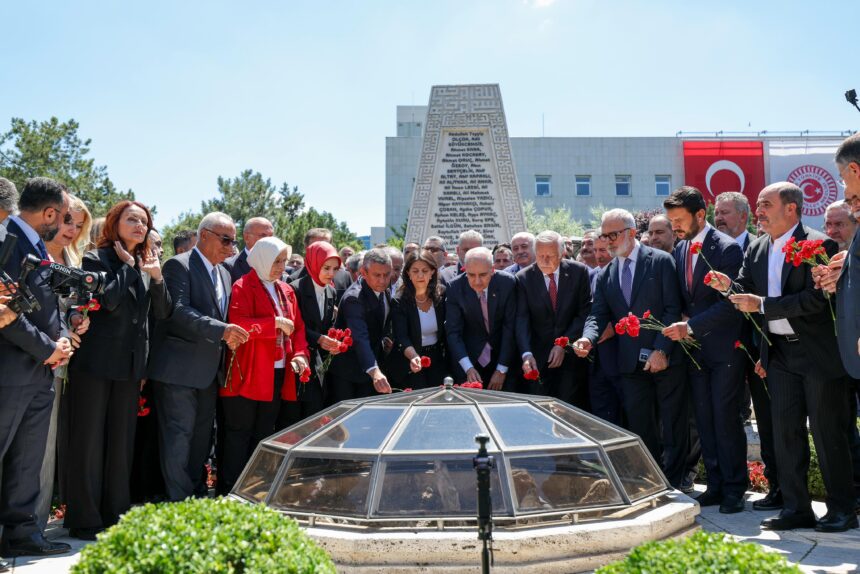
When CHP municipalities display official slogans, when opposition leaders commemorate July 15 within Erdoğan’s conceptual framework and when politicians across competing parties repeat “FETÖ,” the government can claim that its account is accepted not only by the AKP but by the entire legitimate political system.
That appearance of consensus helps obscure how the aftermath of July 15 accelerated Turkey’s transformation into a centralized autocracy. The tenth anniversary remains deeply divisive precisely because the extraordinary crackdown that followed reshaped the state and dismissed or detained vast numbers of people.
The CHP’s participation in the Yenikapı rally in August 2016 was the beginning of this historic failure. For nearly a decade, opposition parties and municipalities have renewed it annually.
Accommodation has protected no one
The opposition may initially have believed that accepting the official account would protect it from accusations of supporting military intervention.
It may have believed that participating in the commemorations would allow it to criticize Erdoğan’s later actions without being excluded from legitimate politics.
That strategy has failed completely.
İmamoğlu is imprisoned.
Opposition mayors and municipal employees have been arrested or removed.
The judiciary has overturned the CHP’s internal leadership choice.
Özel is preparing a new political party because the courts may prevent his faction from continuing through the CHP.
Kılıçdaroğlu has now demonstrated that even enthusiastic adherence to the official July 15 narrative offers no protection from a “FETÖ” accusation. The label can be redirected against anyone whenever it becomes politically useful.
Özel’s elaborate self-defence proves that he understands the danger. Yet he continues to use the language that makes such criminalization possible.
Erdoğan’s government no longer needs to impose its language
Turkey’s opposition appears hopeless because it seeks protection inside the ideological framework of the government persecuting it.
It wants Erdoğan’s courts to treat CHP politicians fairly while refusing to confront the political labels that destroyed fairness.
It condemns guilt by association when directed against Özel but continues to tolerate it when directed against others.
It opposes trustees when they threaten CHP municipalities after tolerating their normalization elsewhere.
It denounces judicial coups against İmamoğlu and the CHP while participating in the annual state ritual that gives Erdoğan’s post-2016 system its democratic disguise.
A serious opposition would commemorate every innocent person killed on July 15 without accepting the government’s complete explanation of the events.
It would stop using “FETÖ.”
It would reject criminal accusations based on who supports, praises or communicates with a politician.
It would demand publication of the complete parliamentary record and an independent investigation into the conduct of all senior political, military and intelligence officials.
CHP municipalities and other opposition administrations would withdraw from government-scripted “Democracy and National Unity Day” ceremonies and organize independent commemorations focused on the victims, democratic accountability and the rejection of collective guilt.
Until that happens, Turkey’s opposition will continue condemning Erdoğan’s autocracy while helping to reproduce its founding mythology.
Erdoğan’s government no longer needs to impose the July 15 narrative upon the opposition.
The opposition has internalized it—and now uses it against itself.
Erdoğan’s legitimacy is not only sustained from inside but also outside Turkey. At home, the opposition strengthens him by accepting his political language, participating in state ceremonies and treating his official narrative of July 15 as unquestionable. Abroad, Western governments—especially the United States—strengthen him by presenting him as an indispensable strategic partner. As Tom Barrack’s recent remarks suggested, Washington’s recognition provides Erdoğan with international legitimacy that he converts into political authority at home. Turkey’s opposition legitimizes him domestically; the West legitimizes him internationally.
By: News About Turkey (NAT)