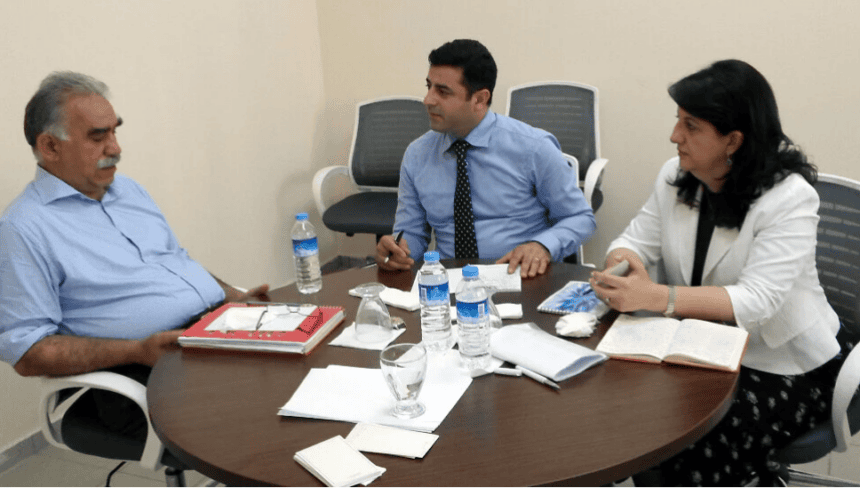
On May 20, News About Turkey (NAT) argued that the new Kurdish process unfolding in Turkey was about considerably more than ending the armed campaign of the Kurdistan Workers’ Party (PKK). The more consequential possibility, we suggested, was that Abdullah Öcalan’s restoration as the indispensable interlocutor for disarmament would also restore his authority over the broader Kurdish political field, including its legal and civilian components. The question was therefore not simply whether Ankara needed Öcalan to close the PKK chapter, but whether the authority accumulated through that role would enable him to shape the political order that followed it. Less than four months later, developments inside DEM Party are giving that forecast a much firmer factual foundation. What was hypothetical in May is not yet fully realized, but the sequence is now visible: Öcalan is involved not only in discussions about ending armed struggle but increasingly in discussions about the political structures, cadres and program that are supposed to emerge afterward. The evidence has accumulated in stages. In an August 2 message relayed by the DEM Party’s İmralı delegation, Öcalan described the process as the beginning of a democratization project and called for serious work toward a “democratic republic.” The phrase itself is not new to DEM politics; the party had used the concept before the current process, which means it would be simplistic to portray the Democratic Republic project as something suddenly imposed from İmralı. What is new is the organizational connection now being drawn between Öcalan and the next stage of the party. In August, Pervin Buldan said explicitly that the September 6 congress was not the “real congress” but largely one necessitated by legal requirements, with the more consequential congress expected before Newroz. She then added that Öcalan was discussing “a new party” involving changes to its statutes, program and cadres and said that work on the new structure would begin after September 6. In the same briefing, Buldan said Öcalan would participate in a planned “Disarmament and Politicization” subcommittee because he would have a role in organizing the transition. That moves his involvement beyond ideological influence and into the institutional architecture of the process. By the end of August, DEM’s own leadership was publicly defining the destination. Tuncer Bakırhan said the party was preparing for a later “Democratic Republic Movement Congress” and described September 6 as the starting point of a much larger political transformation rather than an endpoint. On September 6 he became more explicit: the leadership elected at the congress would prepare what he called the larger congress, while DEM would reshape its program, political language, organizational practice and cadre structure to fit the new period. He then announced that the “Democratic Republic Movement” was beginning that day. Buldan reinforced the point after the congress, saying another congress would be held within a few months to build the new movement and that September 6 represented its first step. The final legal form is still not entirely settled in public: the Democratic Republic Movement could become an umbrella around a transformed DEM, the party itself could be renamed and reconstructed, or another legal vehicle could eventually emerge. But the political objective is no longer vague. A post-PKK political formation is being deliberately constructed, and Öcalan is already connected to its ideological direction, its proposed program and statutes, its cadres and the institutions managing the transition. That makes it increasingly reasonable to describe Öcalan as the emerging de facto political leader of the new order, even though he holds no formal party office. De facto leadership is ultimately a question of where decisive political authority resides, not what title appears in a party registry. If senior figures travel to İmralı for strategic guidance, if Öcalan is consulted over the program and personnel of the new formation, if the movement adopts a political framework he has placed at the heart of the transition, and if he participates institutionally in managing the passage from armed organization to political activity, then the absence of a formal chairmanship does not eliminate effective leadership. A future de jure role is a different matter. Öcalan remains imprisoned, and the existing legal framework does not itself create a path to conventional party leadership. Any formalization of his authority would therefore require major legal and political changes that have not occurred. But if his status is transformed in later stages of the process, the gap between his informal authority and formal position could itself become a political issue. That is a future scenario; the stronger claim today is narrower but increasingly defensible: the man overseeing the liquidation of the armed structure is also becoming a central architect of the political structure intended to follow it. That development raises a more fundamental question than the name of the future party. What exactly does the transition from armed struggle to democratic politics mean? Normally, demilitarization should redistribute authority toward elected politicians, voters, parliament, municipalities and civil society. An armed organization disappears because political representation is moving into institutions in which leadership can be contested and legitimacy must periodically be renewed at the ballot box. But another outcome is possible: the weapons can disappear while the vertical hierarchy constructed during the armed struggle survives. Political authority can migrate rather than decentralize. In that scenario, the Kurdish movement would undergo demilitarization without a corresponding decentralization of political power. The emerging movement could be broader in social composition—DEM explicitly wants to address Turks, Kurds, Alevis, workers, women, young people and other constituencies—while still becoming more centralized around one ultimate source of political authority. A movement can therefore become socially more inclusive while becoming internally less pluralistic. This is the tension that matters most in the next stage, and it is also where Selahattin Demirtaş becomes much more than a secondary personality in the story. Demirtaş embodies an alternative source of legitimacy that Öcalan does not possess: direct electoral legitimacy developed through competitive national politics. The distinction is not simply between two Kurdish leaders. Öcalan’s authority is historical, organizational…