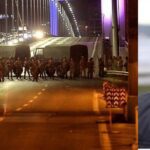


Turkish courts have jailed two people over social-media posts concerning the failed coup of July 15, 2016, highlighting the risks of challenging the government’s narrative of one of the most politically sensitive events in Turkey’s recent history.
An İstanbul court on Friday ordered the pretrial detention of Nasuh Mahruki, founder and former president of the volunteer search-and-rescue organization AKUT, on charges of “inciting the public to hatred and hostility or degrading the public.”
The investigation was launched after Mahruki described the events of July 15 as a “controlled coup attempt.” He alleged that state institutions had detected the operation in advance but knowingly allowed it to proceed because it presented an opportunity to change Turkey’s system of government.
Mahruki also accused the United States of planning the operation, saying it had “made Erdoğan king and checkmated the Turkish people.”
Prosecutors described his allegations as baseless.
Mahruki denied inciting hatred, saying he intended to criticize the authorities’ failure to act on warnings reportedly received before the coup attempt.
“The accusation brought against me cannot be drawn from this post,” he reportedly said during questioning.
His claims of deliberate inaction and US involvement have not been independently established. However, his pretrial detention has raised concerns that controversial interpretations of July 15 are being answered through criminal prosecution rather than evidence and public debate.
Mardin social-media personality also jailed
In a separate case, a court in Mardin ordered the pretrial detention of Melek Akarmut, a social-media personality known as Mardin’s “Marilyn Monroe,” over a post questioning the official account of July 15.
Akarmut was detained after authorities concluded that her social-media posts contained potential criminal elements. Following police questioning, she was transferred to the Mardin courthouse, questioned by a prosecutor and brought before a criminal judgeship of peace, which ordered her imprisonment in Mardin Closed Prison.
In the post at the center of the investigation, Akarmut wrote:
“Unasked questions about July 15: Where is Parliament’s July 15 report? A coup—if you believe it.”
After her arrest, relatives posted a statement through her social-media account saying she had been imprisoned for expressing her personal opinion about July 15.
Her words contained no apparent call for violence or hostility. She questioned the absence of the parliamentary report and expressed disbelief in the official narrative. Yet those questions were sufficient to send her to prison before trial.
The case is especially significant because it shows that the crackdown is not limited to nationally known political critics such as Nasuh Mahruki. A local social-media personality can also be jailed simply for asking where an official parliamentary report is and mocking the state’s explanation of July 15.
Akarmut had previously received a two-year prison sentence for violating privacy after sharing footage of a taxi driver who was recorded running over a dog sleeping on a pavement outside her workplace.
Different charges, similar consequences
Mahruki and Akarmut face different criminal accusations, but both have been imprisoned before trial over online speech concerning July 15.
The Turkish government blames the faith-based Gülen movement for organizing the coup attempt. The movement strongly denies involvement in the attempt or any terrorist activity.
Questions have persisted over what senior political, intelligence and military officials knew before the first visible military movements, why warnings failed to prevent the operation and how President Recep Tayyip Erdoğan used the aftermath to purge opponents and consolidate executive power.
Following the coup attempt, the government imposed a state of emergency and launched a sweeping crackdown. Hundreds of thousands of people were investigated, dismissed from public service, detained or prosecuted over alleged links to the Gülen movement.
Turkey later replaced its parliamentary system with an executive presidency that concentrated extensive authority in Erdoğan’s office.
Opposition accepted the narrative while criticizing the aftermath
Turkey’s main opposition parties have partially criticized the mass purges, emergency decrees, politically motivated prosecutions and concentration of presidential power that followed July 15.
Yet most opposition leaders continue to accept the central structure of Erdoğan’s account and use the government’s “FETÖ” terminology.
Their position has largely been that Erdoğan exploited July 15—not that the full circumstances surrounding the event remain unresolved and require an independent investigation.
On the coup attempt’s tenth anniversary, leading opposition figures again commemorated July 15 within the official framework. Some directly blamed “FETÖ,” while others used less explicit language but still described the event as a centrally organized conspiracy against the elected government.
Mahruki crossed a line the opposition largely avoided for a decade by directly alleging advance knowledge, deliberate inaction and political benefit.
Akarmut was jailed over posts that have not even been publicly disclosed.
The government bears direct responsibility for using criminal law against controversial political speech. But the opposition’s decade-long conformity helped transform Erdoğan’s account of July 15 into an untouchable state narrative.
By repeatedly endorsing the government’s terminology while limiting its criticism to the repression that followed, opposition parties helped separate the authoritarian consequences from the story used to justify them.
That strategy has protected no one. Opposition politicians, mayors and municipalities are now being targeted by the same judicial system strengthened after July 15.
Turkey officially commemorates the anniversary as “Democracy and National Unity Day.” Yet the imprisonment of a nationally known rescue pioneer and a local social-media personality shows how narrowly the authorities define acceptable discussion of the event.
Ten years after July 15, ordinary citizens risk prison for questioning the official account, while opposition leaders continue operating largely within the narrative boundaries established by Erdoğan.
The government enforces those boundaries. The opposition helped legitimize them.