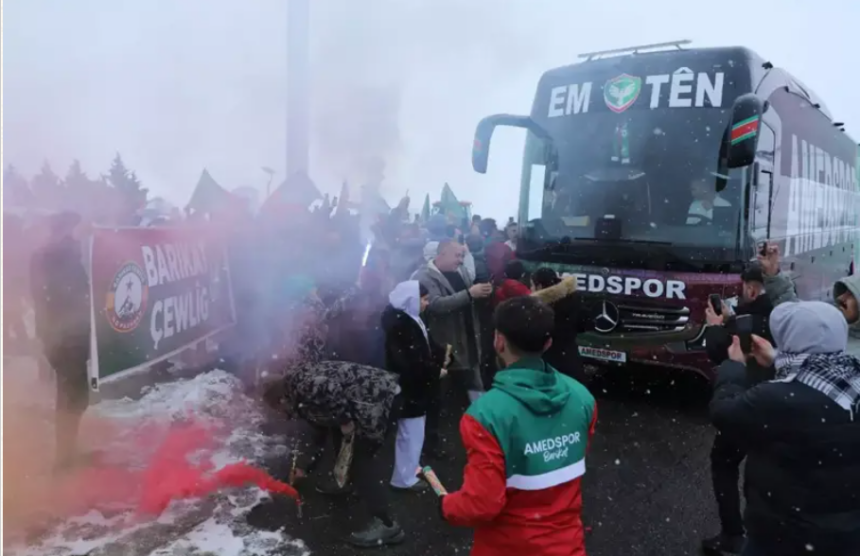
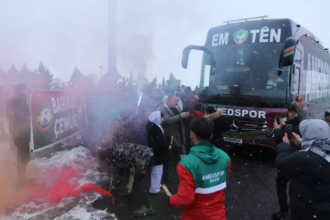
From the lower divisions to second place in Turkey’s Süper Lig, Amedspor has become a remarkable sporting success and a source of collective pride for millions of Kurds. Yet the troubled history of Diyarbakırspor offers a warning: whether Amedspor can develop into an enduring institution comparable to Barcelona may depend not only on football, but also on the fate of Turkey’s renewed Kurdish peace process. November 7, 2026 | Opinion When Amedspor faced Galatasaray in Istanbul on Saturday, it was not simply another encounter between a newly promoted club and one of Turkey's football giants. It was a confrontation that would have seemed almost unimaginable only a year earlier: a team from Diyarbakır, long associated with the lower divisions, challenging the country's most successful club as its closest rival at the top of the Süper Lig. Galatasaray eventually won 4–3, but the scoreline concealed a remarkable contest. Trailing 3–0 after 59 minutes, Amedspor responded with two goals in three minutes, threatening an extraordinary comeback. Galatasaray restored its two-goal advantage in the 80th minute, only for Amedspor to score again in stoppage time. The Diyarbakır club left Istanbul without points, but hardly without pride. After eleven rounds of the 2026–27 season, Amedspor remains second with 23 points, having recorded seven victories, two draws and two defeats. It sits above Trabzonspor, Beşiktaş and Fenerbahçe in the provisional standings, although those clubs have each played one fewer match. Having already defeated Trabzonspor 2–1 and Beşiktaş 3–2, Amedspor has demonstrated that its remarkable opening season is more than a passing surprise. For decades, Turkish football has largely revolved around four established powers: Galatasaray, Fenerbahçe, Beşiktaş and Trabzonspor. Amedspor's presence near the summit challenges that familiar hierarchy. Yet its greatest achievement may have little to do with league standings. The club is increasingly becoming a unifying symbol for Kurdish communities across Turkey and Europe, raising a question that goes beyond football: Can Amedspor become for Turkey's Kurds what FC Barcelona has long represented for Catalans? From Diyarbakır to the Wider Kurdish World Amedspor is rooted in Diyarbakır, but its growing popularity extends far beyond the city. Across Kurdish-majority provinces such as Van, Batman, Mardin, Şırnak, Hakkâri, Muş and Ağrı, the club has attracted supporters who often remain passionately loyal to their own local teams. Vanspor, Batman Petrolspor, Mardin 1969 Spor and other regional clubs maintain distinct histories, identities and traditions. Their supporters do not necessarily abandon those loyalties when they embrace Amedspor. Instead, a new form of overlapping allegiance is emerging. A supporter from Van may consider Vanspor his hometown team while celebrating Amedspor's victories in the Süper Lig. The same applies to fans from Batman, Mardin and other cities. Nor is this phenomenon confined to regional clubs. For generations, millions of Kurds have supported Galatasaray, Fenerbahçe or Beşiktaş, often inheriting those allegiances through family traditions. Many continue to follow these clubs while developing a separate emotional attachment to Amedspor. The distinction is significant. Supporting an Istanbul giant may reflect sporting tradition or family loyalty. Supporting Amedspor may also express a sense of Kurdish cultural belonging. Research published in August 2026 by the Kurdish Studies Center and Rawest Research demonstrates the scale of this transformation. Based on face-to-face interviews with 1,471 Kurdish respondents across 19 Turkish provinces, the study found that 9 percent identified Amedspor as their first team and another 23 percent as their second. The researchers estimated that these figures represented approximately four million Kurdish adults nationwide, four times the estimated number several years earlier. The findings reveal something more profound than ordinary football popularity. Some 38 percent of respondents regarded Amedspor primarily as a symbol of identity, while another 38 percent considered it both a football club and a representative of cultural identity. Only 24 percent viewed it solely as a football team. Yet local loyalties remain important: when asked whom they would support if Amedspor faced their hometown club, 39 percent favoured their local team, compared with roughly one-quarter who preferred Amedspor. This tension is not necessarily a weakness. It illustrates how Kurdish football supporters can maintain multiple allegiances rather than forming a single, uniform fan base. Amedspor's appeal also crosses political and geographical boundaries. Kurds living in Istanbul, Ankara, İzmir, Mersin and other western Turkish cities follow the club, while communities in Germany, France, Belgium, the Netherlands, Sweden and elsewhere increasingly identify with its success. For the diaspora, Amedspor provides an accessible connection to cultural heritage, particularly for younger generations raised outside Turkey. The atmosphere inside Diyarbakır Stadium reflects this extraordinary enthusiasm. During the opening six weeks of the season, its reported occupancy rate reached approximately 97 percent, the highest in the Süper Lig at that stage. The stadium has become more than a sporting venue. It offers a public space where Kurdish songs, language and collective celebration are prominently visible. Amedspor has thereby achieved something important: it has created a shared source of joy and achievement in a community whose public history has so often been defined by conflict, political exclusion and unresolved grievances. Why the Barcelona Comparison Matters FC Barcelona's significance to Catalan society has never been confined to sporting success. Under Francisco Franco's dictatorship, when Catalan language and cultural expression faced severe restrictions, Barcelona became an important institution through which collective identity could be expressed. Its famous motto, Més que un club—more than a club—captures this historical relationship. Barcelona represents a city, but its emotional reach extends throughout Catalonia and among Catalan communities abroad. Its sporting achievements have helped sustain a cultural identity that transcends geographical boundaries. Amedspor is developing a comparable relationship with Kurdish supporters. Its name, derived from the Kurdish name for Diyarbakır, carries particular significance. So do its Kurdish-language communications, the songs heard in its stands and the widespread identification of its victories with Kurdish pride. Nevertheless, the comparison has limits. Barcelona possesses more than a century of institutional development, a global commercial presence, major European trophies, a renowned youth academy and a distinctive membership-based governance tradition. Amedspor is only beginning its journey…